


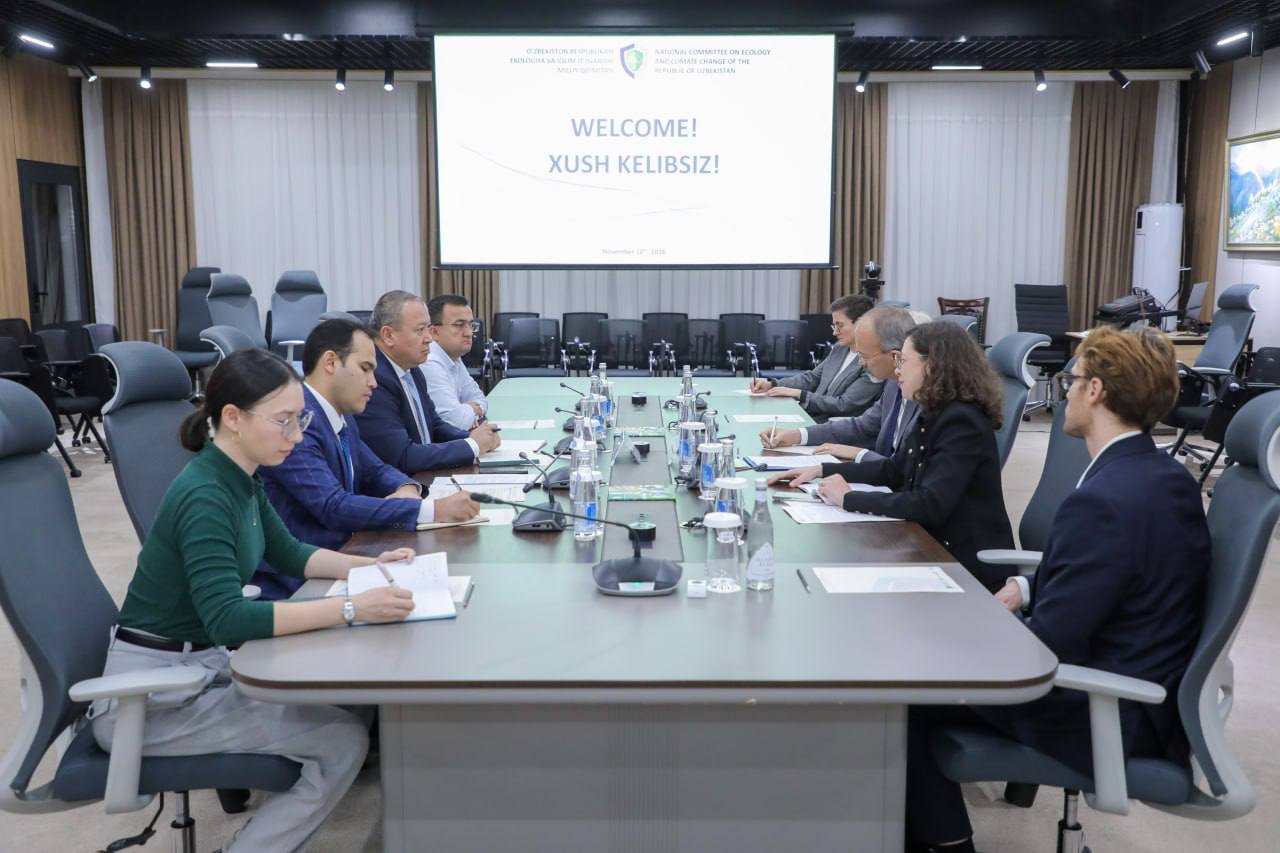

BAKU, Azerbaijan, November 16. Uzbekistan and the Organization for Economic Co-operation and Development (OECD) have discussed expanding cooperation on environmental policy, climate change mitigation and adaptation, and regional environmental monitoring, with a focus on assessing the impact of the country's environmental initiatives at a meeting on Monday, November 16.
According to Uzbekistan's National Committee on Ecology and Climate Change, the issues were discussed at a meeting between Jusipbek Kazbekov, Deputy Chairman of the committee, and William Thompson, Head of the OECD's Eurasia Division.
The parties reviewed the results of the Sustainable Infrastructure Programme in Asia (SIPA), implemented with OECD participation, and explored opportunities to continue the work under a potential second phase.
During the meeting, the Uzbek side presented five nationwide environmental initiatives: Yashil Makon, Clean Air, Zero-Waste Territory, Bio Meros and Eco-Culture.
Particular attention was given to the Yashil Makon initiative, under which around 200 million saplings are planted annually. The program also includes the restoration of degraded land and the planting of saxaul trees on the dried seabed of the Aral Sea. Officials also outlined ongoing measures to improve waste management and air quality.
Kazbekov expressed interest in using the OECD's expertise to assess the practical environmental impact of these initiatives, particularly afforestation and climate adaptation measures.
Additionally, the discussions covered air pollution and the development of low-emission transport. Kazbekov briefed the OECD delegation on efforts to expand the air quality monitoring network, reduce harmful emissions from greenhouses in Tashkent and surrounding districts, develop electric public transport and introduce an environmental sticker system for motor vehicles.
Moreover, the parties considered analytical cooperation on reducing air pollutant emissions and evaluating the effectiveness of environmental measures.
Another area of discussion was the potential integration of OECD research and assessment methodologies into the academic and research programs of Green University, which welcomes students from Uzbekistan and other Central Asian countries.
The meeting also highlighted the importance of regional cooperation, given the cross-border nature of environmental challenges and pollution. The sides emphasized the need to strengthen the collection, monitoring and analysis of environmental data across Central Asia and identify practical areas for joint action.


