


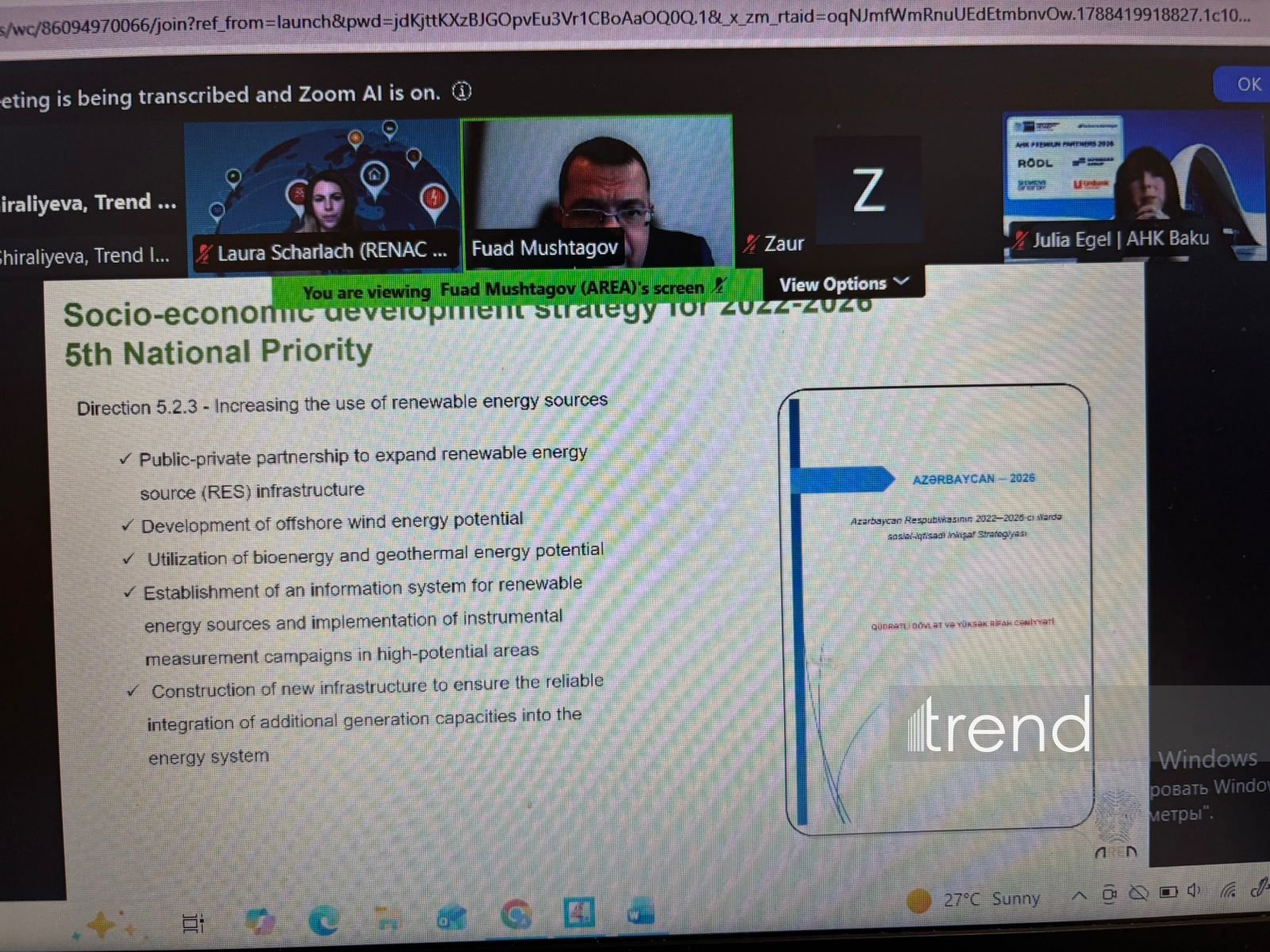

BAKU, Azerbaijan, September 3. Azerbaijan is working to increase the use of renewable energy sources as part of the fifth national priority under the Strategy for Socio-Economic Development for 2022–2026, Fuad Mushtagov, Head of the Hydrogen and Green Technologies Department at the Renewable Energy Agency (AREA) under Azerbaijan’s Ministry of Energy, said, Trend's special correspondent reports.
He made the remark during an online webinar titled “Azerbaijan: Infrastructure Development, E-Mobility and Renewable Energy Storage Solutions.”
According to him, the strategy includes the development of public-private partnerships in renewable energy infrastructure, as well as the utilization of offshore wind energy potential. “Another important area is the development of an information system on renewable energy resources. We are also studying the potential of bioenergy and green geothermal energy. Renewable energy development is closely linked to infrastructure and power grid development. The fifth national priority also covers environmentally friendly transport and other green technologies. In particular, work is underway on the preparation of the National Electric Mobility Plan. We are also exploring the potential for hydrogen production and its use across various sectors. Another important area is energy storage. Storage systems can help manage the intermittent nature of renewable energy,” he said.
Mushtagov noted that Azerbaijan is also studying the possibility of applying carbon capture, utilization and storage (CCUS) technologies in the energy sector. “Thus, our approach is not limited to renewable electricity. We are also looking at broader green energy systems. Azerbaijan has significant renewable energy potential, including both onshore and offshore resources. Considerable potential also exists in Karabakh, Eastern Zangezur and Nakhchivan. The key task is to transform this potential into economically viable projects and integrate them into the energy system. Based on this potential, Azerbaijan is working on the strategic expansion of renewable energy. The goal is not only to build new renewable energy facilities — we also need appropriate transmission and distribution infrastructure,” Mushtagov said.
He emphasized that renewable energy development should be accompanied by modernization of power grids and increased flexibility of the energy system, particularly as the share of variable renewable energy sources grows.
Mushtagov also spoke about the 230 MW Garadagh Solar Power Plant. According to him, it is the largest solar power plant in the Caspian region, with annual electricity generation of around 500 million kWh.
He also highlighted the Khizi-Absheron Wind Power Plant project with a total capacity of 240 MW. “The power plant is located in the Khizi and Absheron districts, approximately 45 kilometers northwest of Baku, and includes 37 turbines. The wind power plant helps save around 220 million cubic meters of natural gas annually. The official opening ceremony took place on January 13, 2022,” he said.



