BAKU, Azerbaijan, May 6. The second day of the 19th Azerbaijan International Agricultural Exhibition and Forum concluded in Baku, Trend reports.
As the region's largest agricultural and food industry exhibitions, Caspian Agro Week and InterFood Azerbaijan are the most important events of the year, bringing together all key players in the relevant industries.
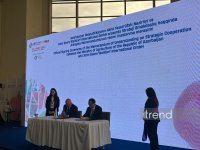
Today, a conference was be held on the topic of "Modern agricultural cooperation as the foundation for sustainable development and a guarantee of food security".
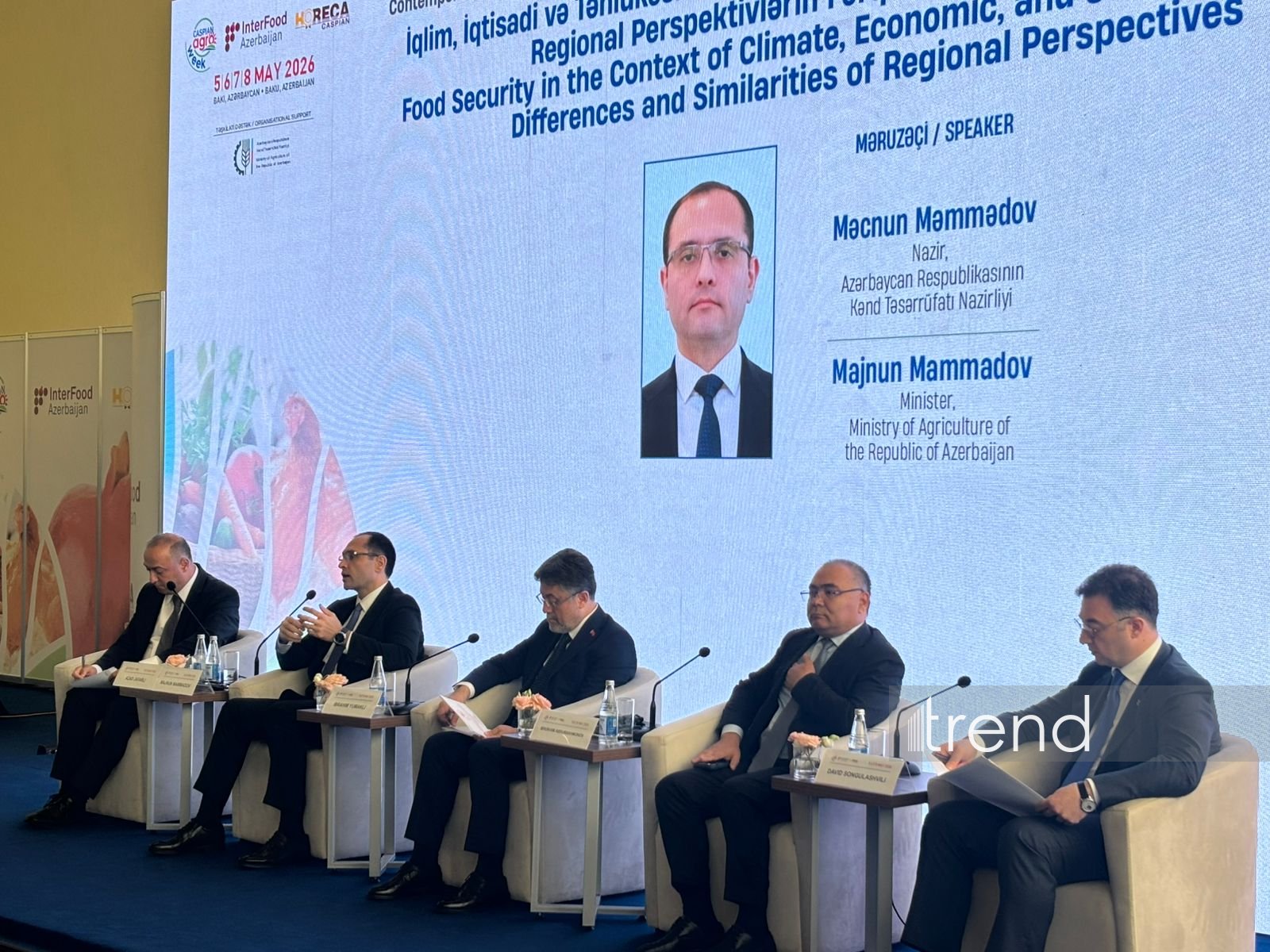
The event featured a panel session on the topic of "Food security in the context of climate, economic, and security issues: differences and similarities in regional perspectives".
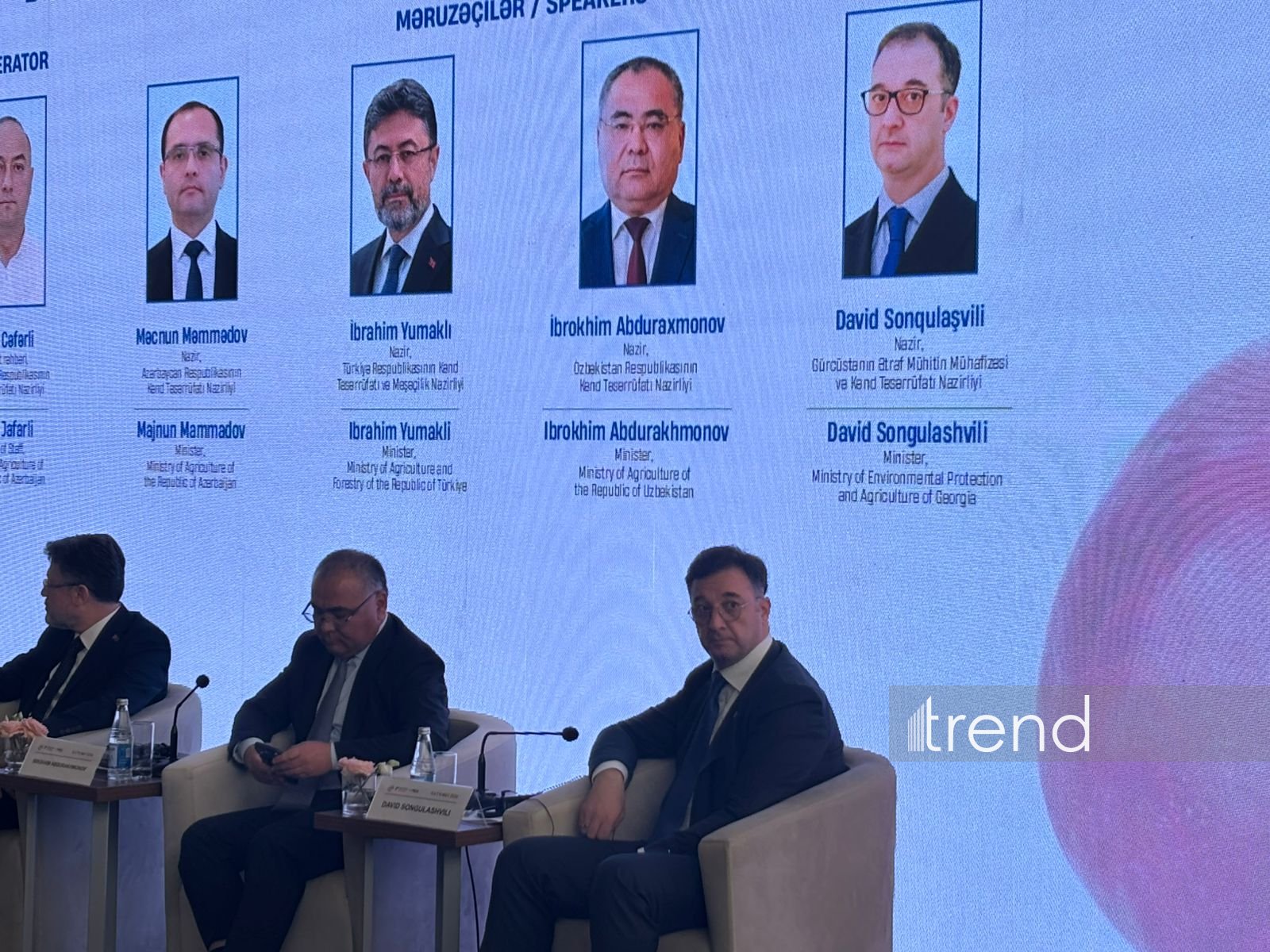
The panel discussion included Azerbaijani Minister of Agriculture Majnun Mammadov, Turkish Minister of Agriculture and Forestry Ibrahim Yumakli, Uzbek Minister of Agriculture Ibrahim Abdurakhmanov, and Georgian Minister of Environmental Protection and Agriculture David Songulashvili.
Speaking at the event Minister of Agriculture, Majnun Mammadov, announced that Azerbaijan plans to increase the area of modern irrigation systems by more than two times by 2030.
"Currently, agriculture accounts for approximately 5–6% of Azerbaijan’s GDP. More than 25% of employment is in the agricultural sector. Thus, we recognize that agriculture plays an important economic role, as well as a very significant social role.
<...> As for the water shortage, in general, in my personal opinion, even though Azerbaijan imports about 70% of its water resources from abroad, we do not have a problem of water scarcity; we have a problem of water resource management," the minister stated.
According to Mammadov, various steps are currently being taken to address this issue: “First, this involves the collection and creation of reservoirs, regardless of their size, whether small, medium, or large. The government is currently implementing large-scale projects across the country.
The second important step is to modernize the water transportation system: transitioning from open channels, especially earthen ones- to concrete channels, as well as to closed systems, particularly pipelines. This reduces water losses, conserves land resources, and improves water use efficiency.
The third step is to ensure that water supplied to villages and agricultural lands is delivered through closed pipeline irrigation systems and, of course, is accounted for (measured).
The fourth step is the implementation of modern irrigation systems.
Mamadov added that currently, approximately 10–14% of irrigated land in Azerbaijan is covered by modern irrigation systems, about 130,000 hectares.
"By 2030, we have a tentative goal of more than doubling this area. Thus, the plan is to expand it to 300,000 hectares covered by modern irrigation systems.
And, as expected, a new agricultural program will be launched to achieve this," Mammadov emphasized.
Uzbek Agriculture Minister Ibrahim Abdurakhmanov said that Uzbekistan aims to increase agricultural production to $60 billion per year and transition to a human-centered agricultural model.
"Last year, Uzbekistan's agricultural production volume amounted to approximately $40 billion; this year, our goal is to increase this volume to $45 billion. In the coming years, we have an agenda to increase this figure to $60 billion.
This year, we plan to harvest at least 4.5 million tons of cotton (last year, 4 million tons). Uzbekistan produces approximately 10 million tons of wheat and 4.5 million tons of potatoes. Average annual growth in agriculture was 3.8%," the minister said.
He noted that given current geopolitical challenges and food security concerns, Uzbekistan has set a new goal of achieving 6% growth by the end of this year.
"This is a significant step. Already at the end of the first quarter, we achieved 5.1% growth over three months, and that's something to be proud of. Agriculture has enormous potential, especially if we seek out new, untapped resources," he concluded.
Georgia’s Minister of Environment and Agriculture David Songulashvili said that ensuring food security requires efficient transport corridors and strengthened cooperation along the Middle Corridor.
"Georgia pays special attention to the development of climate-resilient agriculture, invests in the sustainable management of land and water resources, and implements modern and efficient irrigation systems.
Key to this process are the adoption of technologies, the promotion of innovation, and the exchange of international best practices. These efforts allow us to adapt more quickly and effectively to new climate realities.
In addition, Georgia is actively cooperating with international financial institutions, making major investments in irrigation infrastructure, improving land management, and promoting systemic reforms in water management, with the aim of ensuring long-term sustainability.
“Our policy is aimed at increasing farmers’ resilience, reducing the impact of climate risks on agriculture, and ensuring national food security,” he said.
The minister noted that ongoing geopolitical tensions and regional conflicts are disrupting agri-food value chains.
"These disruptions directly affect food availability and prices in different regions, underscoring the interdependence of the global food system. In this context, regional cooperation becomes critical.
Ensuring food security requires not only effective policies but also efficient transport corridors and reliable logistics chains.
In this situation, Georgia, Azerbaijan, and the Middle Corridor play a key role, and it is crucial to ensure effective coordination in this regard.
Given the current global uncertainty, it is necessary to further strengthen cooperation among countries along these corridors.
Our efforts are aimed at maintaining an open, predictable, and secure environment that supports economic growth and enhances our region’s attractiveness for investment.
At the same time, when we talk about cooperation, we mean more than just trade. We are talking about building trust, strengthening partnerships, and supporting regional stability," Songulashvili concluded.