


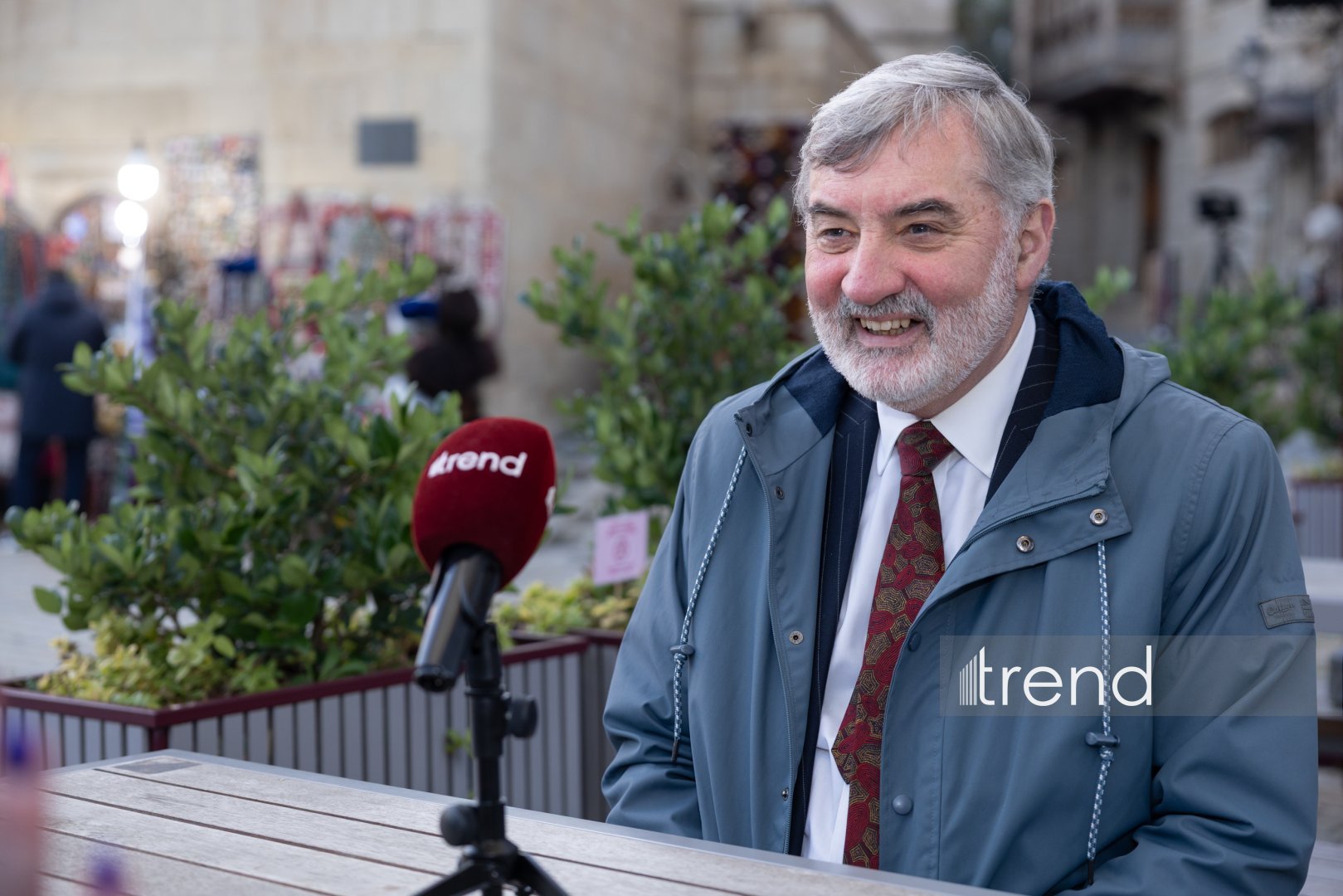

BAKU, Azerbaijan, December 19. The UK is a natural partner for Azerbaijan's economic diversification, and I see our role as bringing world-leading expertise to support Azerbaijan's transformation into a more diversified, sustainable economy, said Lord John Alderdice, UK Trade Envoy to Azerbaijan and Central Asia, in an exclusive interview with Trend.
"I'm delighted to be in Baku for my first official visit as the UK Prime Minister's Trade Envoy to Azerbaijan and Central Asia. This visit comes at an important moment in our bilateral relationship - in August this year, the UK and Azerbaijan announced the elevation of our partnership to a Strategic Partnership, reflecting the depth and ambition of our economic ties," Lord Alderdice said.
He highlighted the scale of UK investment in Azerbaijan, noting that the country is already Azerbaijan's largest foreign direct investor, with over £37 billion invested, and the economic relationship between the sides continues to strengthen.
"What's particularly exciting is how our partnership is evolving in areas where British expertise meets Azerbaijan's development priorities. Clean energy is the standout sector - Azerbaijan's ambitious clean energy agenda aligns perfectly with the UK's new Industrial Strategy. We're seeing real momentum in renewable energy projects, offshore wind supply chains, grid modernisation, and hydrogen development, with over 50 UK companies already active in this space and more joining every year," he said.
Two projects illustrate this momentum. Lord Alderdice spoke about Xlinks, a global leader in renewable energy and green interconnector projects, that signed a non-binding MOU with the Green Energy Corridor Power Company to cooperate on a green energy corridor initiative that aims to take the Caspian's offshore wind energy to the European markets passing through four countries and the Black Sea. "This illustrates how British companies are bringing expertise in interconnectors and grid modernisation to strengthen regional energy security and accelerate decarbonisation," he pointed out.
Lord Alderdice also emphasized UK contributions to sustainable infrastructure: "A landmark agreement between Rapid Solutions and SOCAR Green will modernise Azerbaijan's water infrastructure, one of the country's most energy-intensive sectors. The project will significantly improve energy efficiency whilst supporting Azerbaijan's climate commitments - showcasing how UK innovation in sustainable infrastructure is helping Azerbaijan build the low-carbon systems essential for long-term economic resilience".
Supporting economic diversification
"The UK is a natural partner for Azerbaijan's economic diversification, and I see our role as bringing world-leading expertise to support Azerbaijan's transformation into a more diversified, sustainable economy," said Lord Alderdice. "Our strengths in clean energy, advanced manufacturing, life sciences, digital technologies, and financial services align perfectly with Azerbaijan's ambitions".
He highlighted key projects and sectors: "Clean energy is where we're already seeing this partnership in action. Projects like BP's Shafag solar plant and the Sangachal electrification demonstrate how our energy cooperation is evolving beyond hydrocarbons. UK companies are now actively engaged in Azerbaijan's plans to export clean energy both westward and eastward, bringing enormous expertise in interconnectors, offshore wind, and grid modernisation – areas where Britain is a global leader. For example, the UK company Arup is currently cooperating with Azerishiq on Distribution Grid Modernisation and Upgrade".
On finance, healthcare, and education, he added that UK firms have supported Azerbaijan's banking sector with expertise on carbon markets, accounting standards, and capital-market development. "In healthcare and life sciences, our collaboration continues through ongoing dialogue with Azerbaijan's health authorities. Education is, perhaps, our most powerful long-term investment in Azerbaijan's future. Seventy percent of Azerbaijani State Scholars choose to study in the UK, and institutions like Warwick University are partnering with Azerbaijan State Oil and Industry University to offer dual degrees on renewable energy – training the next generation of professionals who will drive this transformation," he added.
Maximizing the Middle Corridor's potential
Lord Alderdice pointed to Azerbaijan's crucial role in the Middle Corridor, the country being a vital link connecting Europe and Asia. "The UK recognises the Corridor's strategic importance not just for regional trade, but for energy security and sustainable transport across a vast geography that matters enormously to global commerce," he said.
"British expertise in logistics, infrastructure finance, and regulatory reform aligns closely with Azerbaijan's objectives for the Corridor. UK businesses bring world-class capabilities in airport and port master planning, rail modernisation, and integrated multimodal transport systems – the kind of sophisticated infrastructure that can genuinely unlock the Corridor's potential," the trade envoy said.
Moreover, the UK companies are leaders in smart systems that speed cargo movement and reduce friction at borders, which is essential to making the Corridor competitive. "Critically, we believe the Corridor's long-term success must be built on sustainable, low-carbon transport. As the world moves toward net zero, the Middle Corridor has an opportunity to position itself as a green trade route, and the UK's experience in sustainable infrastructure can help Azerbaijan lead that transition," he added.
Leveraging UKEF for strategic projects
Lord Alderdice also spoke about UKEF financing tools: "UKEF is a powerful tool for deepening UK-Azerbaijan cooperation, and we have a substantial £5 billion credit facility available for Azerbaijan. This isn't just about financing - it's about derisking large-scale projects, making them attractive to contractors and investors, and accelerating the strategic investments that support Azerbaijan's economic diversification".
He provided examples, such as the first UKEF-backed transaction in Azerbaijan, which was agreed for a Boeing 777 full-flight simulator for the National Aviation Academy. He explained that this is a deal that not only supports Azerbaijan's aviation sector but opens the door to deeper aerospace cooperation between our countries.
"Clean energy projects are particularly well suited to UKEF support. Whether it's offshore wind, solar, hydrogen development, or grid modernisation - the kinds of large-scale infrastructure that require substantial capital and long-term certainty - UKEF's 22-year extended repayment period for clean growth projects is a critical differentiator. Transport infrastructure linked to the Middle Corridor is another priority area, along with digital systems and city modernisation projects. Water infrastructure and sustainable construction also offer significant financing opportunities where British companies have proven expertise," he added.
British architecture and urban development
"British architects are making significant contributions to Azerbaijan's urban transformation. Companies like Zaha Hadid Architects, Chapman Taylor, and Scott Brownrigg are supporting some of Azerbaijan's most important urban developments, bringing cutting-edge expertise in green buildings, sustainable construction, and future-ready city planning," Lord Alderdice said.
The trade envoy noted the wider impact: "At Baku Build this year, UK architecture and construction companies showcased solutions in digital construction and Building Information Modelling - BIM - which the UK is actively supporting Azerbaijan to adopt. BIM improves efficiency, transparency, and sustainability across the construction lifecycle, while Modern Methods of Construction reduce waste, speed up delivery, and improve energy performance".
Highlighting a flagship initiative, he added: "During my first official visit as Trade Envoy, I was delighted to announce the winners of the 'Women in Architecture' competition at the Heydar Aliyev Centre – itself an iconic Zaha Hadid building. This initiative challenged female students to design creative responses to water scarcity in urban developments. The theme, 'Hope in Every Drop: Art and Architecture for Change,' addresses one of our era's greatest challenges whilst empowering the next generation of female architects."
UK engagement in Central Asia's energy transition
"Central Asia is emerging as a major clean-energy hub, and the region's vast solar and wind potential positions it to play a significant role in the global energy transition. For the UK, this creates enormous opportunities to deepen engagement in a region where British expertise in renewable deployment, clean hydrogen, and low-carbon infrastructure is already making an impact," Lord Alderdice said.
He cited specific projects such as Genesis, which is developing green hydrogen projects in Kazakhstan, Mott MacDonald that designed Uzbekistan's power sector masterplan to 2030, and Worley, which is delivering a 1.5-gigawatt wind project in Uzbekistan. "The UK-Kazakhstan low-carbon hydrogen partnership demonstrates the kind of strategic collaboration we can build, combining Central Asia's renewable resources with British technological leadership," he said.
"The British Geological Survey is helping map critical minerals needed for clean energy technologies, whilst UK firms support responsible extraction, processing, and governance frameworks for these vital resources. This matters because Central Asia holds significant reserves of minerals that will power the global shift to net zero, and how they're developed will determine both economic and environmental outcomes," he added.
Finally, he noted climate cooperation: "We're also helping Central Asian countries cut methane emissions under the Global Methane Pledge - addressing one of the most impactful climate actions available whilst supporting the region's existing energy sectors to operate more sustainably. The combination of Central Asia's natural advantages and the UK's clean energy expertise creates a partnership that can accelerate the region's transformation into a clean-energy powerhouse whilst delivering commercial opportunities for British businesses."



