


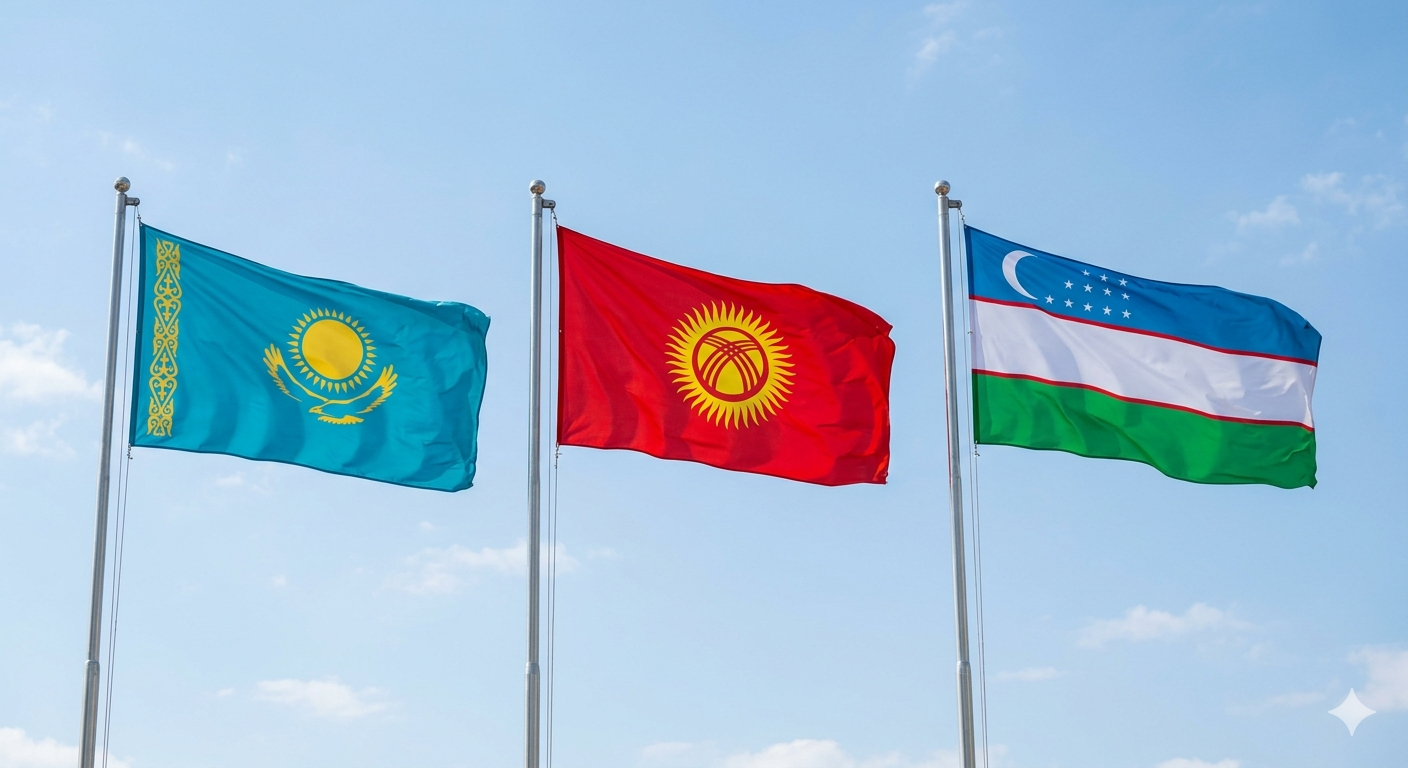
BAKU, Azerbaijan, June 3. On June 2, 2026, the presidents of Kazakhstan, Kyrgyzstan, and Uzbekistan announced major steps to strengthen their economies on the same day, showing that the region is transitioning from separate projects to systemic development.
In Kazakhstan, President Kassym-Jomart Tokayev held a special meeting on the project of the city of the future, Alatau.
“Alatau City is indeed a comprehensively developed and well-balanced project. Global experience shows that it is precisely the cities of the future that are capable of bringing the development of countries to a qualitatively new level,” Tokayev stated.
According to him, the decision to create the city was made under difficult conditions, but proved to be strategically sound. The project portfolio has already reached about 2 trillion tenge (approximately $4 billion). The total volume of investments in infrastructure will amount to 10.4 trillion tenge ($20.8 billion), and the long-term effect by 2050 may exceed $40 billion. Currently, 32 investment projects worth 1.5 trillion tenge ($3.05 billion) have been prepared, of which 20 are being implemented and will attract 1.2 trillion tenge ($2.4 billion) private investment. At the start, the project will provide more than 22,000 new jobs.
In Kyrgyzstan, President Sadyr Japarov opened a new head office of "Eldik Bank" in Bishkek.
“Eldik Bank will take an active part in financing infrastructure, energy, transport, and social projects of national scale,” Japarov emphasized.
For the first time in the country's history, the bank entered international capital markets – in 2026, Eurobonds worth $500 million were placed on the London Stock Exchange. The funds will be used for the construction of the Upper Naryn hydro power plant cascade, the development of transport and aviation, as well as support for education and medicine. This represents a serious strengthening of the financial system and a new channel for attracting external resources.
In Uzbekistan, President Shavkat Mirziyoyev reviewed the work progress of the "Chirchik" chemical-industrial technopark.
“Modernization of industry, production of high-value-added products, and expansion of export potential are among the priority directions of economic development,” the press service of the President of Uzbekistan notes.
The technopark has already established itself as a next-generation platform. Its area is 26.4 hectares, and infrastructure investments stand at $25 million. In 2025, $56 million of investments were absorbed here, 758 jobs were created, and more than 150 types of products worth $60 million were produced. By 2030, it is planned to increase investments to $207 million, production to $294 million, exports to $48 million, and the number of jobs to 2,300. In the chemical industry, the current output of mineral fertilizers is 3.7 million tons per year, and the planned projects are estimated at $2.8 billion.
The projected GDP growth of the region for 2026 remains high – averaging 5-6.1%. This creates a solid foundation for further cooperation and the influx of foreign investments.
Such simultaneous activation noticeably intensifies the effect. When three countries of the region start significant projects on the same day, it becomes an example of a coordinated movement forward, rather than fragmented efforts. Such synchronicity increases the interest of foreign investors in Central Asia as a unified economic space and can accelerate the implementation of joint initiatives.
Today's events confirm that the countries of Central Asia strive to develop in completely different directions, opening up real opportunities for diversification. Kazakhstan invests in advanced urbanism, Kyrgyzstan attracts major world capital, and Uzbekistan relies on deep raw material processing.
Further development of events may follow two scenarios. Under the optimistic scenario, the successful launch of the declared projects will turn the region into a self-sufficient economic hub capable of attracting up to $50 billion of investment by 2030 due to the integration of industrial and financial instruments of neighboring countries. Under the moderate scenario, due to external market fluctuations, part of the projects will be implemented with a delay, but the general trend toward import substitution and moving away from a commodity-dependent mono-structure will be fully preserved.



