


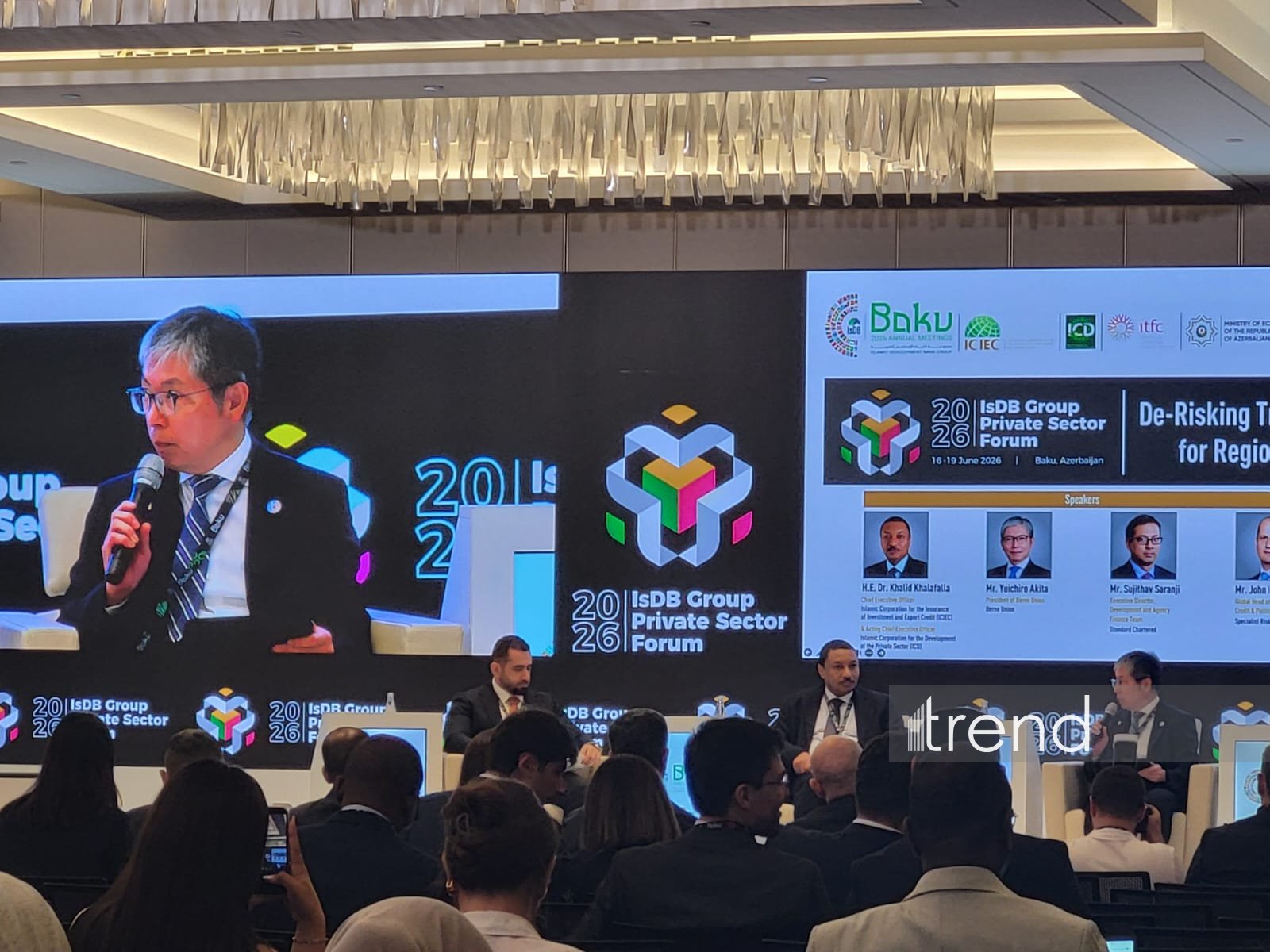

BAKU, Azerbaijan, June 17. The partnership of export credit agencies, multilateral development banks, and private investors is becoming a key factor in financing the energy transition and infrastructure projects in the member countries of the Islamic Development Bank (IsDB), Yuichiro Akita, President of the Berne Union and head of the Japanese export credit agency NEXI, stated at a panel session during the 14th Private Sector Forum of the IsDB Group, Trend's correspondent reports from the event.
"Together with ICIEC, we have already formed a sustainable project portfolio. We have several large deals in the energy sector, primarily in gas generation projects implemented in various member countries of the organization," Akita said.
According to him, cooperation is also actively developing in the field of renewable energy.
"Last year, together with the Islamic Development Bank, we supported our first joint renewable energy project in Central Asia—a solar power plant with an energy storage system in Uzbekistan," he noted.
Akita announced that the project, implemented with the participation of ACWA Power and Japanese investors, provides for the creation of 1,000 MW of solar generation and an energy storage system with a capacity of 1,336 MWh.
"This is one of the largest projects of its kind," he emphasized.
According to the head of the Berne Union, the experience of implementing such projects confirms the need for a pragmatic approach to the energy transition.
"We recognize the important role of natural gas as a transition fuel, while simultaneously accelerating investments in renewable energy sources. The approach must take into account the specifics of each country," Akita said.
He also noted that international partnership makes it possible to attract private capital to large-scale infrastructure projects.
"Japanese companies are investing alongside investors from OIC countries, such as ACWA Power. NEXI, through political risk insurance, co-financing with the IsDB, and reinsurance and co-insurance mechanisms with ICIEC, helps mobilize private capital to implement these projects," Akita stated.
According to Akita, cooperation is already moving beyond supporting individual Japanese companies.
"Our interaction contributes to regional integration, infrastructure development, and broader economic growth in the member countries of the Islamic Development Bank," the head of the Berne Union emphasized.



