


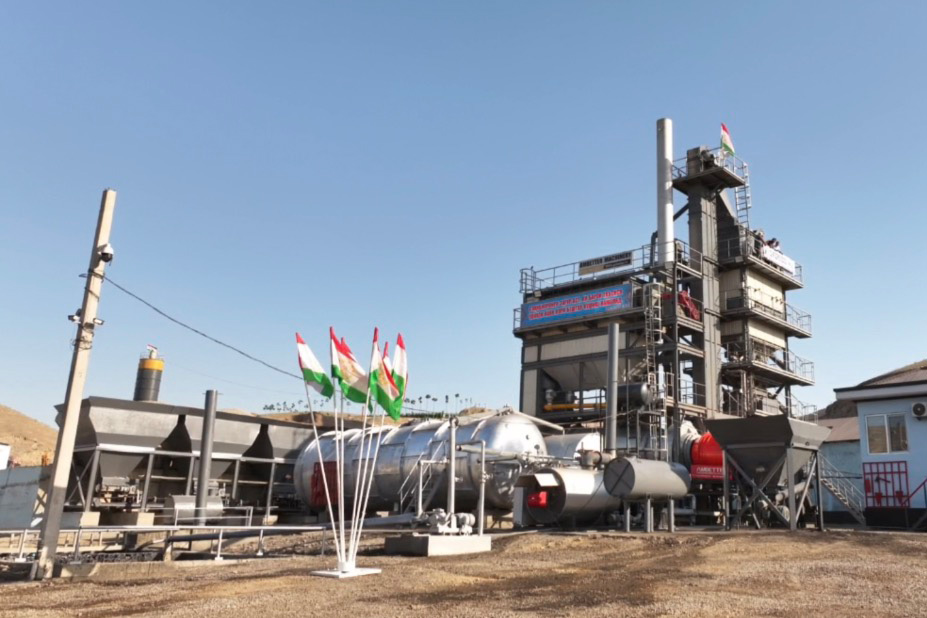

BAKU, Azerbaijan, July 8. Tajikistan has commissioned a construction materials plant to support road projects in its Sughd region.
This was reflected in a statement published by the press service of the Tajik president on July 8 following his working visit to the Bobojon Gafurov district.
"The enterprise has the capacity to produce up to 120 tons of asphalt, 120 cubic meters of concrete, and 80 tons of sand and crushed stone per hour," the presidential press service said.
According to the statement, the Sughdrokhsoz LLC facility is equipped with modern technology and manufactures asphalt, concrete, sand, and crushed stone for infrastructure projects.
The launch of the company led to the opening of 50 permanent jobs. Its output will be used for the construction and reconstruction of roads across cities and districts of the Sughd region, the press service noted.
Meanwhile, accelerated industrialization has been Tajikistan's fourth national development goal since 2018, when President Emomali Rahmon identified the expansion of manufacturing as a strategic priority. To support this objective, the country designated 2022-2026 as the "Years of Industrial Development," focusing on import substitution, job creation, and higher value-added production.
The policy has led to a steady increase in industrial output and the number of manufacturing enterprises. According to the Agency on Statistics under the President of Tajikistan, industrial production increased by 20% year-on-year. Over the past five years, total industrial output has nearly doubled, while more than 2,040 industrial enterprises and 74,000 jobs have been created nationwide. In 2024 alone, 740 new industrial enterprises were launched, generating around 20,000 jobs.
Sughd Region, where the Hajmis brick plant is located, remains the country's largest industrial hub. In the first quarter of 2025, it accounted for 60.8% of Tajikistan's total industrial production and hosted 1,242 industrial enterprises, nearly one-third of all manufacturing facilities operating in the country. The government views further expansion of industries such as construction materials, textiles, and food processing as key to reducing import dependence and supporting long-term economic growth.



