


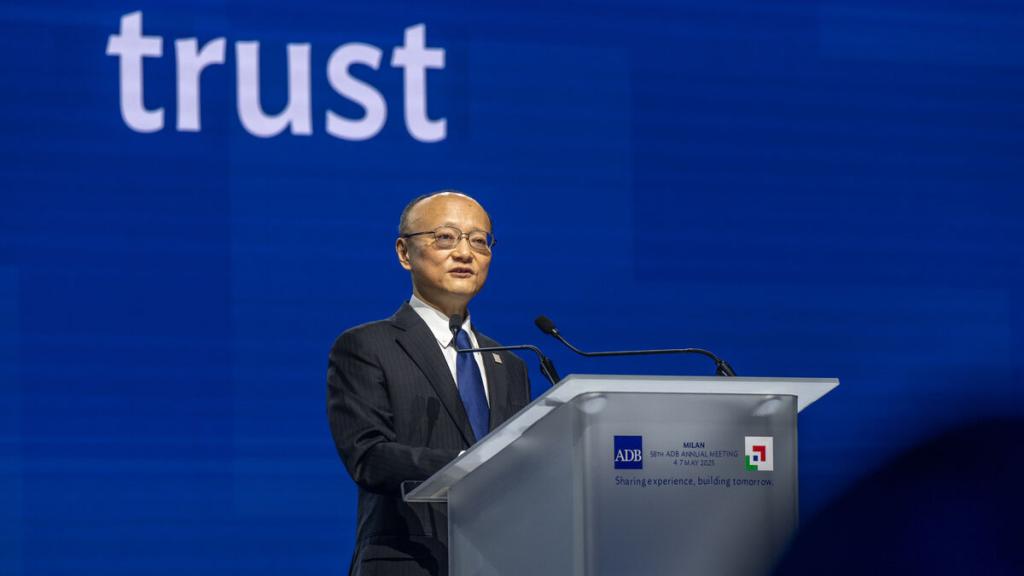

BAKU, Azerbaijan, April 22. The President of the Asian Development Bank (Asian Development Bank), Masato Kanda, has announced his intention to seek reelection for a new five-year term after his current mandate ends on 23 November 2026, Trend reports via the Bank.
Kanda said the bank continues to serve as a “pillar of stability” for developing member countries across Asia and the Pacific amid a challenging global development environment marked by multiple and overlapping shocks. He noted that, if reelected, his priority would be to accelerate urgent action to address current regional challenges while supporting long-term development for future generations.
ADB presidents are nominated by regional member countries and elected by the Board of Governors for five-year terms. Kanda was elected in November 2024 and assumed office in February 2025 to complete the remaining term of his predecessor.
Under his leadership, ADB reported record-scale operations in 2025, committing $29.3 billion from its own resources—an increase of 20% compared to 2024. Including partner contributions of $14.7 billion, total development financing reached $44 billion.
The bank advanced several major regional initiatives, including $10 billion for the ASEAN Power Grid, over $10 billion for the CAREC Program, and the establishment of a Regional Connectivity Fund. ADB also allocated $14 billion toward its $40 billion food systems transformation agenda and provided support for the Philippines’ ASEAN 2026 Chairmanship.
In crisis response, ADB said it was the first multilateral development bank to announce support for the Middle East conflict and delivered rapid assistance for disasters across Afghanistan, Myanmar, Pakistan, the Philippines, Sri Lanka, Thailand, and Viet Nam.
During the period, the bank also introduced key policy and institutional reforms, including updates to its energy policy allowing support for nuclear power for the first time, a new Environmental and Social Framework, procurement reforms, and a landmark agreement with the World Bank Group to rely on each other’s systems in co-financed sovereign projects.
Additional reforms included the first-ever amendment to ADB’s Charter in its 60-year history, enabling a 50% expansion in operations, as well as a new Strategic Human Resource Framework aimed at strengthening institutional agility and effectiveness.



