


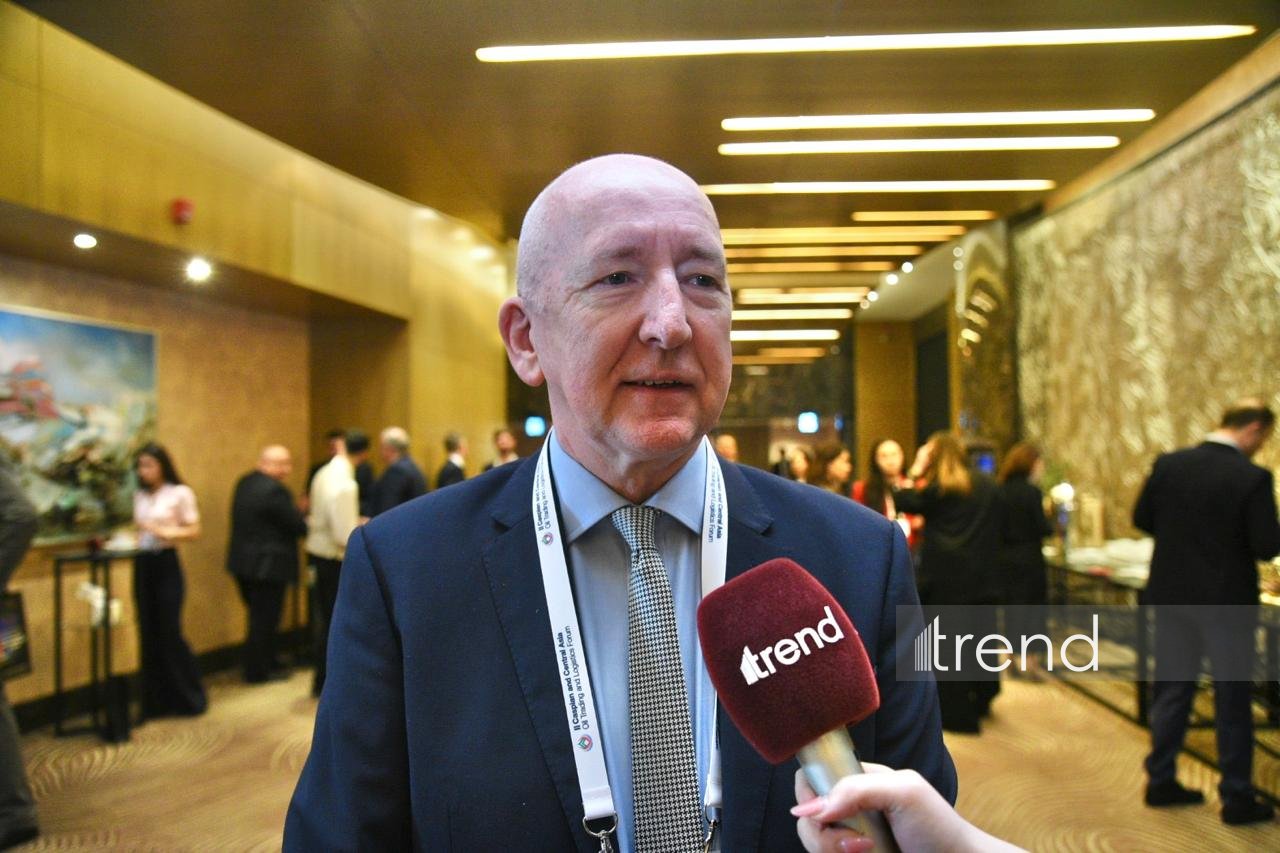

BAKU, Azerbaijan, April 23. The British Chamber of Commerce is ready to support Azerbaijan in the development of artificial intelligence (AI) and other emerging fields, John Patterson (OBE), chairman of the British Chamber of Commerce’s Azerbaijan branch, told Trend on the sidelines of the 2nd Forum on Logistics and Oil Trade in the Caspian and Central Asian Regions in Baku, Trend reports.
"We are Azerbaijan’s largest trading partner largely thanks to bp and the fact that the oil and gas sector has dominated the country’s economy from around 1995 to the present day. Although oil and gas revenues no longer account for the same share of Azerbaijan’s GDP as before, bp and British businesses have maintained an active presence in the market since the mid-1990s,” he said.
According to Patterson, the British Chamber of Commerce in Azerbaijan is working to develop cooperation between British and local businesses, striving to move beyond the oil and gas sector alone.
"We remain actively involved in the energy sector—through bp and British contractors operating in the country. This sector remains an important part of our economic engagement. At the same time, a key factor in Azerbaijan’s long-term economic success is the gradual diversification of the economy and a reduction in dependence on oil and gas. In this context, we strive to support the development of new areas, including education, artificial intelligence, and other technological sectors,” he added.
According to Patterson, the financial sector also plays an important role, especially given that London remains one of the world’s leading financial centers.
In addition, he touched on the transport sector and the significance of the Middle Corridor.
"The Middle Corridor takes on particular significance. Its importance is evident in practice: when disruptions occur on other routes, the significance of alternative transport routes passing through this region increases. For freight transport between China and Europe or in the opposite direction, rail routes along the Middle Corridor have the potential to be faster and more reliable compared to maritime transport, which follows longer and more vulnerable routes. “However, significant work remains to be done to fully realize the corridor’s potential, including a feasibility study and infrastructure development,” Patterson explained.
He believes that another challenge is the fluctuating water level of the Caspian Sea, which requires adaptation of transport and logistics infrastructure, including the development of shipping and other modes of transport.
“Overall, the development of the Middle Corridor is seen as a way to strengthen regional connectivity and create a more resilient transport system that is less dependent on specific geopolitical risks,” Patterson concluded.



