


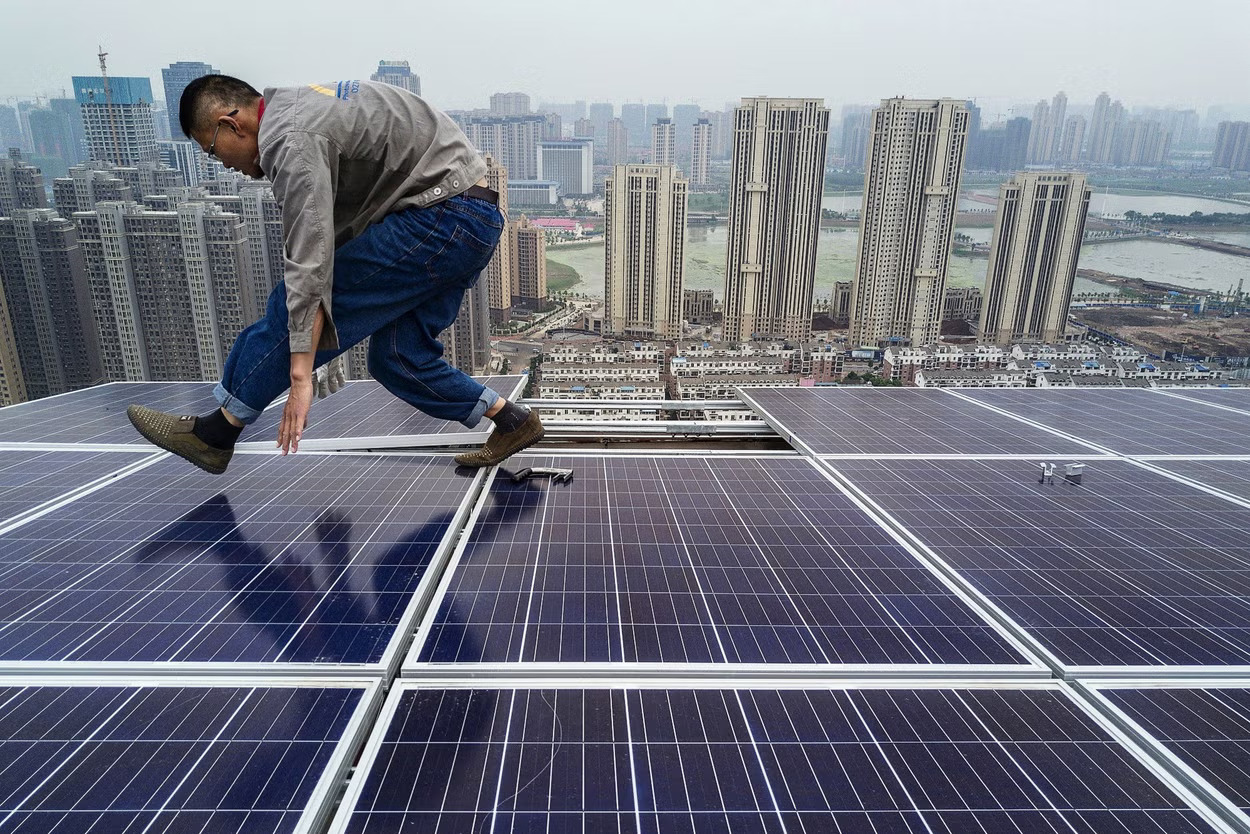

China’s solar power expansion outpaces global trends, redefining clean energy

Economy Materials 23 April 2026 05:36 (UTC +04:00)
China’s solar power expansion outpaces global trends, redefining clean energy
Fuad Namazov
Fuad Namazov
Read more

BAKU, Azerbaijan, April 23. China’s solar power capacity experienced significant growth in 2025, with solar energy accounting for 53.2% of the country’s total renewable energy generation, underscoring its dominant position in the national clean energy mix.

Data obtained by Trend from the International Renewable Energy Agency (IRENA) shows that China’s solar capacity reached 1.2 terawatts (TW) in 2025, marking a 35.5% increase compared to 2024.

The sector has seen a notable acceleration in recent years, with growth rates surging to 55.2% in 2023 and 45.5% in 2024, far outpacing the expansion observed between 2020 and 2022.

The following figures show the total solar energy generation in China:

Year Capacity (MW) Growth
2025 1,202,179 +35.5%
2024 887,100 +45.5%
2023 609,921 +55.2%
2022 393,032 +28%
2021 306,973 +20.9%

The surge in China’s solar power generation from 2023 to 2025 can be attributed to record capacity additions, rapidly falling technology costs, and accelerated project deployment. According to international energy agencies, China dominated global solar installations during this period, with annual additions reaching unprecedented levels and substantially expanding the country's installed base. A large portion of this growth stemmed from the completion of delayed projects, which had been postponed due to pandemic-related disruptions and supply chain challenges in earlier years.

At the same time, the continued decline in solar photovoltaic (PV) costs, fueled by China’s highly integrated manufacturing chain and large-scale production capacity, made solar energy increasingly competitive with conventional power sources. Policy reforms, such as the "whole-county" distributed solar initiative, which promotes market-driven pricing and competitive allocation of renewable projects, further enhanced investment efficiency and expedited project deployment.

Solar energy expanded at a faster pace than wind power, owing to structural advantages in deployment speed and scalability. Solar projects generally require shorter construction periods and face fewer permitting challenges than wind farms, especially offshore installations. Additionally, the accelerated decline in PV equipment costs, coupled with slower wind project development in certain regions, reinforced solar’s dominant role in China’s renewable energy expansion between 2023 and 2025.

Tags:
Latest

Latest