


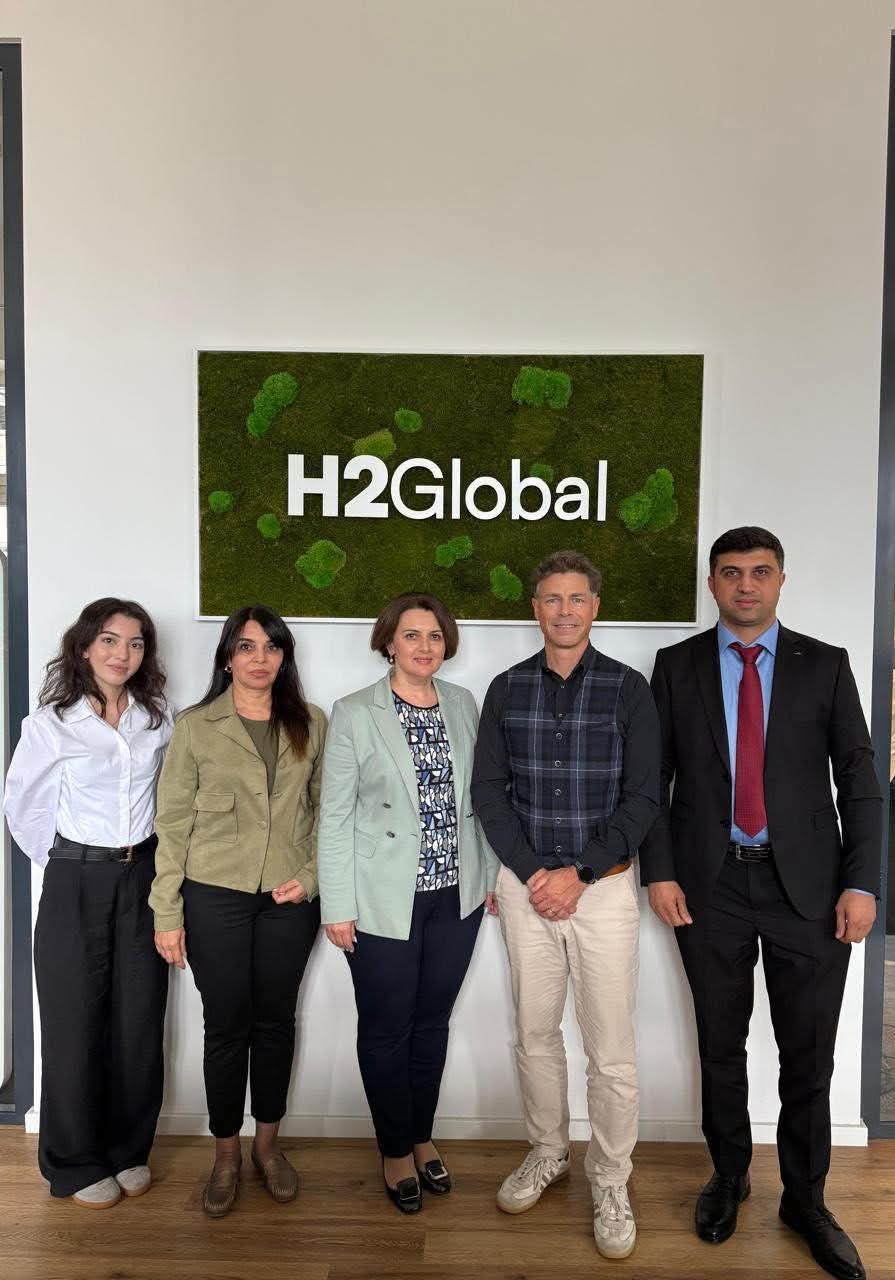

BAKU, Azerbaijan, September 1. The access of Azerbaijan's clean hydrogen projects to international markets, including European markets, and opportunities for cooperation in this area were discussed with the H2Global Foundation as part of a business trip to Germany on August 31.
This was announced in a statement released by Azerbaijan Renewable Energy Agency (AREA).
According to the Agency the talks took place during the meeting between Deputy Director of AREA Rana Humbatova, Head of the Finance Department Ragsana Pashayeva and Deputy Director of the Hydrogen and Green Technologies Department Fuad Hasanov and Project Coordinator of the Clean Energy Center of the Economic Cooperation Organization Nigar Shukurova and Co-founder of the H2Global Foundation Timo Bollerhey.
The meeting exchanged views on the H2Global mechanism, which promotes the development of clean hydrogen and other low-carbon fuel markets, its principles of operation, financing of international projects, and the possibility of delivering clean hydrogen products from producing countries to European markets. During the meeting, it was noted that the "H2Global" mechanism is one of the innovative mechanisms supporting the formation of an international market for clean hydrogen and its derivatives. Within the framework of the mechanism, Hintco GmbH, a subsidiary of the H2Global Fund, purchases clean hydrogen and its derivatives, including green ammonia, e-methanol and SAF, from producers under long-term contracts and supplies them to end consumers in European markets under short-term contracts. The parties discussed the possibilities of Azerbaijani projects to participate in future tenders under the H2Global mechanism, eligibility criteria for potential projects, as well as the impact of long-term hydrogen purchase contracts on project financing and investment decision-making.
Moreover, the meeting emphasized the importance of taking into account certification and sustainability criteria, as well as relevant regulatory requirements of the European Union from the initial stages of projects in terms of access of hydrogen projects to international markets. The parties also discussed possible cooperation opportunities in the areas of hydrogen market development, knowledge and experience exchange, capacity building and institutional cooperation.
During the meeting, information was provided on the work carried out in the country to develop clean hydrogen production, as well as the work carried out within the framework of the preparation of the "Implementation plan of the national strategic review document on hydrogen of Azerbaijan" on the identification of legislation and incentive measures.
The meeting was important in terms of studying the potential participation of Azerbaijan in international clean hydrogen markets, strengthening the country's position as a potential supplier of clean hydrogen and its derivatives in the future, and studying advanced international experience in this field.
Azerbaijan is implementing large-scale projects to increase electricity generation and diversify its energy system. The development of renewable energy sources is one of the key priorities of the country’s energy strategy.
Large-scale investment projects to build solar and wind power plants are currently being implemented with bp, Masdar, ACWA Power, China Gezhouba Group Overseas Investment, SOCAR Green, and other partners. Once completed, these projects are expected to add thousands of megawatts of new generation capacity to Azerbaijan’s energy system in the coming years, reducing domestic demand for natural gas and allowing more gas to be exported.
Meanwhile, according to Azerbaijani Energy Minister Parviz Shahbazov, the share of renewable energy sources in the country’s energy mix is expected to reach about 43% by 2035 as a result of these projects.
The minister said Azerbaijan is implementing strategic projects aimed at establishing a new energy and investment platform between Central Asia and neighboring regions. One of the key initiatives, he said, is the Central Asia-Azerbaijan Green Energy Corridor project.
“The creation of a Trans-Caspian energy corridor connecting the electricity systems of Azerbaijan, Kazakhstan and Uzbekistan is part of our countries’ strategic vision. This project also creates broad opportunities for developing the Middle Corridor, which will serve as a green energy bridge between Europe, Asia and China via the Caspian Sea,” Shahbazov emphasized.
According to the minister, the Green Corridor Alliance joint venture based in Baku is already operating and coordinating feasibility studies financed by the Asian Development Bank and the EBRD.
Meanwhile, intensive work is continuing on the Caspian-Black Sea-Europe Green Energy Corridor, the Azerbaijan-Türkiye-Europe and Azerbaijan-Georgia-Türkiye-Bulgaria electricity interconnectors.
Shahbazov said green energy corridors are shaping the geoeconomic map of the future and that these initiatives will stimulate not only energy exports but also the development of digital connectivity, fiber-optic infrastructure and regional economic cooperation.
AREA Director Javid Abdullayev told Trend in an exclusive interview that Azerbaijan is playing an increasingly important role in establishing a green energy bridge between Europe and Central Asia.
“Azerbaijan is no longer only an exporter of energy resources but is also one of the initiators of regional energy connectivity and green energy corridors. The wind and solar projects currently underway will not only strengthen the country’s energy security but also significantly increase its electricity export potential,” Abdullayev emphasized.
According to him, the Caspian Sea’s substantial wind potential, the development of new electricity transmission lines and initiatives such as the Caspian-Black Sea-Europe Green Energy Corridor will further strengthen Azerbaijan’s role in Europe’s energy security.
“Green energy projects will not only generate additional export revenues for the country but also help optimize the domestic energy balance, reduce natural gas consumption and enable more gas to be directed to foreign markets,” he added.



