


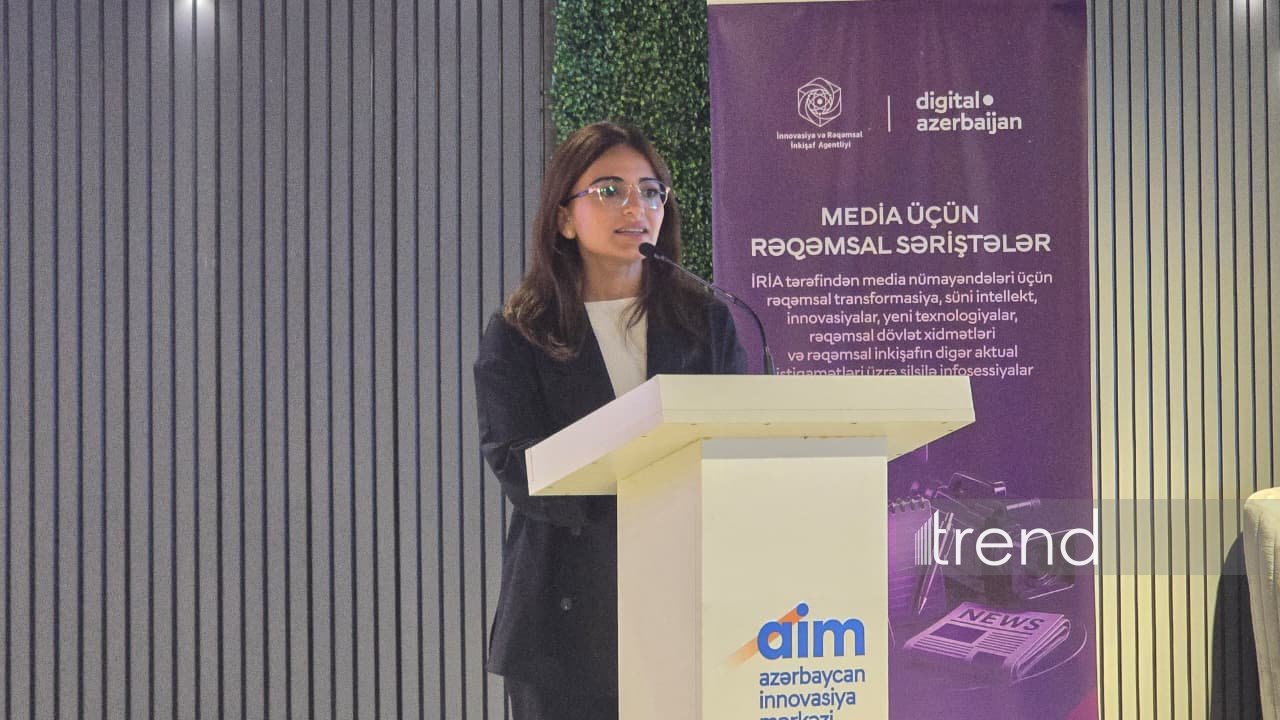

BAKU, Azerbaijan, September 1. New mechanisms have been created to promote participation of startups in public procurement in Azerbaijan, Head of the Legal Department of the Innovation and Digital Development Agency (IDDA), Sabina Humbatzade, said during her speech on the topic "Development of the digital and innovation ecosystem in Azerbaijan: new legislative opportunities" organized within the framework of the educational session "Digital skills for the media", Trend's correspondent reports from the event.
According to her, one of the most important issues for a startup is the formation of customers and demand for its product.
"In this regard, the state's role as the first buyer of startups can help expand their market access opportunities and form a reliable customer base. First of all, a startup needs a customer, there must be demand for its product. A startup must form its portfolio so that it can launch its innovative product on the market and attract real buyers," Humbatzade noted.
She recalled that in the previous period, the complexity of tender and other procurement procedures within the framework of state procurement, as well as numerous requirements, made it difficult for startups to participate in these processes.
"It's a great advantage for the state to act as the first buyer for a startup. If the state trusts them, other buyers can also look at this and trust the startup. This also allows for the formation of a more reliable customer base for the startup," she emphasized.
According to Humbatzade, a number of relevant amendments have been made to the legislation on public procurement.
"If the price of innovative products presented by startups and residents of the Technology Park is up to 100,000 manat ($58,820), they can participate in direct procurement. State bodies and institutions can acquire these products without going through additional procurement procedures," the department head said.
She also noted that a price discount mechanism will also be applied when purchasing innovative products.
"If the estimated price of an innovative product is up to 250,000 manat ($147,060), a 20% discount is applied to the startup. This doesn't mean a 20% reduction in the price of the product. Compared to other offers, a 20% discount is applied to the offer of a startup or resident of the Technology Park, and this offer is evaluated," Humbatzade explained.
The head of the department said that the concept of a "pilot implementation contract" has also been added to the legislation as a new mechanism.
"If a government body or institution has a real need, but it is an innovative product whose purpose and specifications cannot be precisely determined in advance, then a pilot implementation agreement can be concluded," she clarified.
According to her, within the framework of such an agreement, the state body communicates its need to the startup or resident of the Technology Park and determines the product development process according to specific indicators and stages.
"The development process is divided into KPIs, that is, specific indicators and stages. As the specified periods expire, the corresponding part of the product is transferred, and payment is made for each transferred part," said Humbatzade.
She added that the amount of the pilot implementation agreement cannot exceed 1 million manat, and its term cannot exceed 12 months.
Humbatzade also touched upon changes related to the prevention of technological dependence.
"In many cases, software and other technological solutions for state bodies and institutions are developed by private entities. In these cases, the requirement to submit source codes to the state body or institution has also been added to the legislation," - he said.
The official also briefed on the mechanism for financing state digital projects. According to him, the new mechanism mainly covers the financing of projects related to state bodies and institutions, and the goal is to prevent the same or similar digital solutions from being re-developed by different institutions.
"If there is a product that can be used in state bodies and can also contribute to the activities and services of other state bodies, we want to prevent its re-creation. This will prevent the spending of excess funds from the state budget," Humbatzade noted.
She further said that previously, the law "On information, informatization and information protection" had a certain mechanism for the creation of state information resources and systems.
"Before the formation of state information resources and systems, a positive opinion on the feasibility should have been obtained from the Ministry of Digital Development and Transport. After that, the creation of these systems and resources could be carried out," the head of the department said.
According to Humbatzade, the scope of this approach has been expanded in the new mechanism.
"Digitalization projects no longer mean only information systems and resources, but also services, as well as technological equipment necessary for daily use or for the creation and operation of systems and resources," she stressed.
She noted that state bodies and institutions must submit a list of their needs related to digitalization to the Ministry of Digital Development and Transport by the end of April each year.
"The Ministry of Digital Development and Transport reviews that list and assesses the projects' compliance with the system, the services provided by the institution, the overall government architecture, and the digital development vision. If a positive opinion is given, the project is submitted to the Ministry of Finance with that opinion attached," Humbatzade said.
According to her, if the Ministry of Finance considers the project appropriate, the relevant funds are provided in the state budget for the following years.
"Projects related to digitalization are not allowed to be implemented without appropriate opinions. This is already a requirement of the law," she added.



