


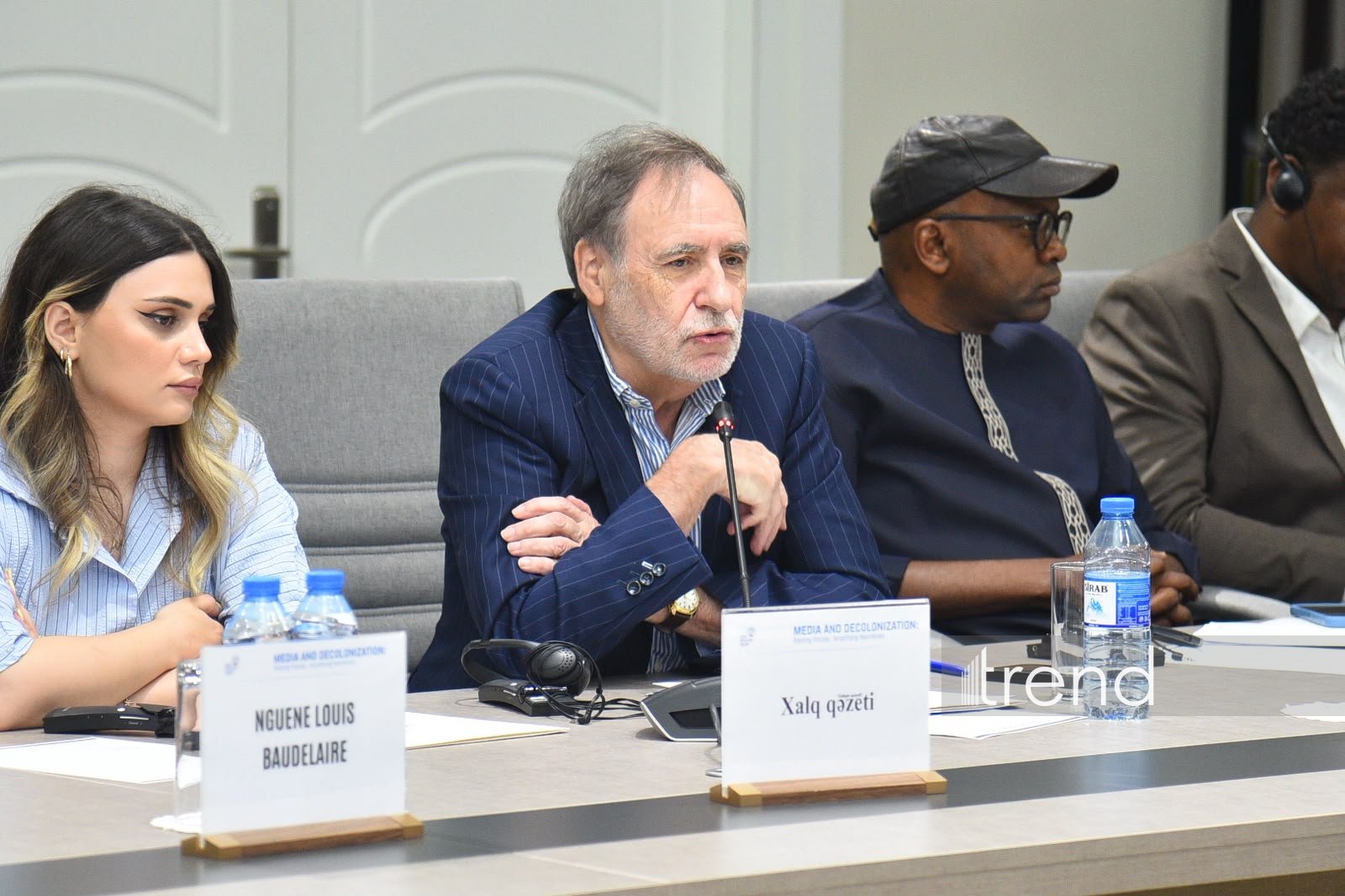
BAKU, Azerbaijan, July 11. The press can serve as a tool for changing perceptions of marginalized peoples, the founder of the French news portal Musulmans en France, Jean-Michel Brun said, Trend's correspondent reports from the event.
Brun made the remark at an international conference on “Media and Decolonization: Rising Voices, Amplifying Narratives” in Baku.
“Colonization is a crime. However, some French presidents have claimed the opposite. They sought to portray their crimes in such a way as to avoid accountability and make them acceptable in the eyes of the public. This was the case in all colonial powers. In particular, the press did not show colonization as it really was, but rather justified it and shaped a positive image of colonialism.
In 1880, the French press portrayed colonization as France’s “civilizing mission,” presenting it as a path to progress: supposedly, hospitals and schools were being built, and security was improving. In reality, however, all of this was used to exploit these territories and intensify the suffering of their populations.
“The press actively participated in creating this colonial image,” he said.
Jean-Michel Brun noted that a colonial press also existed in Algeria, French Guiana, New Caledonia, and Haiti. It contributed to the formation of a colonial identity and presented events exclusively from a French perspective.
“When it came to colonization, it was invariably portrayed in a positive light. When indigenous peoples were discussed, they were presented as something exotic. In the French press, their culture was reduced to folklore and submissiveness,” Brun noted.
He emphasized that today the question arises: how can the media and the press decolonize themselves?
“As journalists, we must be able to inform citizens by providing more opportunities for marginalized people to speak out. We must report on referendums, issues of independence, social problems, and the history of slavery. We must address inequality, break down stereotypes, and remind people of colonial history.
However, on the other hand, the media often portrays public opinion in such a way that decolonization movements appear to be a threat. We see this in the case of New Caledonia, where political tensions persist. Instead of perpetuating such portrayals of overseas territories and focusing solely on the violence occurring there, we could be telling their stories and highlighting their cultures,” he said.
In addition, he said, it is necessary to shed light on their social and economic situation: “We should examine issues of public policy, discrimination, social inequality, and the differences between France and its overseas territories.”
Meanwhile, an international conference organized by BIG on the theme “Media and Decolonization: Rising Voices, Amplifying Narratives” has begun in Baku.
The conference is the first platform of its kind organized in Azerbaijan with the participation of media representatives from former colonial territories.
The conference brings together leaders and representatives of media organizations from former and current colonial territories, journalists, political commentators, representatives of diaspora organizations, experts in media and communications, representatives of civil society institutions, researchers, diplomats, government officials, and representatives of local media.



