


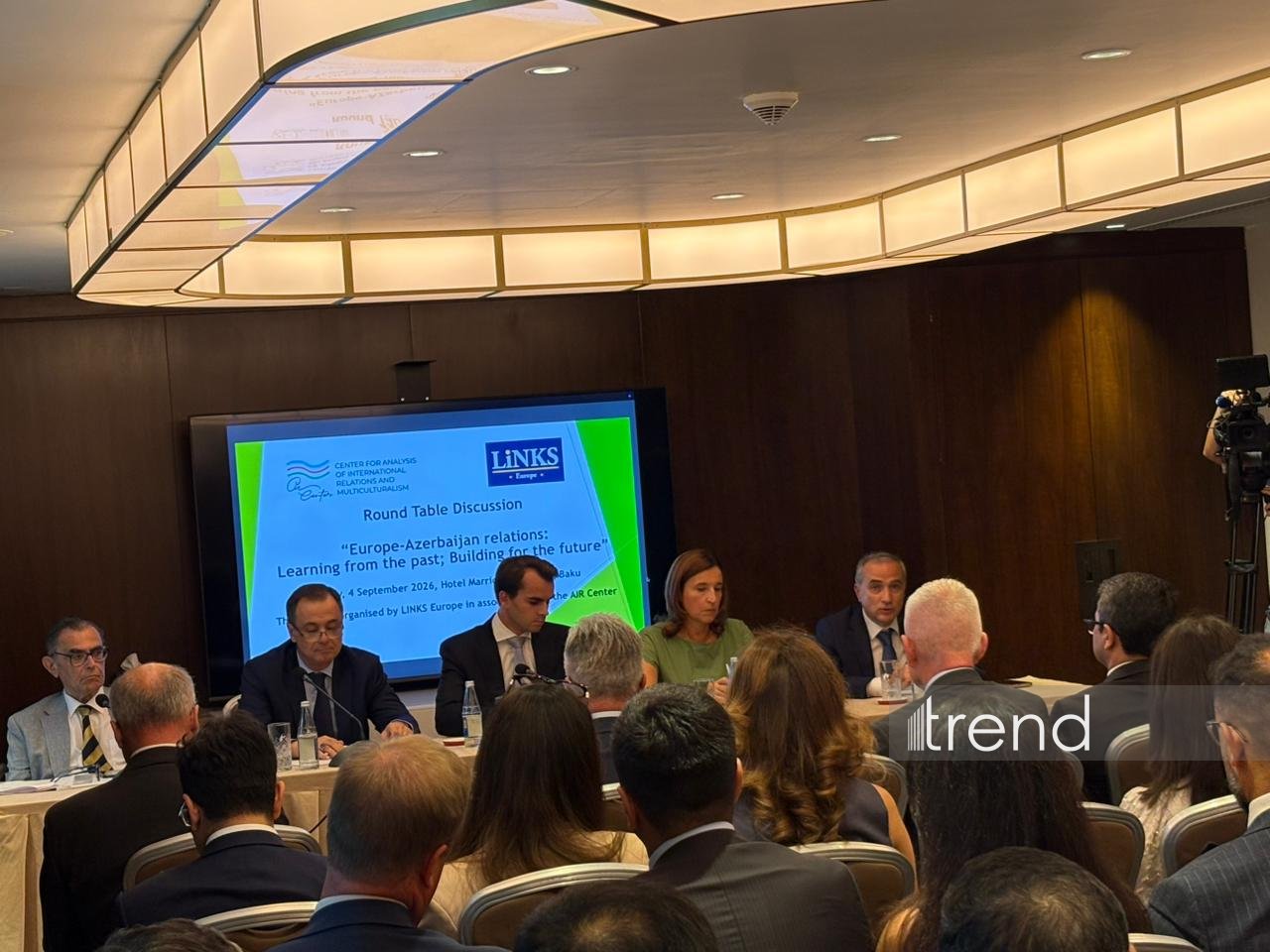

BAKU, Azerbaijan, September 4. Transport and other important issues are already being discussed in Azerbaijan-EU relations, Chairman of the Board of Directors of the Center for the Analysis of International Relations and Multiculturalism, Farid Shafiyev, said, Trend's correspondent reports from the event.
Shafiyev made the remark during the round table on "European-Azerbaijani relations: assessment of historical experience and future directions of cooperation" held jointly by the Center for the Analysis of International Relations and Multiculturalism and the LINKS Europe Foundation.
"When talking about EU-Azerbaijan relations, many experts talk about energy, but I believe that while energy remains important, we have already moved beyond energy. We are now increasingly talking about transport and other important issues," the analyst explained.
He noted that the geopolitical landscape of the South Caucasus has changed significantly.
"First of all, this is related to the Armenian-Azerbaijani conflict - it is already behind us. We are talking about peace.
I know that the European Union is also preparing to cooperate more actively with its partners in Central Asia and Azerbaijan. When talking about EU-Azerbaijan relations, many experts talk about energy, but I believe that although energy remains important, we have already gone beyond energy. Now we are talking more about transport and other important issues," he said.
Shafiyev also noted that strengthening the dialogue between experts and think tanks is of particular importance.
"The Center for the Analysis of International Relations and Multiculturalism believes that such platforms allow for a comprehensive analysis of the political, economic, energy and security aspects of the processes taking place in Azerbaijan-Europe relations, as well as for the early identification of existing and potential opportunities, as well as challenges," he added.
The main purpose of the round table is to discuss the current state and development prospects of European-Azerbaijani relations, to review the results and lessons learned from historical experience, and to assess the existing opportunities for strengthening closer and more effective cooperation in the future.



