

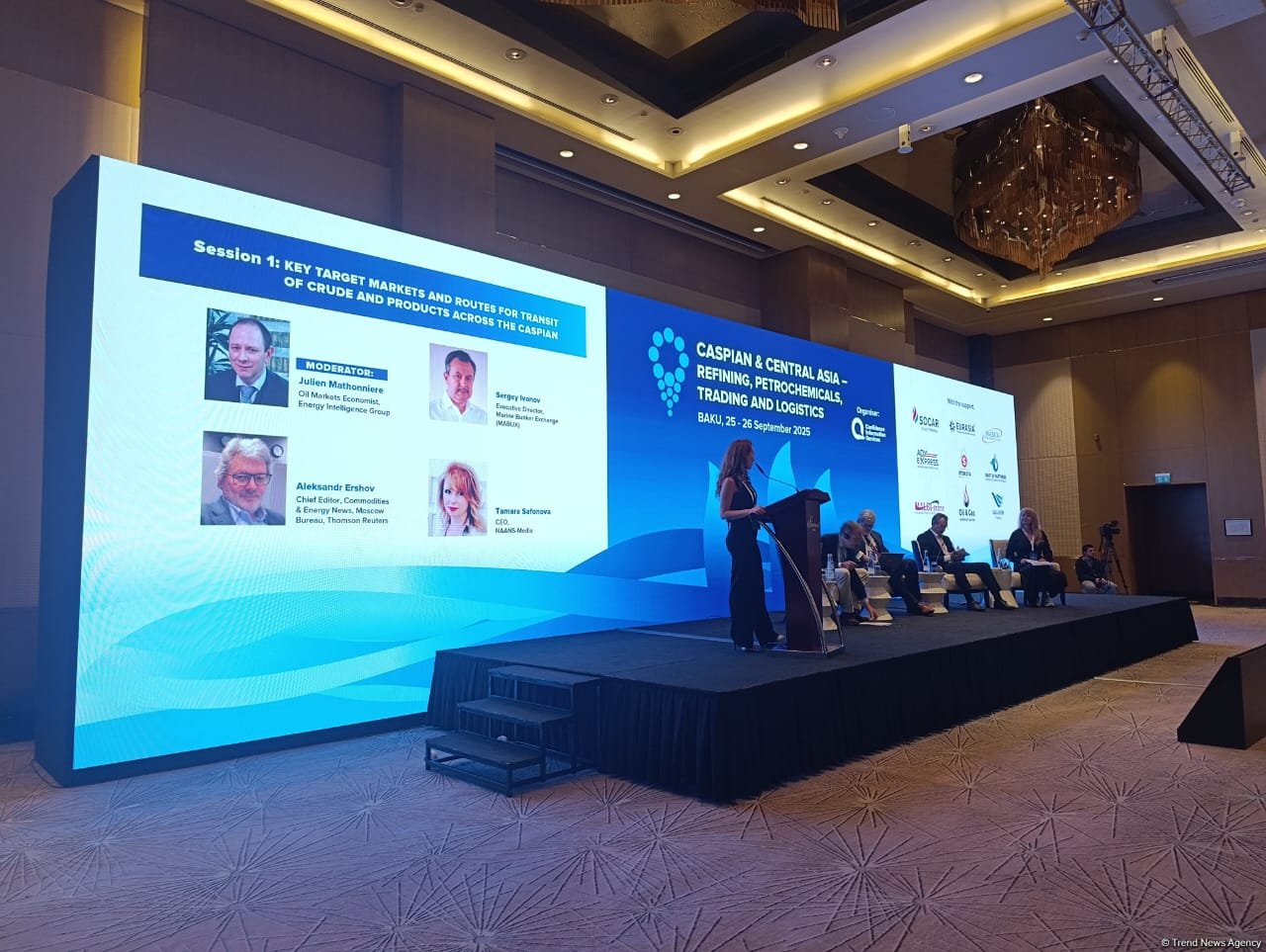




BAKU, Azerbaijan, September 25. A conference on “The Caspian and Central Asia – Refining, Petrochemicals, Trade, and Logistics” has been held in Baku, Trend reports.
According to information, the event was organized by Confidence Information Services.
The following topics are planned for discussion: “Macroeconomic and geopolitical factors shaping the energy market in the Caspian region and Central Asia,” “The state of the global bunker market and prospects for its development,” “Fuel market indicators in the Caspian region and Central Asia: production, supply destinations, and pricing in the region,” “Azerbaijan's decisive role in oil and gas transportation through the Middle Corridor,” “Liberalization of Kazakhstan's fuel market: challenges and prospects for Central Asia,” and others.
Speaking at the event, Julien Mathonniere, an economist at Energy Intelligence Group, said that Kazakhstan is working to lower its dependence on Russia by increasing oil shipments through alternative routes.
“In Kazakhstan, there is a push to increase oil exports through the Baku–Tbilisi–Ceyhan (BTC) pipeline from the current level of around 1.5 million tons to a potential 20 million tons in the future. Oil transport along this route is expected to grow from 1.4 million tons in 2024 to 1.7 million tons in 2025,” Mathonniere explained.
He also highlighted the increasing importance of the Middle Corridor. Kazakhstan is enhancing its railway infrastructure to become a key transit hub between China and Europe, potentially bypassing traditional routes through Russia.
The Director of the Marine Bunker Exchange (MABUX) Sergey Ivanov noted that in the first half of 2025, Turkish ports saw a decline in demand for bunker fuel.
According to Ivanov, demand for bunker fuel fell by 16 percent in Türkiye, 12 percent in New York, 11 percent in Russia, 10 percent in Fujairah, and three percent in Gibraltar.
At the same time, demand for bunker fuel grew by 22 percent in Panama, nine percent in West Africa, eight percent in South Africa, and four percent in Los Angeles, he added.
Chief Editor for Commodity Markets and Energy News at the Moscow Bureau of Thomson Reuters Alexander Yershov said that the transit hub of the Caspian’s major hydrocarbon suppliers will continue to develop and gain greater independence as its transit capabilities expand.
According to Yershov, the Caspian region is witnessing stable and independent development. One of the most prominent examples of this, he said, is the Baku-Tbilisi-Ceyhan (BTC) pipeline - the region’s largest - which operates independently of Russian resources.
Yershov pointed out that the BTC pipeline is a major and self-sufficient infrastructure project, well-integrated into the region’s oil supply system.
Rassul Abdukhalilov, CEO of the Kazakh company RV-Oil&Gas, said that free pricing of fuel in Kazakhstan is expected to help reduce the illegal outflow of fuels and lubricants from the country, stabilize supply markets, and reduce shortages.
"This will also create an additional incentive for the development of exchange trading and the expansion of the network of petrol stations in remote regions. Regarding the impact on the regional market, deregulation is expected to lead to a gradual price alignment with neighboring countries," he also said.
According to him, this will catalyze an increase in market arbitrage opportunities within transboundary zones.
Proximal territories adjacent to Russian hydrocarbon processing facilities will perceive them as pivotal suppliers, and conversely, those facilities will regard these regions as integral consumers.
"Consequently, we can anticipate a reallocation of resource streams based on a substitution framework: for instance, hydrocarbons and lubricants originating from Russia will be directed towards northern Kazakhstan, whereas petroleum products from Kazakhstan will be channeled to Central Asian markets. This initiative will optimize supply chain expenditures and, as a result, lower both wholesale and retail pricing structures across Central Asia," Abdukhalilov elucidated.
He observed that Kazakhstan executed a deregulation of the pricing mechanisms for gasoline and diesel in February of the current fiscal year.
This represents a pivotal milestone in the trajectory of systemic market transformations for the nation.
Concurrently, the pricing dynamics of fuel in Kazakhstan exhibit a comparative advantage, positioning it as the most economical in relation to adjacent nations. This scenario engenders a myriad of challenges, notably the illicit transference of fuel across borders.
Stay up-to-date with more news on Trend News Agency's WhatsApp channel