


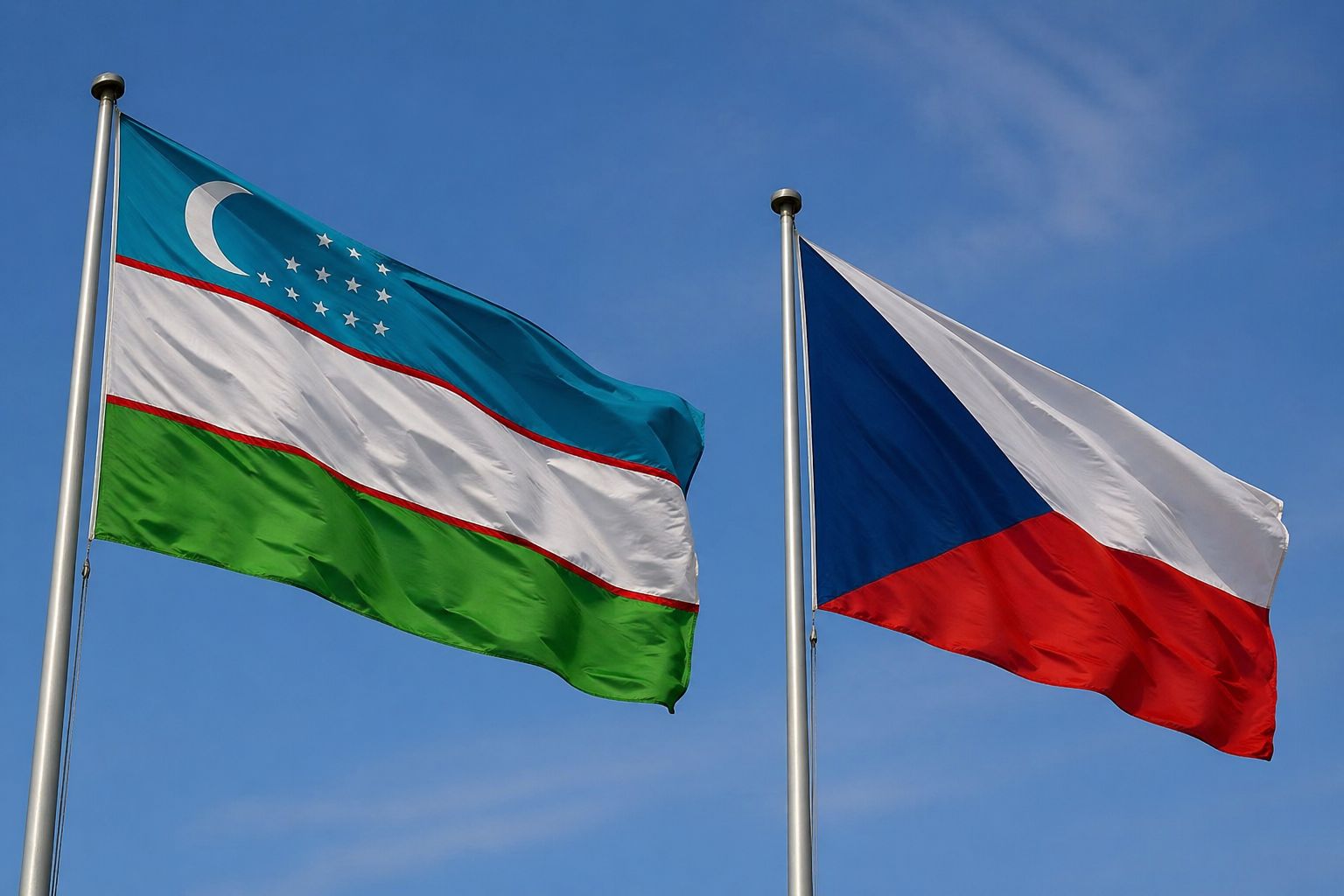

BAKU, Azerbaijan, April 29. Czech Prime Minister Andrej Babiš will pay an official visit to Uzbekistan on April 29-30 as part of a regional tour of Central Asia and the South Caucasus.
Accompanying him will be a substantial business delegation, including First Deputy Prime Minister and Minister of Industry and Trade Karel Havlíček, as well as representatives from approximately 50 Czech companies. The principal objectives of the visit are to strengthen trade and economic relations, promote Czech exports, and facilitate the initiation of new industrial projects.
The visit underscores Prague’s increasing focus on Uzbekistan as one of the most promising markets within Central Asia, reflecting a gradual shift in bilateral relations from conventional trade toward deeper industrial and technological collaboration.
A key event of the program will be a meeting between Prime Minister Babiš and President Shavkat Mirziyoyev, complemented by the Czechia-Uzbekistan Business Forum. The forum is anticipated to provide a platform for direct negotiations between enterprises from both countries and discussions regarding joint investment initiatives.
Economic engagement remains the principal driver of closer bilateral relations. By the end of 2025, trade turnover between Uzbekistan and the Czech Republic amounted to $190.4 million. Although this represented a decrease from the 2024 figure of $434.7 million, the decline was primarily attributable to the completion of major deliveries of Czech machinery and transport equipment. Nevertheless, total trade remained nearly three times higher than in 2018, demonstrating sustained long-term growth. In the period from January through February 2026, trade turnover recorded a further increase of 5.3%.
Currently, 44 enterprises with Czech capital operate in Uzbekistan, spanning sectors including mechanical engineering, pharmaceuticals, the chemical industry, construction, agriculture, logistics, and information technology. For Prague, this presents an opportunity to consolidate its presence in a rapidly expanding market, while for Tashkent, it represents a means of attracting European technologies, investment, and managerial expertise.
A key practical outcome of the ongoing visit may be progress on the Škoda Transportation project to supply and assemble electric trains in Uzbekistan. The initiative envisages the localization of production, with components gradually manufactured domestically. In addition, the establishment of the Škoda Academy at Tashkent State Transport University is under consideration to train engineers and technical specialists.
In 2023, Uzbekistan Railways and Škoda formalized a contract for the supply of 30 electric trains valued at €320 million. Concurrently, Uzbekistan Airways committed to the acquisition of Czech LET L-410 aircraft for domestic routes. These agreements signified a transition from preliminary memorandums to concrete commercial transactions.
The Czech Republic has also demonstrated notable interest in Uzbekistan’s raw material resources and industrial potential. Prague offers advanced technologies in geological exploration, mineral extraction, raw material processing, water management, and energy efficiency. In light of the growing global demand for critical minerals, this sector is poised to become one of the most promising areas of bilateral cooperation.
Digital collaboration is likewise expanding. Czech enterprises regard Uzbekistan as a strategic platform for IT outsourcing, service centers, and the implementation of joint technological initiatives. Moreover, cooperation in the domains of standardization, metrology, and technical regulation provides a framework for industrial collaboration and facilitates access to international markets.
A systematic mechanism for bilateral dialogue remains the Intergovernmental Commission on economic, industrial, and scientific-technical cooperation. Its tenth meeting took place in March 2025 in Prague, where the sides discussed joint production, long-term financing, and new projects in transport, pharmaceuticals, electrical engineering, tourism, and education.
For Uzbekistan, the Czech Republic is attractive not only as an individual market but also as a gateway to the European economy. The Czech Republic maintains strong industrial positions and ranks among Europe’s most developed manufacturing economies. For the Uzbek side, this means access to modern technologies, equipment, and EU production chains.
Politically, the visit is also significant. It confirms Prague’s intention to strengthen ties with partners beyond the European Union while demonstrating Tashkent’s growing multi-vector foreign economic policy.
It is expected that new agreements may be signed following the trip in industry, transport, investment, and workforce training. If the announced projects move into the implementation stage, the Czech Republic could establish itself among Uzbekistan’s key European industrial partners.
The main question now is whether the two sides will be able to transform the current high political interest into a large-scale, long-term investment. If so, this visit could become a turning point in Uzbek-Czech relations and elevate them to a fundamentally new level.



