


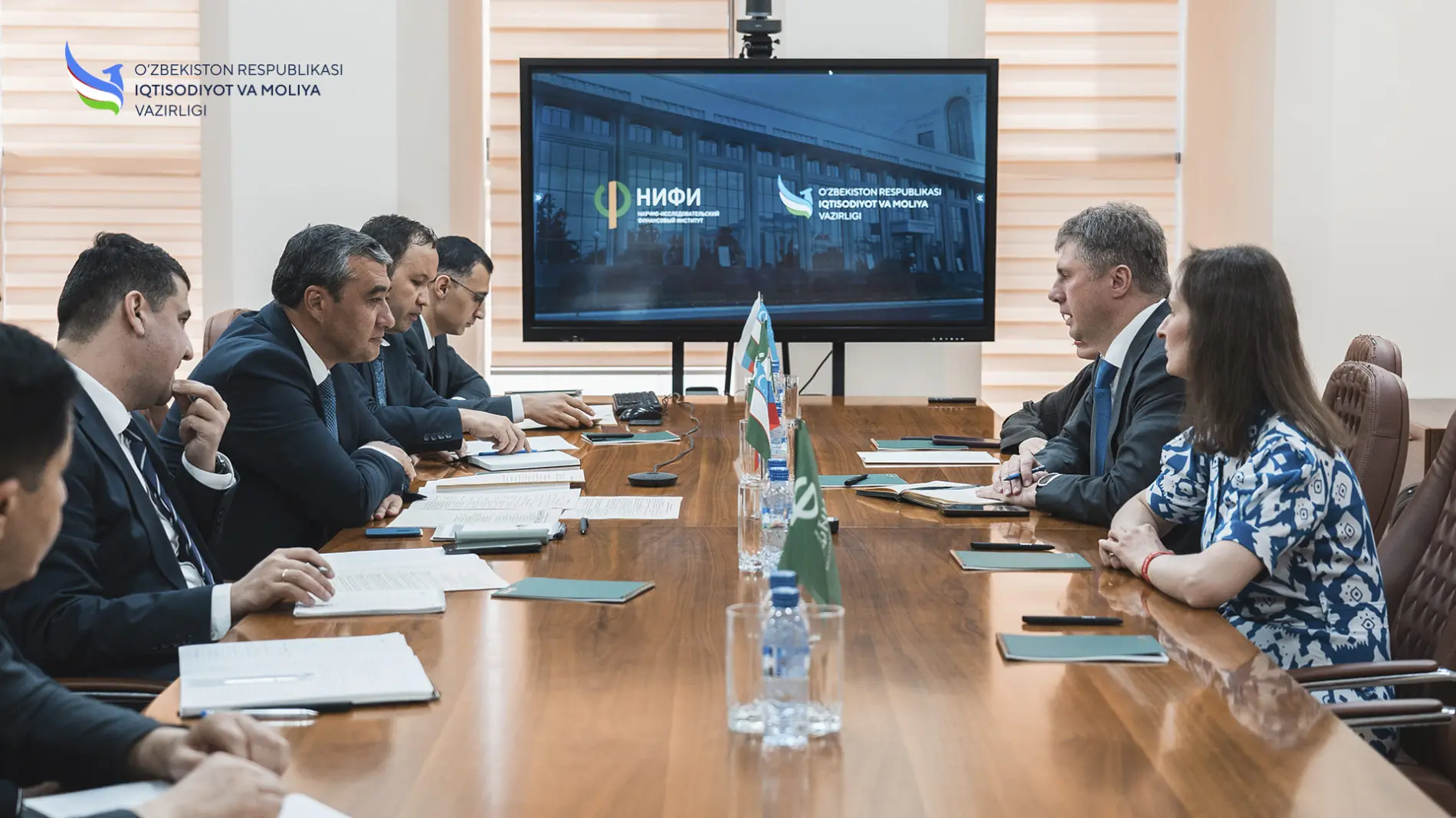

TASHKENT, Uzbekistan, May 25. Uzbekistan’s Ministry of Economy and Finance hosted a delegation from Russia’s Financial Research Institute from May 19–22 for discussions on public financial management, tax policy, and budget reforms, Trend reports via the Uzbek ministry.
The visit took place under a bilateral cooperation program between the two countries’ finance ministries, and was organized by the Financial Research Institute serves as the Russian implementing body for the initiative.
During the visit, Russian and Uzbek officials held a series of working meetings and expert seminars covering budget transparency, public procurement, tax policy, internal auditing and the efficiency of public spending.
On May 20, Acting Director of Russia’s Financial Research Institute Gleb Pokatovich and program curator Tatyana Yaglina met with Uzbekistan’s Deputy Minister of Economy and Finance Ahadbek Haydarov to review the preliminary results of the three-year cooperation program. Senior Uzbek officials responsible for nine areas of bilateral cooperation also participated in the discussions.
Pokatovich additionally held talks with Dilshod Sultonov, deputy director of Uzbekistan’s Fiscal Analysis Institute, which operates under the Ministry of Economy and Finance and focuses on reducing the shadow economy and improving tax and customs administration.
A series of thematic seminars were organized throughout the visit. One seminar focused on improving Uzbekistan’s budget process through program-based budgeting mechanisms. Another addressed cooperation between internal audit services, financial control bodies and the Accounts Chamber, as well as strengthening internal audit systems within local government structures.
Officials and experts also discussed ways to improve the transparency of Uzbekistan’s budget process and public financial reporting in line with international standards.
At the Agency for Industrial Cooperation and Public Procurement, participants reviewed proposals aimed at expanding the use of lifecycle contracts within Uzbekistan’s public procurement system.
Additional sessions focused on medium-term tax policy reforms designed to increase budget revenues and improve business transparency.
Russian experts presented recommendations on tax regimes for self-employed citizens and individual entrepreneurs, the possible introduction of a digital services tax and taxation mechanisms for e-commerce.
Another seminar addressed methods for evaluating the effectiveness of public spending, including programs aimed at developing mahallas and regional infrastructure projects.
The discussions also covered improvements to Uzbekistan’s regulatory framework and regional performance ranking systems.



