


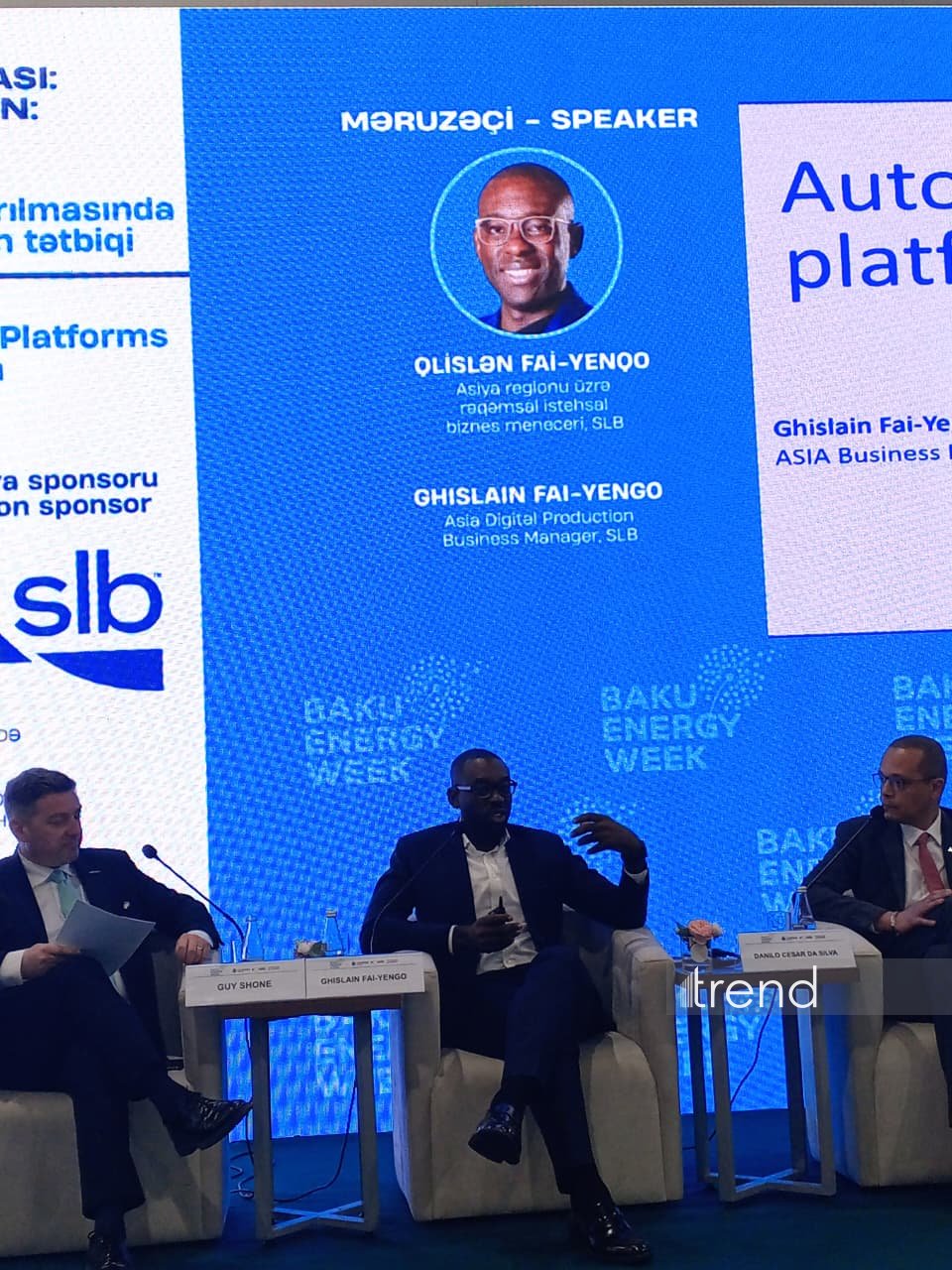

BAKU, Azerbaijan, June 1. Autonomous and remotely operated facilities can significantly reduce operating costs for oil and gas companies and improve the safety of production processes, Ghislain Fai-Yengo, SLB’s Digital Operations Manager for Asia, said during a panel session at Baku Energy Week, Trend reports.
According to him, the oil and gas industry has evolved from the concept of digital fields to remote management and autonomous operations, and today the key challenge is scaling these solutions.
“Wherever I go — to India, Beijing, or Shenzhen — operators ask the same questions: how to improve operational cost efficiency, reduce the number of employees at field sites, cut down on vessel trips, and ensure safer facility operations,” he noted.
Fai-Yengo emphasized that three key components are necessary for the implementation of autonomous solutions: specialized equipment, modern software platforms, and additional engineering services.
In his words, equipment must be designed from the outset for remote control and autonomous operation, while software solutions must support the processing of large volumes of data, the use of digital twins, and artificial intelligence technologies.
“We need to work closely with operators and rethink our approaches to facility design—determining what equipment is truly necessary, how to reduce the size of installations, and how to implement AI to improve efficiency,” the SLB representative said.
He noted that many elements of autonomous systems are already in use in the global oil and gas industry, including remote control of production, injection, mechanized production systems, and chemical processes.
Fai-Yengo paid particular attention to the concept of unmanned offshore platforms.
“If a facility can be operated remotely, the need for a constant on-site presence of personnel at sea is significantly reduced. This allows for smaller platform sizes, faster construction, lower project costs, and improved safety,” he emphasized.
According to him, operators are increasingly setting a goal of reducing the number of site visits to once per quarter, which minimizes risks to personnel and lowers operating costs.
Furthermore, Fai-Yengo noted the importance of intelligent monitoring of pipelines and product transportation systems. Modern digital tools make it possible to predict flow behavior, determine the optimal time for pipeline cleaning, and automatically initiate the necessary processes.
“When the system itself determines the need for intervention and initiates the appropriate actions, operators gain capabilities that were previously unavailable due to a lack of data and control tools,” he said.
In conclusion, the SLB rep stressed that the further development of autonomous facilities requires a comprehensive approach that combines modern equipment, digital technologies, and close collaboration between solution providers and oil and gas asset operators.



