


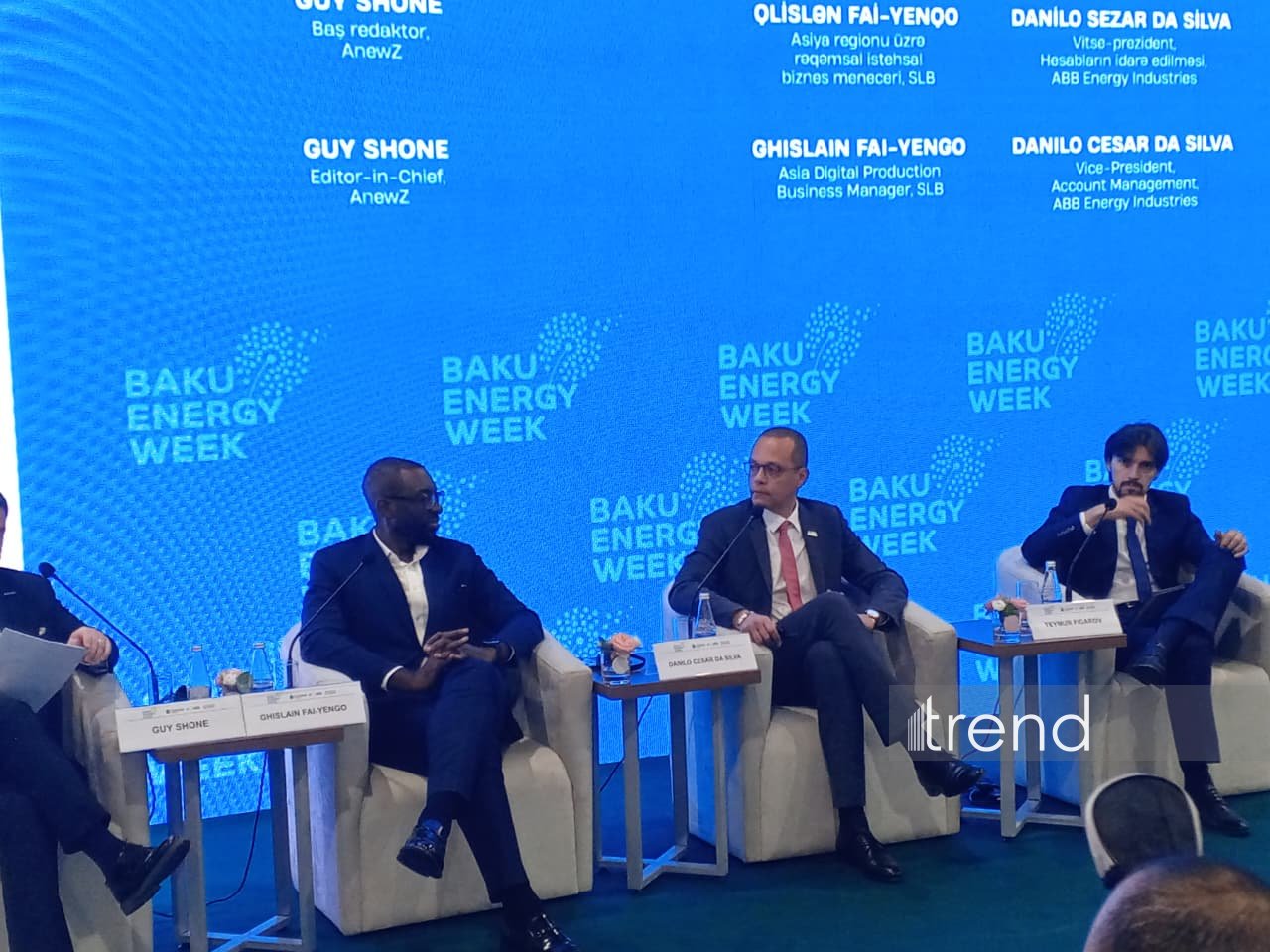

BAKU, Azerbaijan, June 1. The higher the level of autonomy, the lower the cognitive burden on the person responsible for managing the processes, Danilo Cesar da Silva, Vice President of Account Management at ABB Energy Industries, said, Trend reports.
Danilo Cesar da Silva made the statement during a panel session at the 31st International Caspian Oil and Gas Exhibition, currently taking place in Baku.
According to him, today the world is surrounded by a multitude of different technological solutions — from smart warehouses and modern aircraft to autonomous driving systems. At the same time, the key question remains whether these systems are truly autonomous or merely automated.
“Why should we move toward autonomy? It is clear that our industry is seeing an increase in the complexity of energy systems. Additionally, there is a generational shift among specialists, which requires a change in work approaches. Finally, all market participants are under pressure to increase profitability,” he noted.
Danilo Cesar da Silva emphasized that autonomous technologies should not be viewed as a replacement for existing digital solutions.
“I don't mean to say that autonomy will replace cloud technologies, but it does allow us to push the boundaries of what it means to achieve peak efficiency in production assets,” the company representative said.
He cited the example of autonomous transportation, where there is already a clear classification of autonomy levels, ranging from Level 0 to fully autonomous driving.
“There are six levels of autonomy in the automotive industry. However, our industry lacks a structured approach to defining exactly what autonomy means,” he noted.
According to him, ABB has adapted this approach for industry, defining the level of autonomy based on the degree of human involvement in performing tasks.
“In other words, the level of autonomy can be measured by the extent to which a person’s hands, eyes, and mind are involved in performing a task. At level zero, most processes are performed manually and depend entirely on humans. As the level of autonomy increases, human involvement gradually decreases,” Danilo Cesar da Silva explained.
He noted that at the second level of autonomy, the operator’s hands may no longer be involved in performing certain operations; at the third level, the need for constant visual monitoring may periodically decrease; and at the fourth level, human involvement becomes even more limited. The fifth level implies full autonomy.
According to a representative of ABB Energy Industries, automated systems form the foundation for the transition to higher levels of autonomy.
“The higher the level of autonomy, the more digital solutions are applied on top of the automated foundation. As a result, as autonomy increases, the cognitive load on the person responsible for process control decreases,” he emphasized.



