


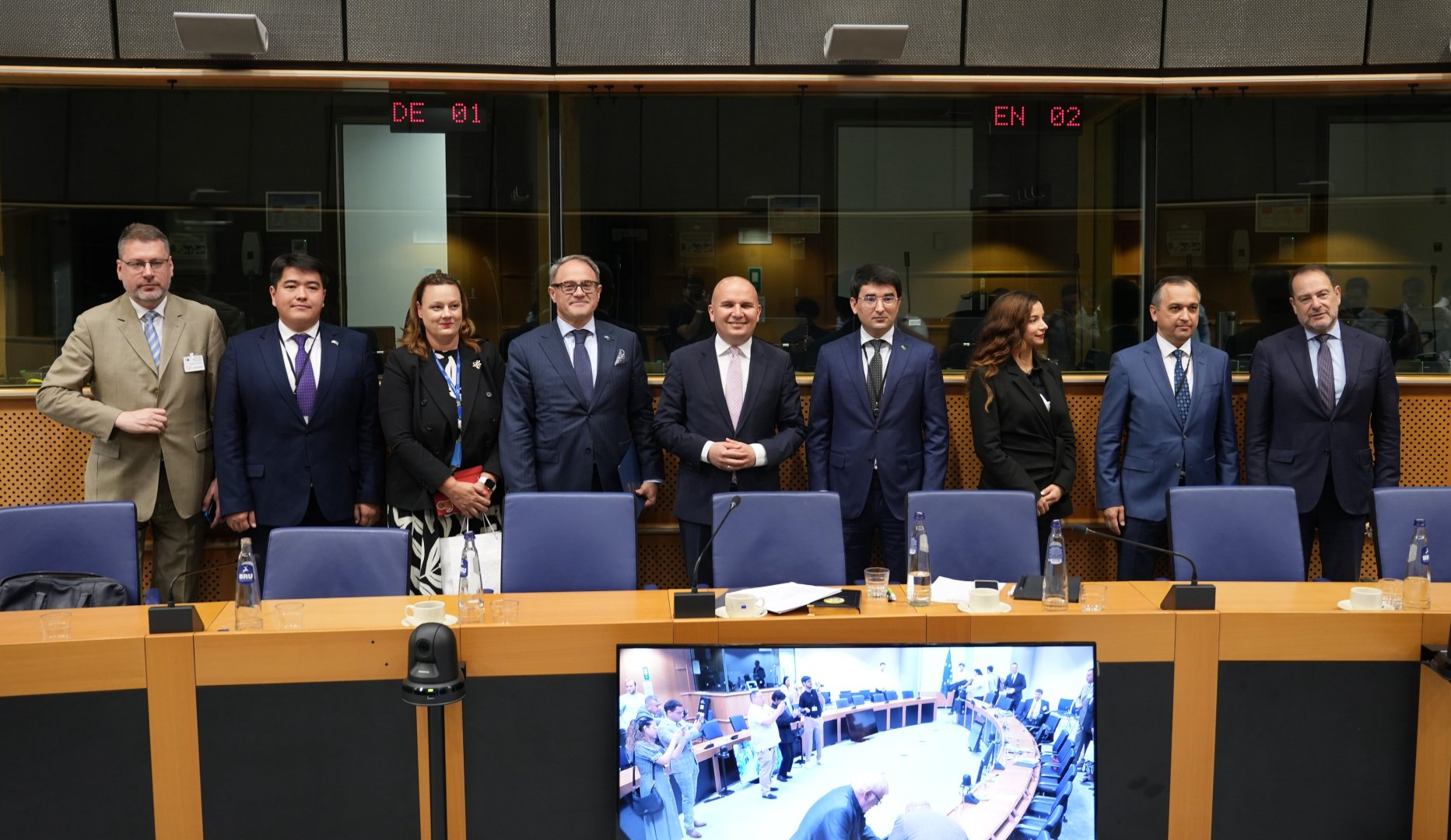

BAKU, Azerbaijan, July 3. Turkmenistan joined a high-level round table on the Trans-Caspian Corridor at the European Parliament in Brussels.
This was reflected in a press release published by the Embassy of Turkmenistan in Brussels.
"Participants highly appreciated the growing role of the Trans-Caspian Transport Route in strengthening links between the European Union, Central Asia, the South Caucasus and the wider Eurasian space," the press release said.
According to the embassy, the event was organised with the support of Member of the European Parliament Ilhan Kyuchyuk and brought together ambassadors of Turkmenistan, Kazakhstan, and Uzbekistan. The programme featured panels on regional connectivity and investment under the EU's Global Gateway initiative, moderated by Central Asia expert and Tashkent State University of Oriental Studies PhD candidate Derya Soysal.
The embassy said Turkmenistan's Ambassador to Belgium, Sapar Palvanov, stressed that transport connectivity is now directly linked to supply chain resilience, strategic autonomy, route diversification, and reliable international connections.
According to the press release, Palvanov said the Trans-Caspian Transport Route provides Europe with an additional strategic link to Central Asia and the wider Asian region through the South Caucasus and the Caspian Sea.
The embassy noted that the ambassador described the corridor as a transport ecosystem that includes ports, vessels, railways, roads, customs procedures, digital solutions, logistics operators, and private-sector participation.
According to the press release, the programme featured panels on regional connectivity and investment under the EU's Global Gateway initiative.
The embassy added that participants called for closer cooperation among the European Union, Central Asian countries, the South Caucasus, international financial institutions, and the private sector to advance practical projects along the Trans-Caspian Transport Route.
Meanwhile, the Trans-Caspian International Transport Route, also known as the Middle Corridor, is a multimodal trade route linking Europe and Asia via Central Asia, the Caspian Sea, the South Caucasus, and Türkiye. The corridor has become a central transport component of the European Union's Global Gateway strategy, the bloc's flagship initiative to strengthen sustainable infrastructure and connectivity with partner countries.
As part of Global Gateway, the EU is working with international financial institutions to mobilise around 10 billion euro for transport infrastructure along the Middle Corridor. The initiative includes investments in ports, railways, border crossings, and digital customs systems, reflecting the bloc's efforts to diversify trade routes, improve supply chain resilience, and deepen economic links with Central Asia and the South Caucasus.



