


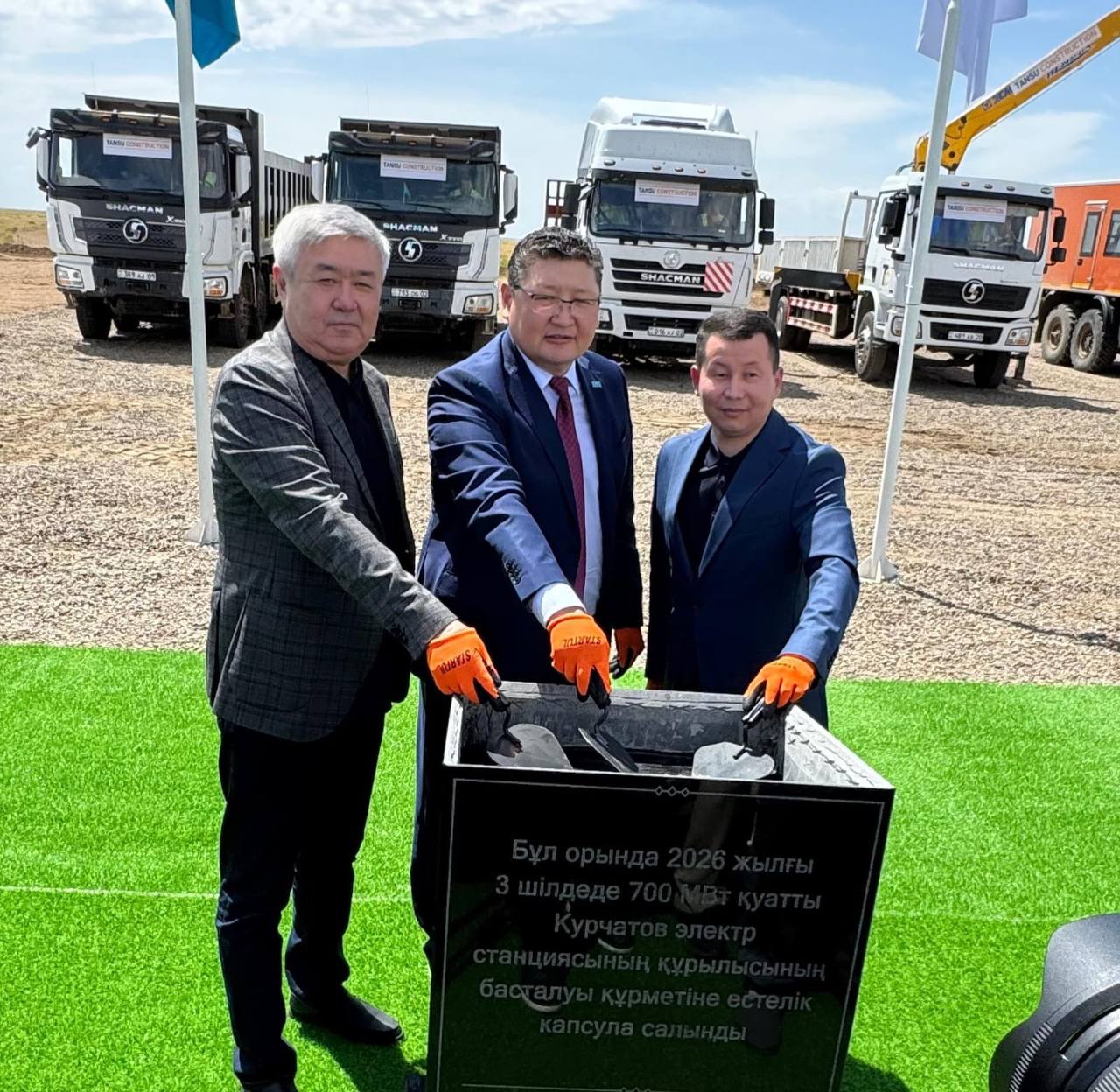

BAKU, Azerbaijan, July 3. Construction of a new 700 MW condensing power plant (CPP) has officially begun in the city of Kurchatov in Abai region, Kazakhstan, the country's Ministry of Energy announced.
This was reported by the press office of the Ministry of Energy of Kazakhstan following a time capsule laying ceremony held as part of the project's launch.
"The new power plant is aimed at strengthening the country’s energy security, reducing the risk of electricity shortages in the national power system, and creating additional conditions for industrial development and investment attraction in the region," the ministry said.
According to the ministry, the total cost of the project amounts to 759 billion tenge ($1.6 billion), with implementation scheduled for 2026–2032. Once operational, the plant is expected to generate up to 5 billion kWh of electricity annually, significantly boosting the region’s industrial capacity.
Kazakhstan has adopted a National Project for the development of coal-based generation, under which 7.8 GW of new and modernized capacity is planned, including the construction of eight new power plants.
The new construction program covers key energy hubs across the country and includes a 700 MW CPP in Kurchatov, the large-scale 2,640 MW Ekibastuz GRES-3, thermal power plants in Karaganda (350 MW) and Ekibastuz (180 MW), as well as new combined heat and power plants in Zhezkazgan (500 MW), Kokshetau (240 MW), Semey (360 MW), and Oskemen (360 MW).
Kazakhstan’s Condensing Power Plants (CPPs) and Combined Heat and Power Plants (CHPs) generate the vast majority of the country's electricity. While CPPs focus solely on electricity, CHPs produce both power and district heating. The system currently relies heavily on fossil fuels, but is undergoing massive modernization to curb pollution and add capacity.



