


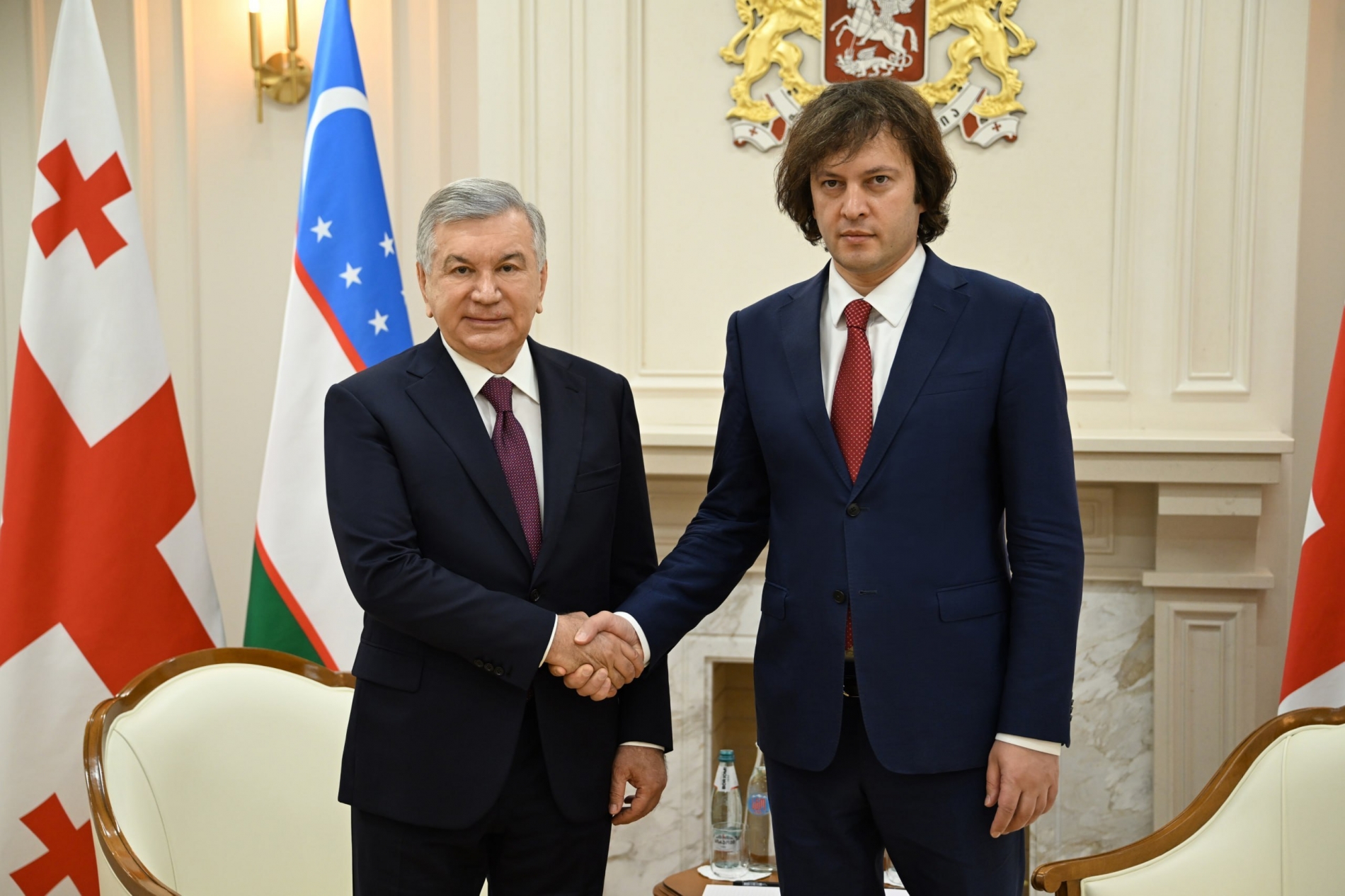

BAKU, Azerbaijan, July 3. President Shavkat Mirziyoyev and Georgian Prime Minister Irakli Kobakhidze held talks in Georgia aimed at expanding bilateral cooperation across trade, transport, investment, and industrial sectors.
This was reflected in the statement by the press service of the Uzbek president.
''During the meeting, Mirziyoyev noted that the state visit, the first by an Uzbek president to Georgia in more than two decades, marks a significant step in strengthening ties between the two countries,'' the press service says, citing Mirziyoyev's remarks.
According to information, the talks focused on broadening practical cooperation in political, trade, economic, investment, transport, tourism, and cultural spheres.
Moreover, the information indicates that, in the course of the meeting, the sides highlighted the growing pace of bilateral engagement at all levels and expressed support for maintaining active intergovernmental, parliamentary, business, and humanitarian exchanges.
Trade turnover between Uzbekistan and Georgia reached $270 million in 2025, while bilateral trade has already exceeded $100 million since the beginning of this year. The sides agreed to adopt a separate roadmap aimed at increasing trade to $1 billion in the coming years, reducing imbalances, and expanding mutual exports through cross-industrial exhibitions.
“We have agreed on concrete steps to significantly increase trade and deepen industrial cooperation in key sectors,” the Uzbek side said following the talks.
Transport and transit cooperation featured prominently in the discussions, with particular emphasis on expanding the use of the Port of Poti and the Port of Batumi for the transportation of Uzbek cargo.
The leaders also backed plans to establish a logistics hub in Georgia, including an industrial zone and showroom for Uzbek-made products.
Mirziyoyev welcomed the launch of the Baku–Tbilisi–Kars railway corridor and proposed linking it with the future China–Kyrgyzstan–Uzbekistan railway to strengthen Eurasian connectivity.
Industrial cooperation was identified as another major priority. The sides praised the outcomes of a joint business forum held earlier, which resulted in the signing of a cooperation program through 2027.
New projects are expected in agriculture, electrical engineering, energy, pharmaceuticals, food production, light industry, construction materials, digitalization, IT, digital banking, and tourism.
To support these initiatives, the leaders proposed creating a joint investment fund.
The talks also highlighted growing cultural ties, including the successful Georgian Culture Days held in Tashkent in March and Georgia’s decision to name one of Tbilisi’s parks after Alisher Navoi.
The sides also agreed to establish an Uzbek embassy in Georgia and to hold joint education and tourism forums later this year.



