


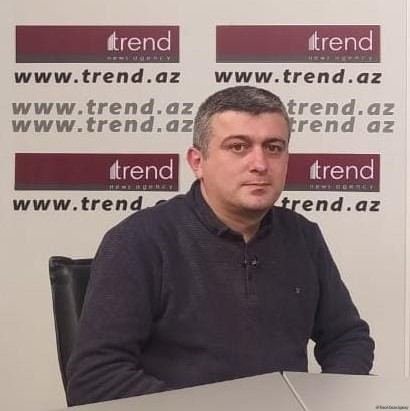
BAKU, Azerbaijan, September 24. Iran and the United States are finding it far more challenging than in 2015 to come to a new agreement rather than a comprehensive shared action plan., Iranian expert Diako Hosseini told local media, Trend reports.
According to him, also impressive is the political climate change. There was no talk about the Ukrainian war, Donald Trump was not president, and Iran-US relations were not as bad. Competition between China, Russia, and the US was also low. All of this overshadows the Tehran-Washington dispute.
“I do not expect unexpected discussions and results during Iranian President Masoud Pezeshkian's visit to New York. However, the parties may use this opportunity to reach an agreement on a basic framework. In my opinion, the US government is not ready to enter into serious discussions with Iran as before. The US presidential election is close at hand. The US policy will be determined for a certain period after the new government assumes power. In the current situation, it is very difficult for Iran to discuss with a government that is not sure whether it will be in the White House in two months,” he said.
The Iranian side has made various appeals in recent days for the resumption of nuclear discussions on the nuclear program.
Meanwhile, in January 2016, Iran and the P5+1 group (the US, Russia, China, the UK, France, and Germany) implemented the Comprehensive Joint Plan of Action concerning Iran’s nuclear program.
In May 2018, the U.S. announced its withdrawal from the deal and reimposed sanctions on Iran.
By the end of 2020, the Iranian parliament decided to pursue a strategic plan in the nuclear sector to counter the sanctions, leading to a suspension of additional steps and the Additional Protocol as per the nuclear agreement.
Consequently, the International Atomic Energy Agency (IAEA) faced a reduction in monitoring capabilities by 20-30 percent.



