


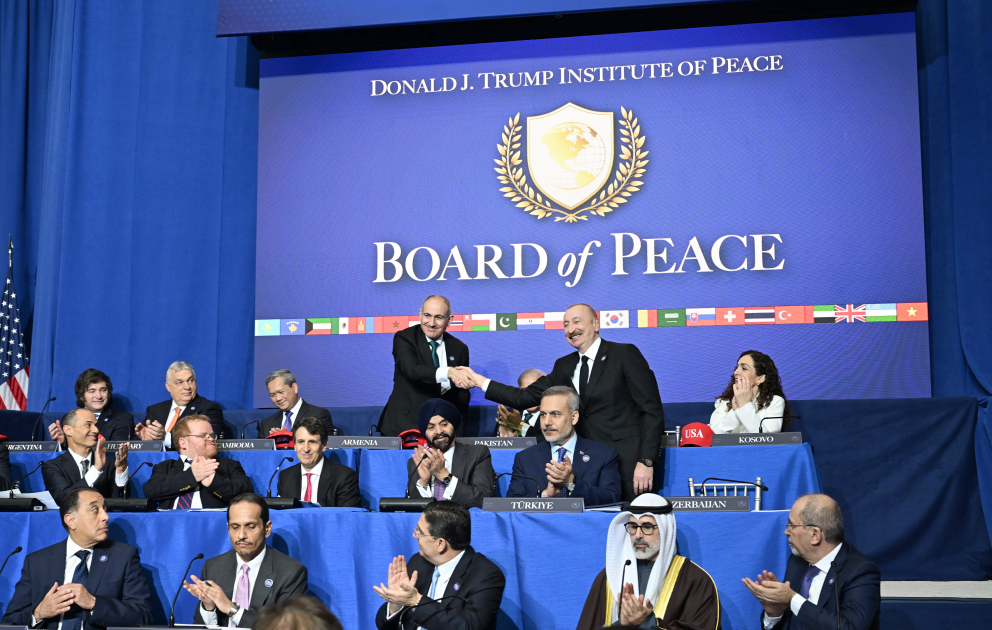
BAKU, Azerbaijan, February 20. The first meeting of the Board of Peace, held on February 19, 2026, in Washington, D.C., became an event that went far beyond protocol diplomacy. It marked the emergence of a new architecture of international engagement based on the principles of responsibility, mutual respect, and practical peacebuilding. In this process, the role of the President of the Republic of Azerbaijan, Ilham Aliyev, assumed particular significance - a leader who understands the true cost of peace and has demonstrated in practice a steadfast commitment to the principles of peaceful coexistence.
For decades, the South Caucasus remained a zone of tension. Azerbaijan endured a protracted conflict, human losses, and an extremely complex negotiation process. It is precisely for this reason that Baku’s position on peace is grounded not in abstract declarations but in real historical experience. The initialing of the peace agreement between Azerbaijan and Armenia on August 8, 2025, in Washington confirmed President Ilham Aliyev’s consistent course toward achieving a sustainable settlement.
In his letter, President Donald Trump formally invited Azerbaijan to join the "Charter of the Board of Peace" as a founding country: "As Chairman of the Board, I formally invite the Republic of Azerbaijan to join as a Founding Member State, and become a party to the Charter of The Board of Peace, as represented by you." This invitation became a logical continuation of joint initiatives aimed at achieving peace in the region.
In response, President Ilham Aliyev emphasized the strategic importance of Azerbaijan’s participation. "I accept this invitation as a sign of mutually respectful and beneficial partnership between the Republic of Azerbaijan and the United States of America, and as a recognition of Azerbaijan's role in the promotion of peace and stability at the regional and global levels," the head of state noted in his reply.
These letters set the tone for interaction between the leaders during the first meeting of the Board of Peace. At the event, Donald Trump underscored the historic significance of cooperation between Azerbaijan and Armenia. "I achieved peace between two very important countries and I will never forget it. They are good people, but they are tough. I think they have become friends. This was a great thing that you and your new friend did. We worked out for 24 hours, and it was a good piece," he said.
This assessment demonstrates that the successful resolution of a regional conflict has become a practical example upon which the work of the new international organization is being built.
In turn, U.S. Vice President JD Vance highlighted the importance of leadership and partnership. "We're grateful for your partnership, and in particular to the President of Azerbaijan, the Prime Minister of Armenia, who I just saw last week, thank you all for making it possible and for showing what real leadership can accomplish. That's what the Board of Peace, I think, is fundamentally about, is making the peace stick. And it's an incredible thing that you guys have all done. So to all of the leaders gathered here today who are investing in the future, who are investing in peace, we're grateful to you," the Vice President stated.
His remarks organically connect the experience of concluding the conflict in the South Caucasus with the mission of the Board of Peace - ensuring the durability of peace agreements.
On the sidelines of the meeting, President Ilham Aliyev also held an informal conversation with the Prime Minister of Armenia, Nikol Pashinyan. This once again demonstrates that Azerbaijan remains open to dialogue. Baku’s practical experience is becoming an example of how a post-conflict country can participate in shaping the global architecture of peace.
Today, the conditions have been created for the final signing and ratification of the peace agreement between Azerbaijan and Armenia. This path - from conflict to institutionalized peace - lends particular significance to the country’s participation in the Board of Peace. Azerbaijan is capable of offering the world not a theoretical model, but a practice-tested approach that combines political firmness with readiness for dialogue.
Azerbaijan’s participation in the first meeting of the member states of the Board of Peace is a natural stage in its foreign policy development. The role of President Ilham Aliyev demonstrates that peace is not a tactical compromise, but a strategic objective of state and regional development. Standing on the threshold of a final peace agreement after 30 years of conflict, the country is ready to share its experience and contribute to the formation of a more sustainable and secure world order.



