


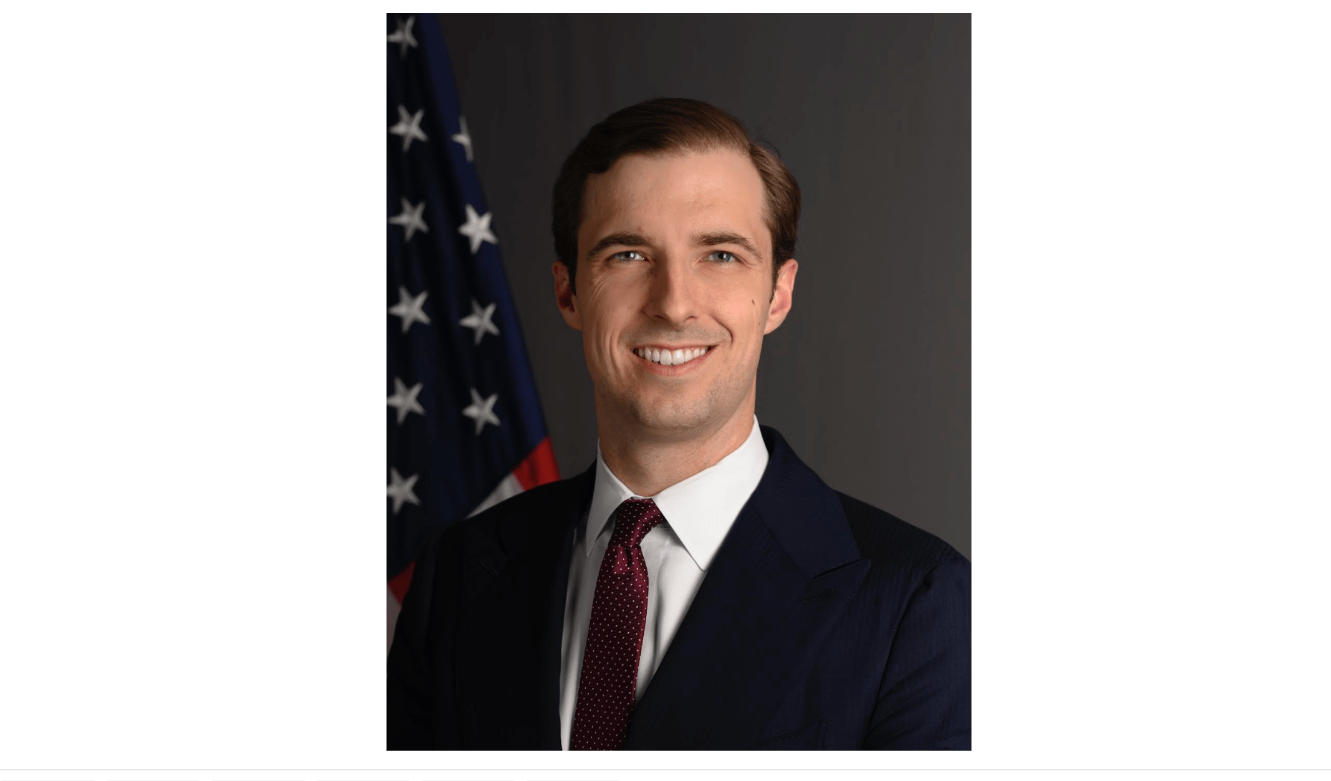

BAKU, Azerbaijan, February 18. The U.S. is interested in exploring options to support Azerbaijan’s role as the region’s digital hub, Assistant Secretary for Economic, Energy, and Business Affairs Caleb Orr at the U.S. State Department said in an exclusive interview with Trend.
“There are currently over 200 U.S. companies operating in Azerbaijan, and we want to see bilateral trade and economic relations increase. Specific areas for deepening economic cooperation include energy investments; regional connectivity infrastructure; trade, including defense sales; and AI partnerships and digital infrastructure,” he said.
Talking about the significance of the Trump Route for International Peace and Prosperity (TRIPP), Orr pointed out that it will create a vital link in the Trans-Caspian Trade Route.
“TRIPP will establish unimpeded, multimodal transit connectivity
on the territory of Armenia. While connecting the main part of
Azerbaijan and its Nakhchivan Autonomous Republic and creating a
vital link in the Trans-Caspian Trade Route, the TRIPP is expected
to generate reciprocal benefits for international and intra-state
connectivity for the Republic of Armenia.
The ultimate objective of the TRIPP is to strengthen the prosperity
and security of Armenia and Azerbaijan and further American
commerce by expanding regional trade and connectivity as well as
create new transit opportunities linking Central Asia and the
Caucasus to Europe,” he said.
Orr went on to add that the Middle Corridor could transform trade across Eurasia.
“Trans-Caspian Trade Route (TCTR), or Middle Corridor, is a trade and transit route spanning the Central Asian steppe, across the Caspian Sea, and through the Caucasus, linking the region to U.S. and European markets. With investment in critical infrastructure and customs improvements, a fully operational TCTR could transform trade within and across Eurasia. During the C5+1 Tenth Anniversary Summit in November 2025, the five Central Asian countries and the United States identified developing the potential of the Trans-Caspian Trade Route as a priority to strengthen supply chain connectivity and resilience by securing the movement of cargo, information, and energy,” he explained.
Orr believes that investments in transit and logistics, critical
minerals, agribusiness, and digital infrastructure, will create
opportunities for U.S. business investment while increasing the
amount of goods and critical resources through the TCTR.
As for energy cooperation, Orr noted that U.S. companies continue
to seek opportunities to expand their role in oil and gas
activities to support Azerbaijan.
“We understand Azerbaijan’s oil and gas sector is focused on maximizing production from established Caspian fields, while exploring and developing new sources of onshore and offshore oil and gas for both domestic consumption and export. Such opportunities include the 2025 Memorandum of Understanding between ExxonMobil and SOCAR to explore, develop, and produce unconventional onshore oil and gas reserves. Capacity expansions for oil and gas export pipelines are also being considered. U.S. companies continue to seek opportunities to expand their already significant role in oil and gas activities to support Azerbaijan in these endeavors,” he added.
Orr also touched upon other spheres of cooperation, noting that U.S. companies are global leaders in providing power generation and grid technology and services, important areas for Azerbaijan’s economic future.
“Additionally, we are interested in connecting U.S. technology
companies with Azerbaijan and exploring options to support
Azerbaijan’s role as the region’s digital hub. Azerbaijan also
plays a critical role in the Trans-Caspian Trade Route (Middle
Corridor). U.S. investments in smart port technologies, modern rail
infrastructure, and integrated logistics hubs will enhance
connectivity and ensure faster, more reliable trade flows between
Asia and Europe,” he said.
Orr also highlighted the important role of the U.S.-Azerbaijan
Chamber of Commerce (USACC) in facilitating business connections,
trade missions, and networking platforms that enable U.S. and
Azerbaijani firms to engage and pursue commercial
opportunities.
“These activities help build trust and generate commercial leads for U.S. companies - an essential function in emerging markets where relationships and local knowledge are critical to success,” he said.
Furthermore, as Orr noted, the USACC fosters regional business collaboration, which is particularly important given Azerbaijan’s role as a geostrategic hub in the South Caucasus.
“Its position in energy transit corridors and regional connectivity initiatives presents significant cross-border opportunities for U.S. firms. As an example, in September 2025, USACC brought a U.S. business delegation to Azerbaijan to explore commercial opportunities in multimodal transportation, logistics, and critical infrastructure. This year, USACC celebrates its 30th anniversary, marking three decades of fostering trade, investment, and cultural ties between the United States and Azerbaijan. I am confident that our partnership is poised for continued excellence and look forward to deepening our engagement in the months and years ahead,” he concluded.



