


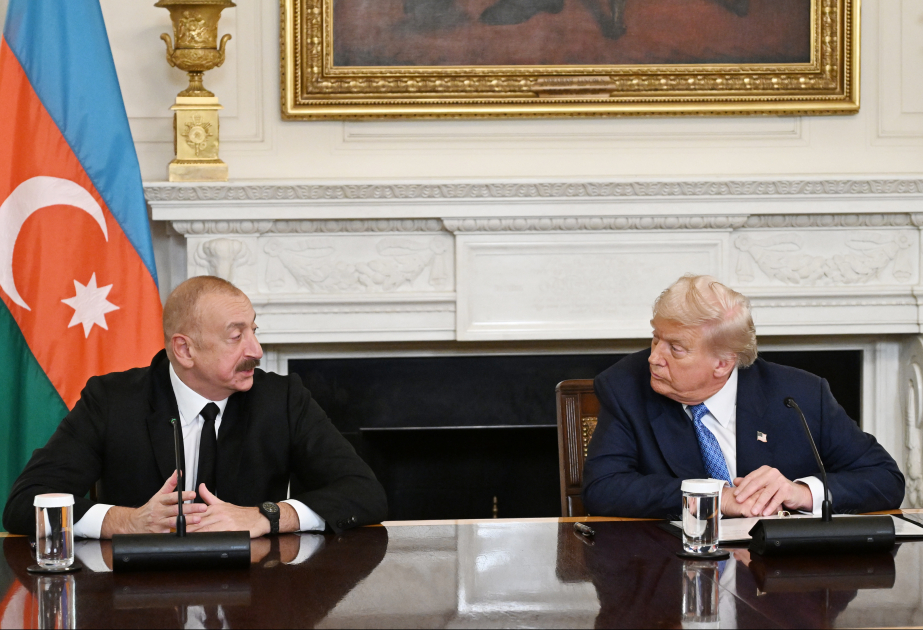

BAKU, Azerbaijan, January 8. The post-war era of global governance is now undergoing its most profound challenge. From the corridors of the White House to the shores of the Caspian Sea, a new paradigm of "Sovereignty First" diplomacy is emerging, casting international organizations not as essential arbiters, but as relics of a previous era.
As U.S. President Donald Trump leads a significant withdrawal from numerous international bodies, a parallel shift is taking place in Azerbaijan. Under the leadership of President Ilham Aliyev, Baku is adopting a similar transactional approach, asserting that when international institutions fail to yield tangible results or encroach upon national interests, they forfeit their legitimacy to operate.
The reverberations in Washington are still being felt. Recently, President Trump signed a significant Presidential Memorandum, directing the United States to withdraw from 66 international organizations. This comprehensive list includes 31 UN entities and 35 non-UN bodies.
The White House’s rationale is direct: these organizations, it argues, "promote globalist agendas at the expense of U.S. priorities" and "fail to address critical issues efficiently." By halting U.S. contributions to the UN Human Rights Council (UNHRC) and the UN Relief and Works Agency (UNRWA), Trump is signaling a clear stance, American taxpayer dollars will no longer support institutions perceived as undermining U.S. sovereignty.
While Washington’s move may appear abrupt, Azerbaijan’s departure from international bureaucratic structures has been a gradual process over the past decade. In 2025, Baku furthered this policy by suspending participation in several international organizations it considers ineffective, including the closure of local offices for the United Nations High Commissioner for Refugees (UNHCR) and the United Nations Development Programme (UNDP).
This isn't a new playbook for President Ilham Aliyev. As early as 2014-2015, Azerbaijan shuttered the OSCE office in Baku, citing a lack of neutrality and efficiency. For Baku, the logic is simple: if an organization cannot fulfill its mandate - or worse, becomes a tool for external pressure - its presence is no longer justified.
The core of this shared skepticism lies in the perceived paralysis of international law. For years, Western institutions like the Venice Commission of the Council of Europe have attempted to "lecture" Azerbaijan on domestic governance. Now, in a striking parallel, the U.S. is also withdrawing from the Venice Commission, echoing the sentiment that these bodies often overstep their bounds to interfere in the internal affairs of sovereign states.
President Ilham Aliyev recently addressed this systemic failure in an interview with local TV channels, highlighting the decades-long frustration with international inaction regarding the restoration of Azerbaijan’s territorial integrity.
"Unfortunately, international law norms do not function. And Azerbaijan was one of the first victims of the malfunctioning of international law when our lands were occupied, and the United Nations Security Council adopted four resolutions demanding withdrawal... But these resolutions remained on paper for 27 years and would have remained on paper forever if we had not liberated our lands by force," he stated.
President Ilham Aliyev’s critique goes deeper, describing a 'wall of silence' from established diplomatic groups.
"I remember I already spoke about that on a couple of occasions, my numerous meetings with the then OSCE Minsk Group, when they were advising Azerbaijan to accept realities on the ground. And all my arguments about Security Council resolutions, international law, and violations of international law were met again with a kind of wall of silence," he added.
To supporters of President Donald Trump and President Ilham Aliyev, these moves will be considered a necessary "reality check" for a bloated international system that has lost its way. They may argue that multilateralism has become a shield for the status quo, where "talk shops" replace actual problem-solving. By exiting these bodies, leaders argue they are reclaiming resources for domestic priorities - infrastructure and security - while protecting their nations from foreign interference.
Whether this is a temporary realignment or the permanent dismantling of the 20th-century order remains to be seen. What is clear is that both Washington and Baku are no longer willing to wait for international organizations to reform themselves. They are creating their own "realities on the ground," leaving the rest of the world to decide whether this is a crisis of diplomacy - or a long-overdue correction.



