


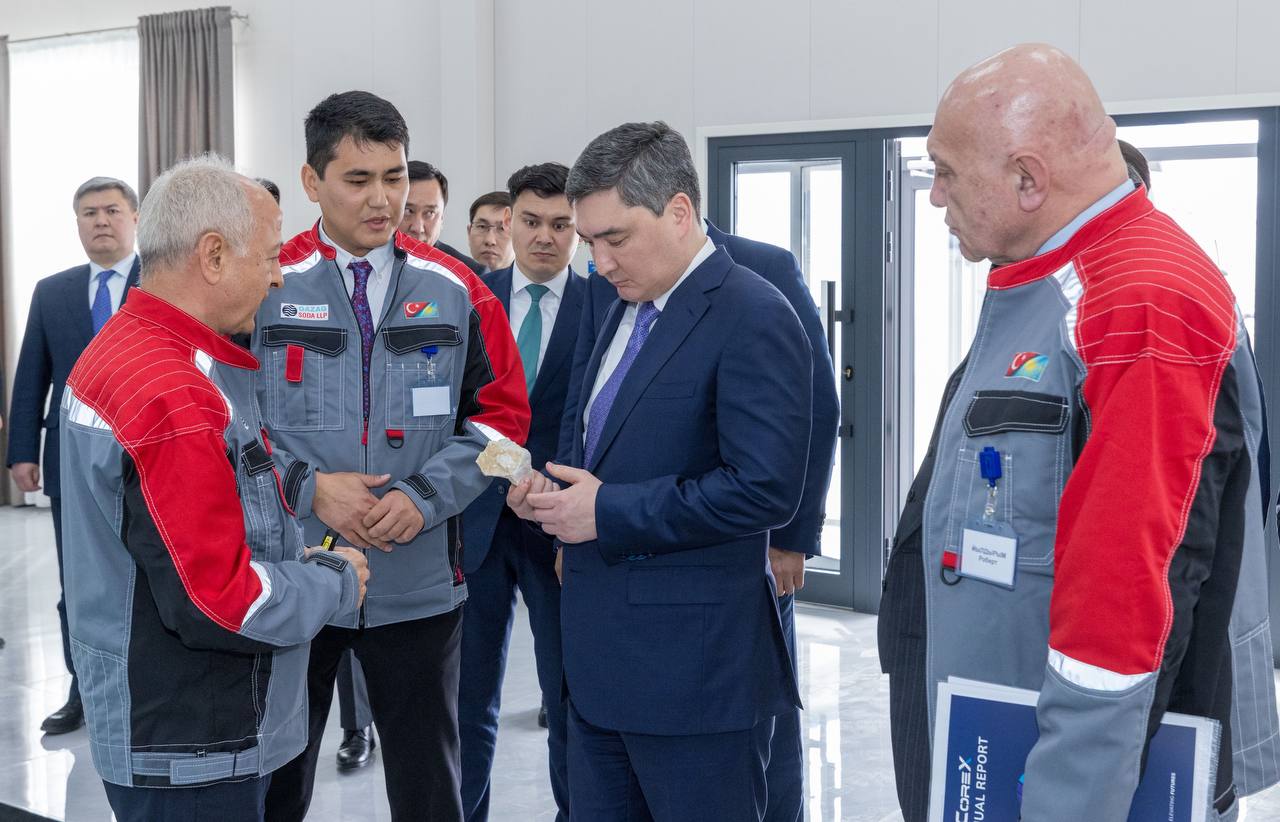

ASTANA, Kazakhstan, April 17. During a working visit to the Zhambyl region, Kazakhstan's Prime Minister, Olzhas Bektenov, reviewed the progress of various projects, including the construction of the "Qazaq Soda" plant in the Sarysu district, and checked the implementation of the President's instructions, Trend reports.
At the meeting, Ismail Jeylan, Executive Director of Yildirim Holding, and Ramazan Ibrahimov, Director of "Qazaq Soda," provided updates on the project. According to him, the plant, located on a 42-hectare site, will have an initial production capacity of 500,000 tons per year, with plans to expand to one million tons in the future.
"Calcined soda serves as a pivotal reagent across various sectors, including metallurgy, glass manufacturing, food processing, textile production, and chemical synthesis, in addition to its applications in domestic chemical formulations. At present, the annual consumption metrics for soda in Kazakhstan hover around the 350,000 to 400,000-ton threshold. This initiative aims to comprehensively supplant imports while strategically facilitating export opportunities to the CIS and the People's Republic of China," the Kazakh premier's press service stated.
Construction and installation work is currently 30 percent complete, and the main equipment is being delivered. The plant is scheduled to begin operations in August 2026. The project will create 1,000 jobs, including 400 permanent positions. The total investment in the project is approximately $400 million.
The prime minister emphasized the importance of timely project completion, which will position Kazakhstan among the world’s top producers of calcined soda, reduce reliance on imports, and foster the growth of the country's chemical industry. By carrying out this project, Kazakhstan will join the ranks of leading global soda producers such as China, Türkiye, the US, and Russia.
In total, 18 participants are registered in the Zhambyl Region’s SEZ. By the end of 2024, investment in the region is expected to reach 506 billion tenge (approx. $961.4 million), with growth projected to approximately 850 billion tenge (approx. $1.615 billion) in 2025 due to the construction of nine projects.



