


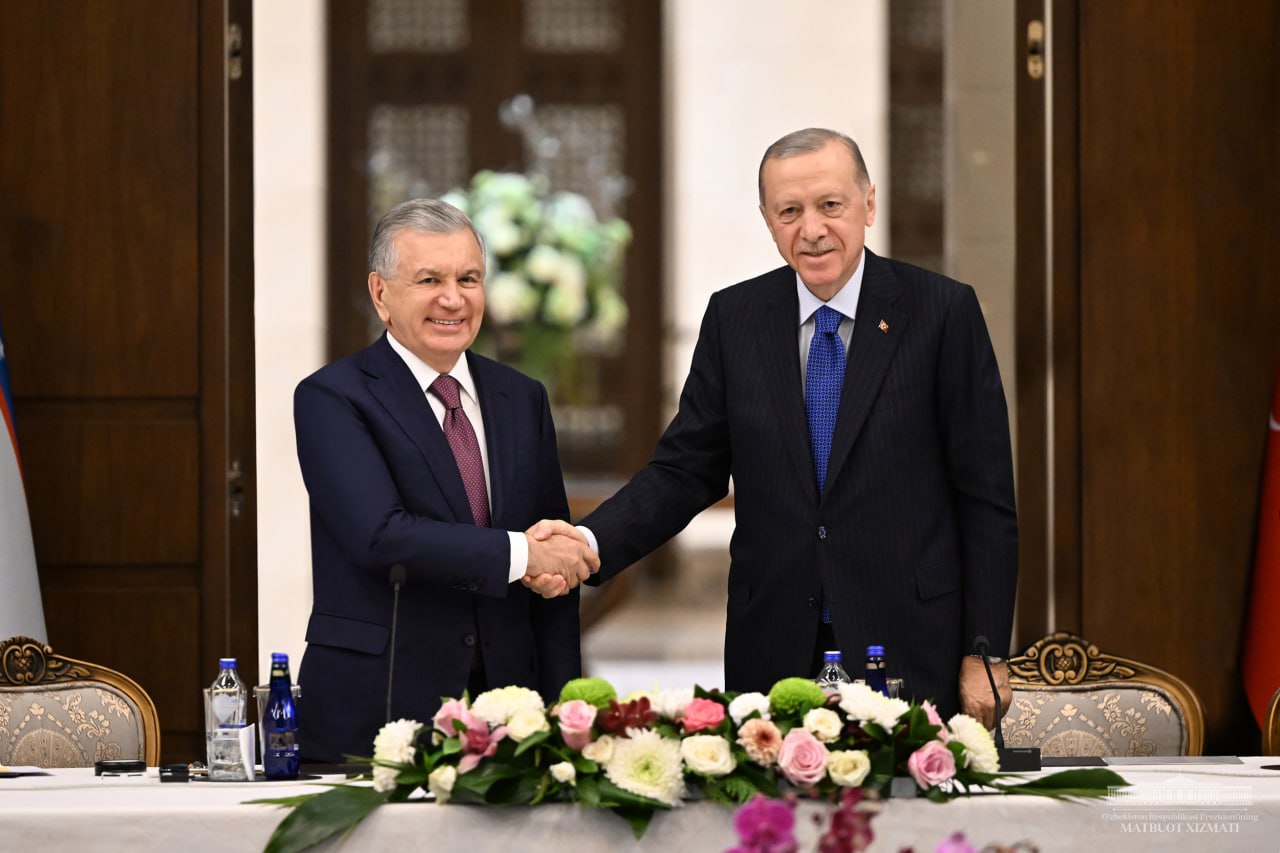

BAKU, Azerbaijan, January 28. President of Uzbekistan Shavkat Mirziyoyev will pay an official visit to Türkiye on January 29 to take part in the fourth meeting of the High-Level Strategic Cooperation Council.
In recent years, the council format has become the main institutional mechanism driving the development of Uzbek–Turkish relations. Each meeting has been accompanied by the signing of significant agreements in trade and economic cooperation, investment, energy, and transport, laying the groundwork for a long-term partnership.
Previously, the president of Uzbekistan emphasized that the establishment of the Strategic Cooperation Council marked an important milestone in the development of bilateral relations.
“The establishment of the Strategic Cooperation Council opened a new chapter in the history of Uzbek–Turkish relations and gave a strong impetus to the further development of partnership across all areas,” Mirziyoyev said following the third meeting of the High-Level Council.
Expectations for the upcoming summit in Ankara remain high. The forthcoming summit in Ankara is expected to focus on further expanding trade, strengthening cooperation in energy and transport, and enhancing regional connectivity between Central Asia and international markets via Türkiye.
Meanwhile, during the previous Council meeting held in June 2024, the presidents of Uzbekistan and Türkiye signed a Joint Declaration on Deepening the Comprehensive Strategic Partnership, along with 19 bilateral documents. At that moment, both parties pointed out that in recent years, bilateral trade had surged by 1.5 times, the number of joint ventures had doubled, Turkish investments in Uzbekistan’s economy had skyrocketed by 2.5 times, and tourist arrivals from Türkiye had tripled.
At the same time, current trade dynamics point to a slowdown in growth. Türkiye remains one of Uzbekistan’s largest trading partners and consistently ranks fourth; however, according to the results of 2025, bilateral trade amounted to $3.03 billion. Data from the Statistics Committee show that this figure was slightly below the 2024 level and declined compared to 2023. This suggests that the previous model of trade expansion, largely based on the exchange of finished goods, is gradually reaching its limits.
Against this backdrop, the objective of increasing bilateral trade to a higher level takes on a qualitatively different meaning. The focus is not merely on boosting volumes but on developing industrial cooperation, expanding localization of high value-added production, and building joint supply chains. This strategy would pave the way for Uzbekistan to boost its exports of processed goods and generate new employment opportunities, while also helping Türkiye to solidify its manufacturing foothold in Central Asia and tap into third-country markets through collaborative ventures.
Additional momentum could come from reduced customs tariffs under the Preferential Trade Agreement and the opening of Uzbekistan’s trade representation office in Istanbul.
For Türkiye, Uzbekistan represents a fast-growing market and a production base in Central Asia. For Uzbekistan, in turn, Türkiye serves as a source of investment, technology, and managerial expertise, as well as an important gateway to international markets. The most promising areas of cooperation include textiles, agribusiness, construction, and manufacturing.
Energy remains one of the key pillars of bilateral cooperation. Uzbekistan’s economy continues to demonstrate steady growth, accompanied by a constant increase in electricity demand. Industrial development, digital projects, and population growth are placing growing pressure on the energy system each year, much of which was built decades ago. In this context, priorities include not only commissioning new capacity but also modernizing the entire energy infrastructure.
A number of Turkish firms are actively participating in these endeavors, and Uzbekistan has previously launched initiatives to construct modern power plants with a combined investment of around $1 billion and a total capacity of about 1.8 GW, in collaboration with Turkish partners. Uzbekistan’s Minister of Energy, Zhurabek Mirzamakhmudov, has previously emphasized that cooperation with Türkiye in the energy sector continues to expand.
“The Turkish companies were among the first to actively support Uzbekistan’s reforms, including the implementation of the country’s first public-private partnership projects,” he noted.
A landmark step in this direction was the decision to transfer the management of electricity distribution networks in the Samarkand region to the Turkish company Aksa Enerji. This marks the country’s first large-scale public-private partnership involving a private operator in electricity distribution. The project covers the design, financing, modernization, and operation of over 30,000 kilometers of distribution networks, many of which were once thought to be past their prime. The project is expected to reduce power losses, improve reliability of electricity supply, and ease pressure on the state budget.
In addition, Turkish company Cengiz Enerji is implementing a project to build a 240 MW thermal power plant in the Tashkent region, aimed at meeting rising electricity demand and enhancing the country’s energy resilience.
Transport is another important area of cooperation. For landlocked Uzbekistan, developing alternative routes and diversifying logistics corridors is of strategic importance. Türkiye, for its part, views cooperation with Uzbekistan as part of a broader effort to strengthen its role as a transit hub between Asia and Europe.
In this context, the two sides are discussing prospects for expanding the international multimodal transport corridor along the Uzbekistan-Turkmenistan-Iran-Türkiye route. The project is envisaged under a protocol signed at the 12th meeting of transport ministers of the Economic Cooperation Organization, held in November 2023 in Tashkent.
This route's development will allow Uzbekistan to broaden its export and transit avenues, gaining greater access to Middle Eastern and European markets. For Türkiye, it signifies a boost in transit traffic and improved logistics capabilities.
Overall, cooperation between Uzbekistan and Türkiye now spans a growing range of sectors, from trade and industry to energy, transport, investment, and tourism. For Uzbekistan, the partnership brings capital inflows, access to technology, and expanded access to foreign markets. For Türkiye, it strengthens economic presence in Central Asia and participation in major infrastructure projects.
The upcoming visit of Mirziyoyev to Ankara could give additional momentum to Uzbek-Turkish cooperation, shifting the focus from simple growth in indicators toward scaling projects and deepening cooperation in industry, energy, and transport infrastructure.
Stay up-to-date with more news on Trend News Agency's WhatsApp channel



