


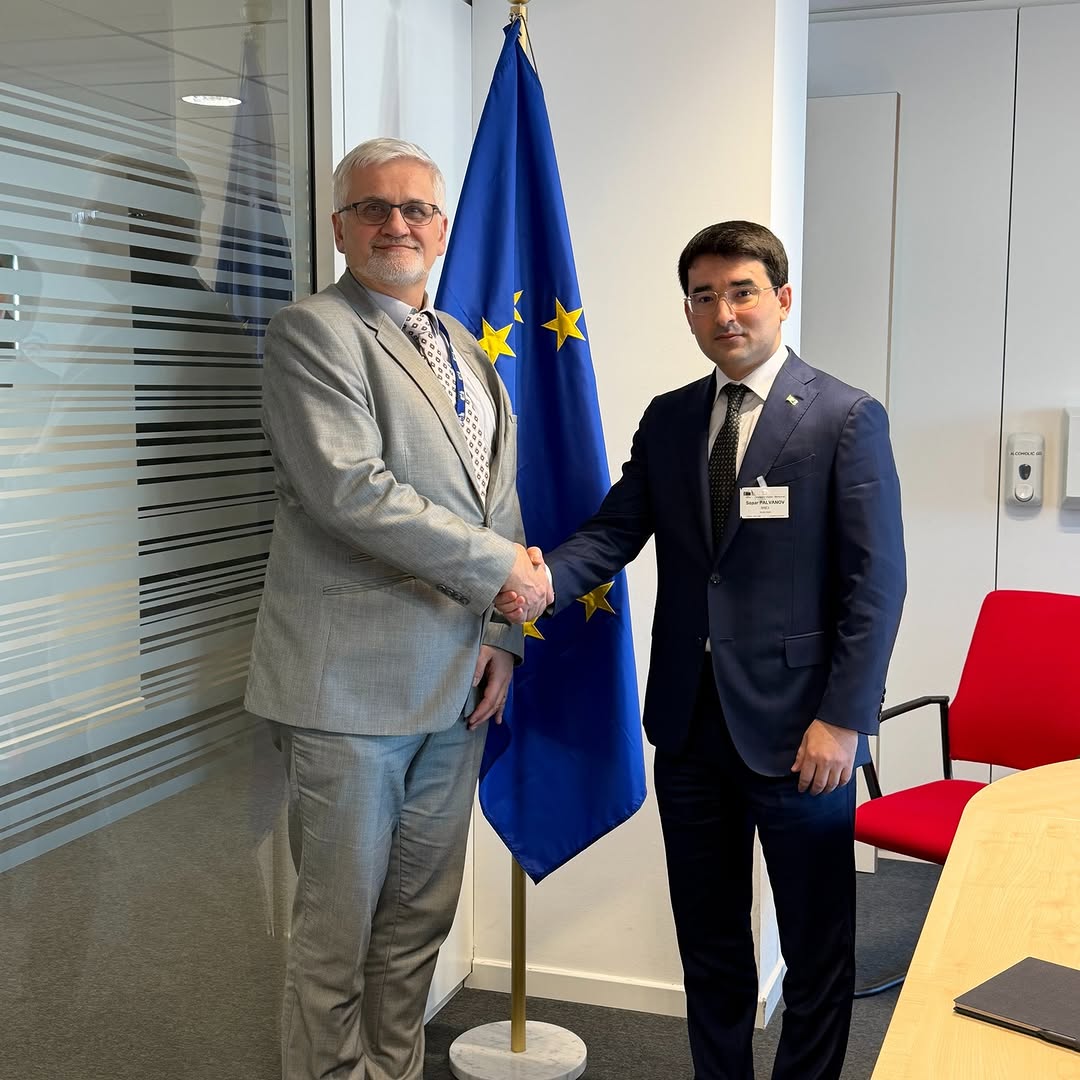

ASHGABAT, Turkmenistan, February 27. The European direction is among the key priorities of Turkmenistan’s foreign policy for 2026, Turkmen Ambassador to Belgium Sapar Palvanov said, Trend reports via the Turkmen Embassy in Brussels.
Ambassador Palvanov made this statement during a meeting with Jan Dusik, Deputy Director-General of the European Commission’s Directorate-General for Climate Action.
The discussions emphasized climate and energy as pivotal areas for bilateral cooperation between Turkmenistan and the European Union.
Palvanov highlighted Turkmenistan's role as a significant energy producer and its commitment to environmental protection and sustainable development. This includes Turkmenistan’s recent accession to the Global Methane Pledge, announced at COP28, and its active participation in the Paris Climate Agreement. These initiatives provide a robust political framework for enhancing cooperation with the EU on methane emission reduction, climate adaptation, and environmental modernization.
Further discussions centered on the EU’s “Green Turkmenistan: Political Dialogue and Climate Action 2024-2028” program, which is being implemented with European and German support. Ambassador Palvanov underscored the program’s practical approach and the tangible outcomes achieved thus far, including the introduction of emission monitoring mechanisms and efforts to increase environmental awareness.
The sides agreed on the importance of expanding cooperation through joint projects, expert exchanges, and the existing EU-Central Asia regional frameworks. They reaffirmed that climate policy remains a strategic priority for the EU, with a particular focus on long-term emission reduction targets and carbon removal initiatives.
Furthermore, Ambassador Palvanov addressed regional priorities, including water resource management, climate adaptation, Caspian Sea level issues, and the exchange of modern environmental technologies. In this context, he introduced Turkmenistan’s proposal to establish a Regional Center for Environmental Technologies in Central Asia.
The prospects for the development of solar energy and cross-border energy infrastructure were also discussed. The European side positively assessed Turkmenistan's potential in the context of growing demand for environmentally friendly electricity.
The interlocutors confirmed that the strengthening of the strategic partnership between the EU and Central Asia should be accompanied by the expansion of specific bilateral cooperation between Turkmenistan and the European Union.



