


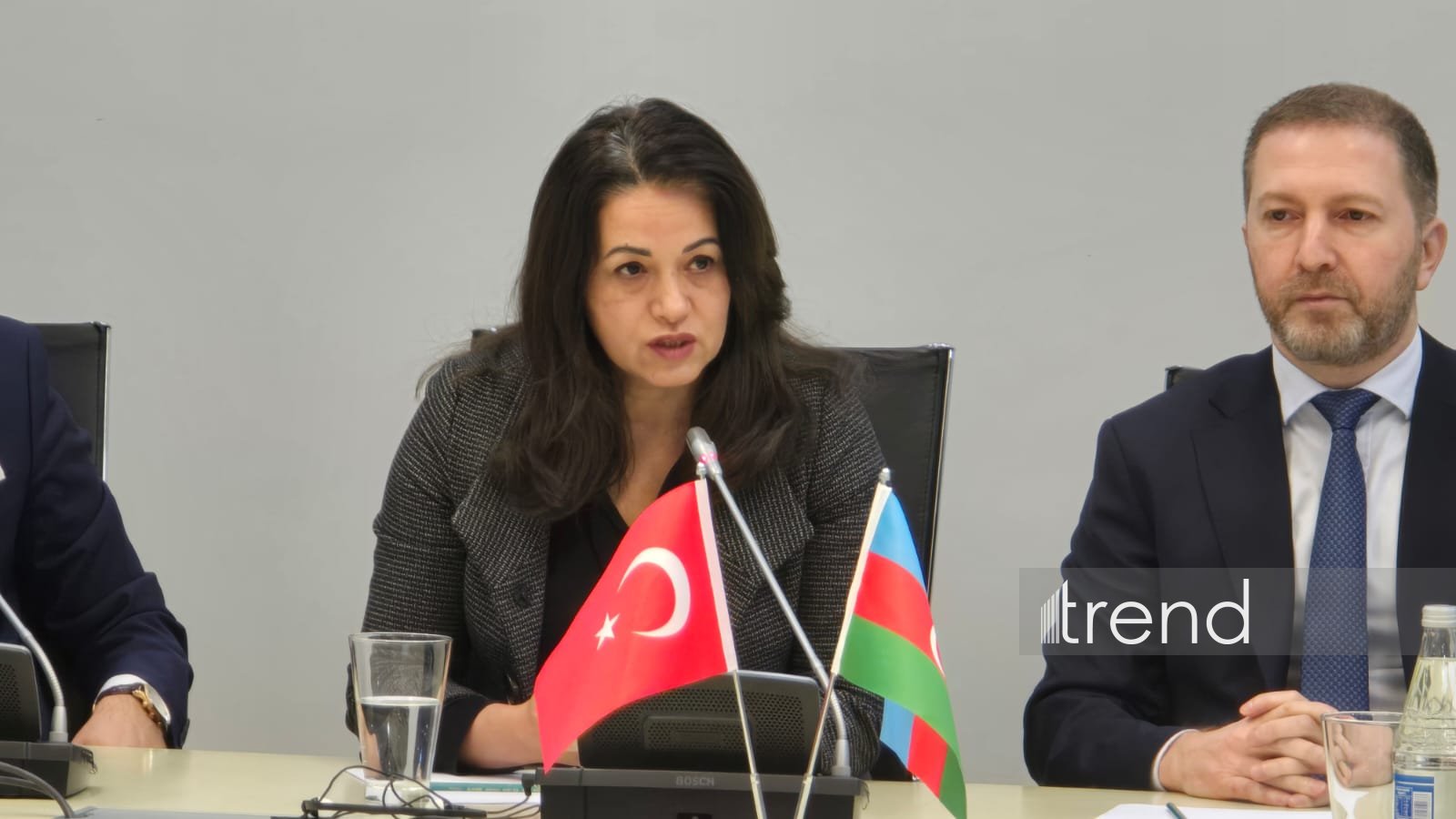

BAKU, Azerbaijan, December 26. Türkiye targets to achieve a free trade agreement with Azerbaijan based on mutual concessions and creating broader opportunities, the Chief Trade Counselor of the Turkish Embassy in Azerbaijan, Gulizar Yavas, said at an event held in Baku today on the topic "Access to the Turkish market: export, legal, and practical aspects," Trend reports.
She noted that, overall, the energy sector accounts for a large part of the approximately $8 billion trade turnover between Azerbaijan and Türkiye.
"As the Turkish side, our desire is that the existing bilateral relations, alliances, and brotherly ties between our countries be realistically reflected in trade and investments.
The main task of both offices is to develop cooperation in this area, and all our responsibilities continue in this direction. Currently, there is no free trade agreement between Türkiye and Azerbaijan. Although discussions are ongoing, there is a preferential trade agreement that is currently in force. Within the framework of this agreement, the list, which initially included 30 products, was later expanded to 50 products. The main part of the list is agricultural products. The demands of the Azerbaijani side were also focused mainly on agricultural products. Moreover, some industrial products were also included in the list.
Within the framework of the special agreement on Karabakh, there is a separate list of products that can be imported by Türkiye with unilateral concessions, tax reductions, or zero customs duties. Since this is a special agreement, it is impossible to find it in open sources," she explained.
Besides, she recalled that the 12th meeting of the Joint Intergovernmental Commission on Economic Cooperation between Azerbaijan and Türkiye was held in Baku.
"A 110-item action plan was signed at that meeting. This plan, in addition to covering the work done in the previous period, also defines the goals for the next year. It envisages cooperation directions and specific measures in energy, education, trade, and other fields.
This means that as cooperation between the two countries expands in transport, energy, and other fields, it is expected to have a positive impact on trade turnover because this cooperation also covers raw material supplies, investments, and trade in services. Trade is no longer limited to goods, but trade in goods and services is considered together," Yavas noted.
The embassy official emphasized the very high interest in Azerbaijan from Türkiye.
"Since I took office, we have received 12 business delegations in just five months. One of them was a delegation from the Istanbul Chamber of Industry (ISO). Approximately 70 percent of Turkish production is carried out by these industrialists. Last month, they visited Azerbaijan with a delegation of about 150. This group brought together Türkiye's largest investors, industrialists, exporters, and importers.
Many of them said that they were visiting the Azerbaijani market for the first time. This also shows that Azerbaijan is becoming an increasingly attractive market. As the interest of Turkish businessmen increases, it's inevitable that Azerbaijani entrepreneurs will also increase their interest in cooperation with Türkiye because these relations should be based on long-term and sustainable cooperation, not short-term purchases and sales.
Our offices are trying to support entrepreneurs from both countries in establishing these relations and solving existing problems. We consider it important to create joint mechanisms for this purpose. On December 1, this issue was also discussed at the meeting with Minister of Economy of Azerbaijan Mikayil Jabbarov, and the establishment of a technical working group was proposed. The goal is both to develop bilateral investment and trade relations and, if necessary, to explore opportunities for joint cooperation in third countries," she announced.
Yavas noted that, according to observations, Azerbaijan's production and export potential, especially in the agricultural sector, coincides with the areas that Türkiye protects the most.
"In terms of industrial products, price competition with China remains a serious problem for both Azerbaijan and Türkiye. For this reason, it is sometimes difficult to obtain any price advantage in mutual trade. Türkiye has a Customs Union agreement with the European Union, and within this framework, customs duties on many products for 27 countries have been zeroed. This means that products entering the Turkish market from Azerbaijan have to compete with products from those countries under zero duties. At the same time, Türkiye also has numerous free trade agreements with Egypt, Morocco, and other countries.
Our goal is to achieve a free trade agreement with Azerbaijan based on mutual concessions and creating broader opportunities.
Such accords provide a more expansive array of advantages compared to preferential trade pacts. However, there are a number of issues that sectors and government agencies of both countries must agree on for this.
The initial discussions began in 2024 and moved to the technical phase in 2025. If the main negotiations begin in 2026, it will be possible to achieve significant progress in this long-term process. There are serious concessions unilaterally offered by Türkiye, especially regarding the reconstructed regions, including Karabakh. Significant advantages have been created for the export of products produced in Karabakh to the Turkish market," she concluded.
Stay up-to-date with more news on Trend News Agency's WhatsApp channel



