


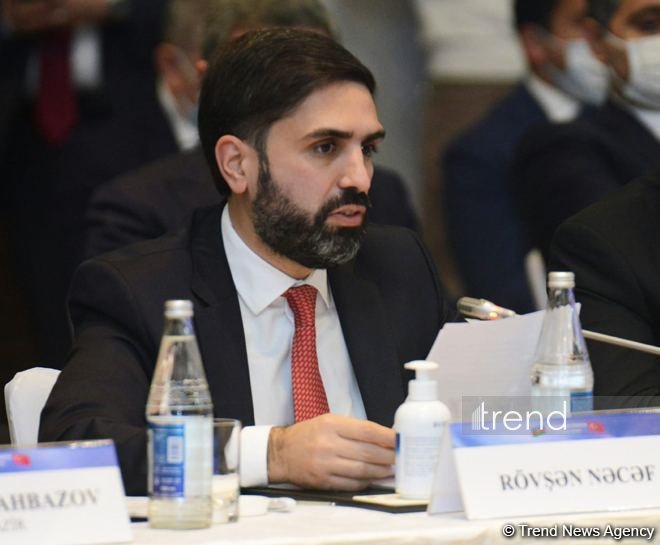

BAKU, Azerbaijan, January 8. Azerbaijan is strengthening its position as a future hub for cross-border clean energy transmission through the development of so-called green energy corridors, Rovshan Najaf, President of the State Oil Company of the Azerbaijan Republic (SOCAR), said in an article published on the website of the World Economic Forum, Trend reports.
The article notes that the combined capacity of three green energy corridors, the Caspian–Black Sea–Europe corridor, the Azerbaijan–Türkiye–Europe corridor, and the Central Asia–Azerbaijan–Europe corridor, could reach up to ten gigawatts of renewable energy, significantly reinforcing Azerbaijan’s role in the transnational transmission of clean energy.
According to the publication, global energy supply increased by 13% from 2014 through 2023, driven by steadily growing demand.
“Industrialization, population growth, and economic development will further increase demand over the next twenty-five years, particularly from developing countries and Asian economies outside the Organisation for Economic Co-operation and Development (OECD). This growth has also led to a 77% rise in global carbon dioxide emissions since 1990, underscoring the urgent need for coordinated action. In response, more than 140 countries have adopted carbon neutrality targets, covering the majority of global emissions. A practical approach includes rapidly scaling up clean energy and energy efficiency while reducing the environmental footprint of the existing system. Since climate change knows no borders, collective cooperation is essential for a just transition,” the article states.
Against this backdrop of global uncertainty and geopolitical tension, Najaf said energy security and climate resilience have emerged as central pillars of Azerbaijan’s national strategy, shaping a transition that blends renewable energy development with system reliability and economic stability.
“The country has incorporated the goal of ‘Clean Environment and Green Growth’ into the Azerbaijan 2030 strategy, with a strong focus on renewable energy development. The Energy Efficiency Fund supports initiatives that reduce environmental impact and improve sector efficiency by offering loans, grants, and subsidies. While continuing to rely on its hydrocarbon sector, Azerbaijan is simultaneously advancing renewable energy development. As a net electricity exporter since 2007, the country has strengthened energy security by modernizing generation facilities and reinforcing transmission networks. By 2023, electricity generation reached 29.3 billion kilowatt-hours, representing a 25.5% increase compared to the previous decade,” the article notes.
The publication also recalls that under the Strategic Roadmap adopted in 2016, the government committed to diversifying the energy mix and expanding power generation from renewable sources.
Najaf noted that Azerbaijan’s technical potential for renewable energy is substantial, estimated at 135 gigawatts onshore and 157 gigawatts offshore.
As part of its long-term ambitions, Azerbaijan aims to lift the share of renewables in its electricity generation mix to nearly 40% by 2030.
The article outlines significant progress achieved over the past 5 years in deploying renewable energy projects. These include the Garadagh solar power plant with a capacity of 230 megawatts, the largest solar facility in the Caspian region, commissioned in 2023; hydropower projects in Karabakh and East Zangezur, where 32 stations with a combined capacity of 270 megawatts have been commissioned, with plans to expand to 500 megawatts; the Khizi–Absheron wind power plant with a capacity of 240 megawatts, being developed by ACWA Power and SOCAR, with full capacity expected by the end of 2025; the Bilasuvar and Neftchala solar projects with capacities of 445 megawatts and 315 megawatts, respectively, which reached financial close at COP 29 and are expected to generate more than 1.7 billion kilowatt-hours annually; and the Shafag solar power plant with a capacity of 240 megawatts, the first industrial-scale solar project in the liberated territories, with an expected annual output of 500 million kilowatt-hours.
Data from the State Statistics Committee of Azerbaijan shows a remarkable surge in renewable energy over the past five years, with electricity production from hydropower plants rising 2.8-fold and solar generation expanding more than 12.6-fold.
“National transition strategies can deliver regional decarbonization benefits beyond national borders. Given its strategic geographic location, existing transmission infrastructure, and established energy partnerships, Azerbaijan is uniquely positioned as a bridge between the Caspian region, Central Asia, and Europe,” the article states.
The article adds that Azerbaijan is actively developing three main green energy corridors: Caspian–Black Sea–Europe, Azerbaijan–Türkiye–Europe, and Central Asia–Azerbaijan–Europe.
In 2022, the signing in Bucharest of the Strategic Partnership Agreement on the development and transmission of green energy between Azerbaijan, Georgia, Romania, and Hungary marked a significant step toward opening a green energy corridor to Europe, the article concludes.
Stay up-to-date with more news on Trend News Agency's WhatsApp channel



