


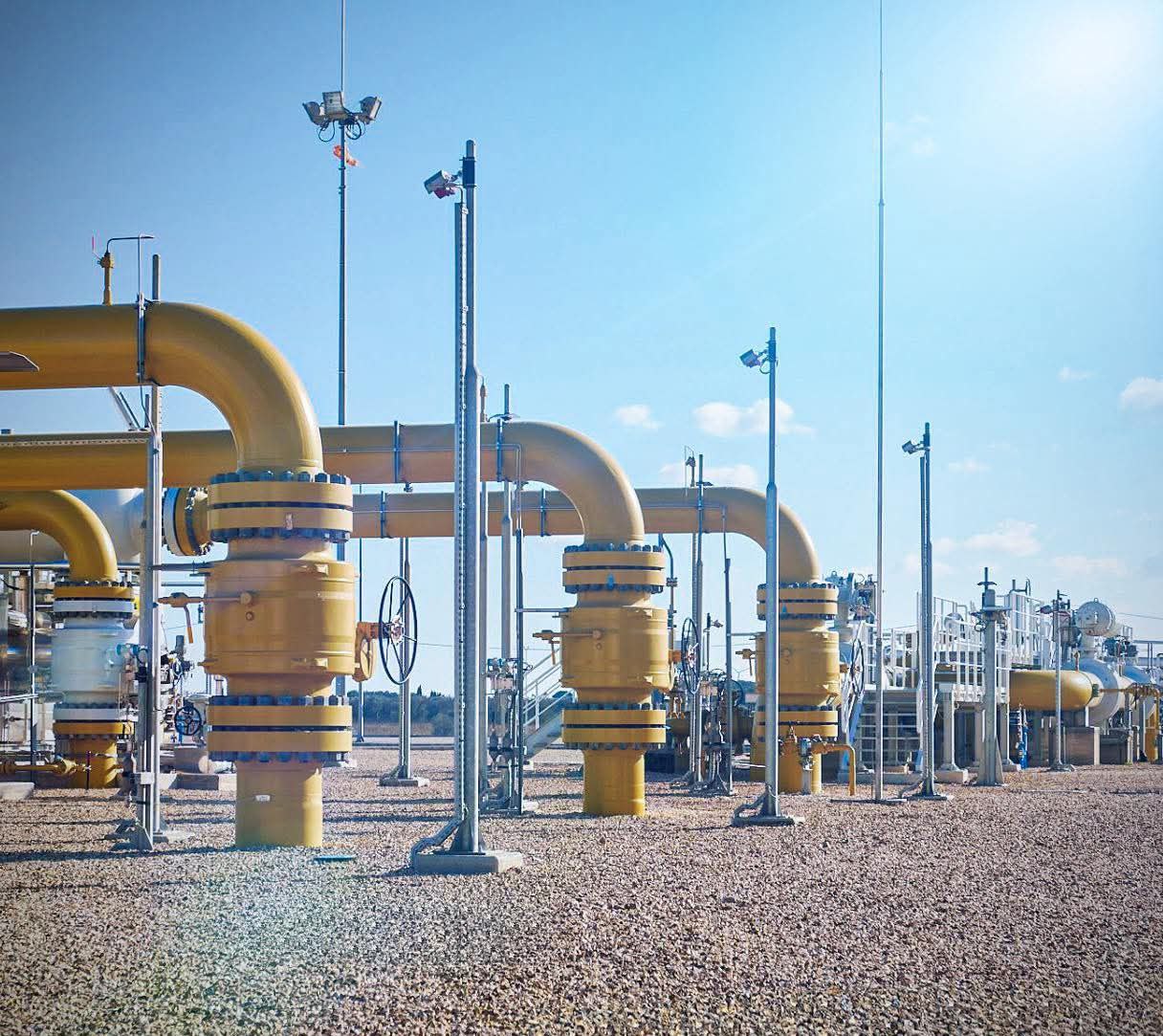

BAKU, Azerbaijan, January 17. The State Oil Company of Azerbaijan (SOCAR) has begun supplying Azerbaijani natural gas to Austria and Germany through Italy starting from January 2026, marking a significant milestone in the evolution of the European gas market. These supplies not only expand the geographical presence of Azerbaijani gas on the continent, increasing the number of purchasing countries to sixteen, but also form part of a broader strategy to diversify energy sources and supply routes. Against the backdrop of the European Union's decision to fully cease Russian gas imports by the end of 2027, these new supply routes play a key role in enhancing energy security, reducing dependency on historically dominant suppliers, and minimizing risks associated with geopolitical instability.
Statistics published by the independent regulator E-Control show that Austria's physical gas imports from neighboring countries in October 2025 amounted to approximately 12.3 TWh, which is a 10.5% increase compared to October 2024. Meanwhile, exports rose by 65.4% to 6.8 TWh. As a result, net imports decreased by 21.7% to 1.52 TWh compared to the previous year. These figures reflect growing activity in the Austrian market, which, in light of the cessation of supplies via the Baumgarten hub, has intensified imports through Western European routes. The increased gas storage injections and rising supply levels highlight that Austria is successfully adapting to new market realities, compensating for the reduction of traditional sources.
Along with the rise in imports, Gas Connect Austria reports significantly higher consumption levels in 2025 compared to the previous year, especially during the winter months. From January through August 2025, gas consumption reached 50.39 TWh, 15.5% higher than the same period in 2024, with peak demand occurring in February and March when temperatures were moderately below long-term averages. This suggests that, despite the advancement of energy efficiency programs and the development of renewable energy sources, natural gas continues to play a vital role in the country's energy balance, particularly during peak demand periods.
A critical element of these changes has been the active use of the West Austria Gas Pipeline (WAG). After the cessation of supplies through Baumgarten, Austria began meeting its needs primarily through the western entry at Oberkappel, with supplies from Germany sharply increasing: from July through September 2025, this route delivered 20.47 TWh of gas, compared to just 2.26 TWh the year before. Gas supplies from Italy via the international interconnection point Arnoldstein/TAG also increased, though they remained relatively moderate at around 2.8 TWh.
Furthermore, Austria significantly boosted gas exports eastward, through the Mosonmagyaróvár exit point to Hungary, where deliveries grew from 0.05 TWh in 2024 to 7.59 TWh in the same period of 2025. The increase in transit activity indicates that Austria's gas infrastructure not only meets domestic needs but also serves as a crucial transit hub within the regional energy system.
The situation in Germany, Europe's largest economy, also reflects substantial changes in the gas market structure. According to preliminary data from Bundesnetzagentur, Germany's gas import flows in 2025 reached 1,031 TWh, a 19.3% increase from 864 TWh in the previous year. The main sources of supply were Norway (44%), the Netherlands (24%), and Belgium (21%). The increase in liquefied natural gas (LNG) deliveries to 106 TWh (approximately 10.3% of total supplies) reflects the growing contribution of the global gas market to Germany's energy security, providing an additional buffer against seasonal and geopolitical risks. In terms of overall consumption in 2025, German households and the commercial sector accounted for about 40% of the demand, while industry accounted for the remaining 60%. The total consumption reached almost 864 TWh, a 2.2% increase from 2024. These trends reflect the resilience of domestic gas demand despite climate fluctuations and the rising share of alternative energy sources.
Against the backdrop of these dynamic changes, Azerbaijan is increasingly becoming a significant and reliable gas supplier to European markets. In 2025, the country produced 51.5 billion cubic meters (bcm) of natural gas, of which 27.9 bcm came from the large Shah Deniz field, 14.1 bcm from the Azeri-Chirag-Gunashli block, 1.6 bcm from the Absheron field, and 7.9 bcm from SOCAR. Total exports amounted to 25.2 bcm, including 12.8 bcm to Europe, 9.6 bcm to Türkiye (of which 5.6 bcm via TANAP), 2.3 bcm to Georgia, and 0.5 bcm to Syria. The European segment of the Southern Gas Corridor — the Trans-Adriatic Pipeline (TAP) — has so far delivered over 54.3 bcm of gas to EU countries, significantly contributing to supply diversification and strengthening energy security.
As representatives of the European Commission highlighted in an interview with Trend, the development of TAP has not only strengthened the stability of European energy markets and reduced dependence on politically vulnerable suppliers but has also promoted economic growth in transit countries such as Greece and Italy, through job creation and enhanced regional integration.
Considering the European Union's decision to completely phase out Russian gas imports by September 30, 2027, with a possible extension until October 31, 2027, in exceptional cases, infrastructure changes and new supply routes are becoming critically important. Specifically, the regulation foresees a gradual cessation of Russian gas imports starting in the spring of 2026, increasing the need for sustainable alternative sources. In this regard, the delivery of Azerbaijani gas to Austria and Germany clearly demonstrates how regional energy strategies and supply diversification contribute to reducing systemic risks.
Looking ahead, the key issue lies not only in maintaining supply volumes but also in developing infrastructure capable of ensuring flexibility and resilience in the face of intensifying competition for energy resources and changing climate demands. Projects aimed at expanding the capacity of Western routes, such as the expansion of the WAG Loop, as well as strengthening the integration of European gas transport networks, will play an increasingly important role in ensuring energy stability. In the medium term, this could open up additional opportunities for increasing the share of gas from Azerbaijan and other regions, strengthening the position of Central and Eastern European countries in the energy market.
Against this backdrop, it's becoming clear that Azerbaijan is not only expanding its supply geography but also building trust with European consumers as a reliable energy supplier capable of adapting to the rapidly changing geopolitical and market environment. New routes and increased deliveries mark a broader transformation of the European energy landscape, shifting from dependence on a limited number of suppliers to a more diversified, resilient, and integrated supply system.



