


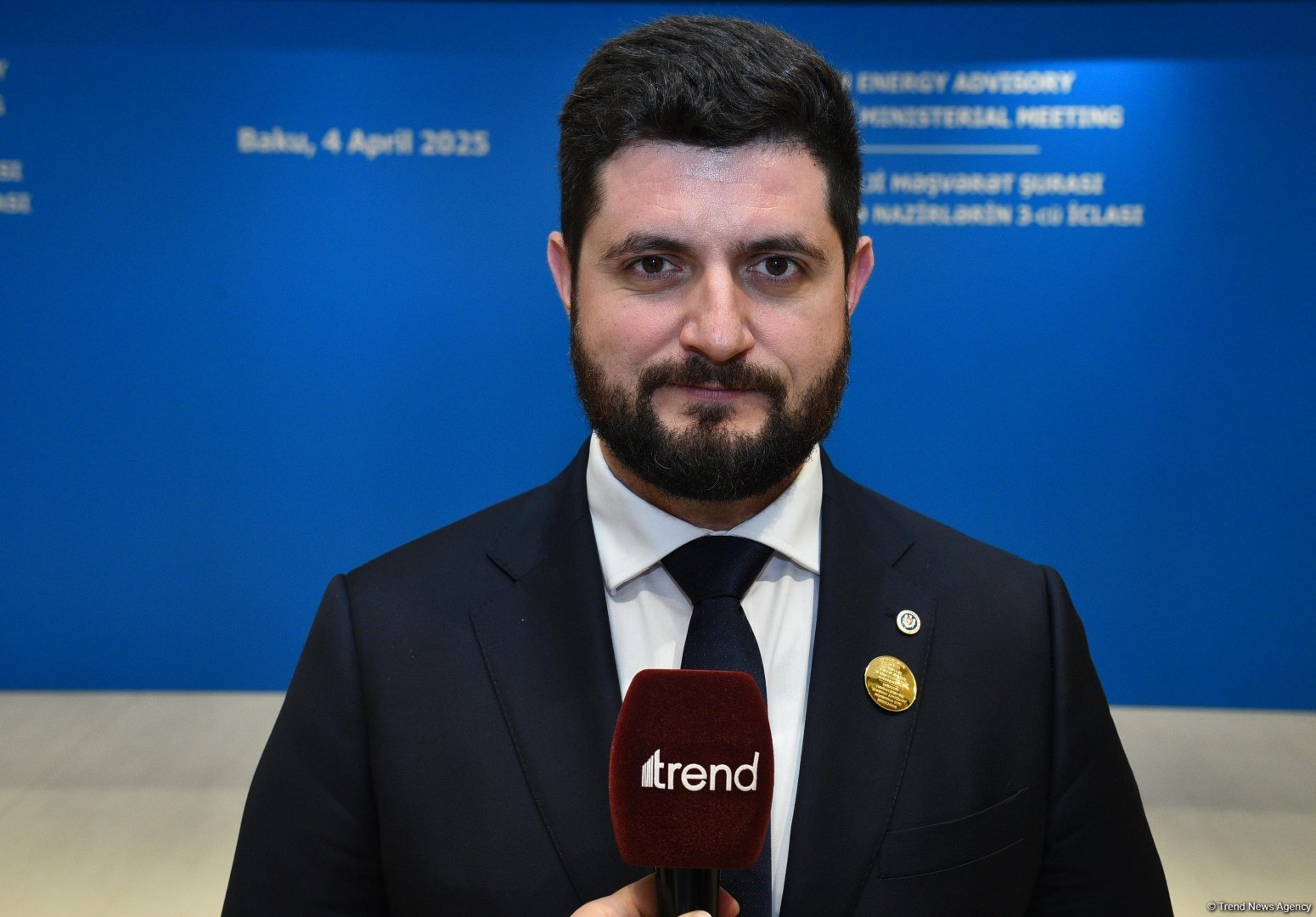

BAKU, Azerbaijan, March 3. Moldova is interested in attracting investments from Azerbaijan in petroleum product storage infrastructure, Moldova’s Minister of Energy Dorin Junghietu said in an exclusive interview with Trend ahead of the 12th Ministerial Meeting of the Southern Gas Corridor Advisory Council in Baku.
“Given the considerable efforts undertaken by the Republic of Moldova to diversify its natural gas supply routes, Republic of Azerbaijan represents a potential strategic partner for our country,” he said.
In this context, Junghietu noted that in line with the objectives pursued during his participation in the 12th Ministerial Meeting of the Southern Gas Corridor Advisory Council, one of the priorities is to strengthen energy ties with Azerbaijan, including exploring potential cooperation with SOCAR regarding the export of natural gas and petroleum products.
“The Republic of Moldova is open to expanding cooperation with Republic of Azerbaijan beyond natural gas supplies, including in the field of energy infrastructure and joint projects. One area with concrete potential for cooperation is the petroleum products sector, particularly the storage of petroleum products,” said the minister.
He pointed out that in this context, the Republic of Moldova is in the process of transposing Directive 2009/119/EC on the obligation to maintain minimum stocks of crude oil and/or petroleum products, which entails developing adequate storage capacities and appropriate institutional mechanisms.
“The implementation of this framework creates opportunities for foreign investment and partnerships with international actors that have relevant experience in the field,” Junghietu added.
The minister noted that the authorities of the Republic of Moldova are interested in attracting investments from Republic of Azerbaijan in petroleum product storage infrastructure, as well as in other related energy projects, under transparent and competitive market conditions aligned with European standards.
“Such initiatives would contribute both to strengthening the Republic of Moldova’s energy security and to diversifying bilateral economic cooperation. The Republic of Moldova is looking for a strategic investor, given that Lukoil will exit the petroleum products market. In this context, Republic of Moldova encourages Azerbaijani companies, such as SOCAR, to explore the opportunities available on the national market. It is essential that the new investors integrate with existing partners and contributes to the development of the country's energy infrastructure. SOCAR, recognized as a reliable business partner, provides high-quality services and adheres to rigorous safety standards in the petroleum products sector. The proposed collaboration could also include exchanges of information on the investment climate in the energy sector of the Republic of Moldova, with the aim of attracting new investments and facilitating strategic partnerships between the two states,” he added.
The minister recalled that on an official visit to Baku for the 11th Ministerial Meeting of the Southern Gas Corridor Advisory Council, he held a series of high-level meetings.
“Discussions focused on opportunities for cooperation in the energy sector, with a particular emphasis on diversifying natural gas supply sources and implementing modern technologies for electricity generation and distribution,” he said.
During the meeting with Rovshan Najaf, President of the State Oil Company of the Republic of Azerbaijan (SOCAR), Minister Dorin Junghietu underlined the Republic of Moldova’s interest in diversifying energy sources and in importing petroleum products and natural gas from Republic of Azerbaijan. The Minister also discussed attracting investments from Azerbaijani companies into Republic of Moldova’s energy market, noting that mutually beneficial cooperation opportunities are available.
“At the same time, the petroleum products market in the Republic of Moldova is a liberalized, open, and competitive market that allows access for all suppliers that meet the applicable legal and regulatory requirements. In this regard, the market is also open to suppliers of petroleum products from Republic of Azerbaijan. The supply of petroleum products is carried out on a commercial basis, in line with market conditions, and the state does not conclude long-term supply contracts for petroleum products. Decisions regarding the import of petroleum products, including from Republic of Azerbaijan, are taken by private economic operators, which are free to choose their sources of supply based on economic and logistical considerations,” Junghietu explained.
He pointed out that the authorities of the Republic of Moldova ensure the necessary regulatory and institutional framework for the efficient functioning of the market and for the diversification of supply sources, including by creating favorable conditions for the entry of new suppliers, in accordance with European standards.
Prospects for long term gas contracts
Junghietu said that the Republic of Moldova, through its state-owned energy trader JSC „Energocom”, maintains an ongoing and constructive dialogue with Azerbaijan’s state oil company SOCAR.
He noted that at present, JSC „Energocom”, has a framework agreement in place with SOCAR that establishes general commercial terms and allows for transactions on a spot or short-term basis, depending on market conditions.
“In this context, companies are already able to trade gas volumes flexibly in line with prevailing market conjunctures. At the same time, the main limiting factor for economically viable gas procurement from Republic of Azerbaijan, including on a potential long-term basis, remains logistics — specifically, the cost of transportation along the available routes. Current tariffs applied by transmission system operators along the relevant corridors are still significant and materially affect the price of gas delivered,” said the minister.
Junghietu pointed out that JSC „Energocom”, is closely monitoring developments related to the Trans-Balkan route and other regional transport corridors.
“Should further infrastructure optimization and tariff reductions improve the overall economics of transportation, JSC „Energocom” would be ready to consider advancing discussions on longer-term contractual arrangements, including with SOCAR. At this stage, however, no negotiations on a binding long-term gas supply contract have been finalized,” he said.
As for gas supplies via the Interconnector Greece-Bulgaria (IGB), the minister recalled that the National Agency for Energy Regulation (ANRE) decided, in November, to introduce two new special bundled cross-border capacity products – “Route 2” and “Route 3” – aimed at facilitating natural gas flows from Greece to Ukraine via the Trans-Balkan infrastructure.
“These products will be available for the period December 2025 – April 2026. This decision complements ANRE’s earlier decisions adopted in May and October 2025, which approved the proposal submitted by LLC „Vestmoldtransgaz” (Natural gas transmission system operator of the Republic of Moldova) to introduce the monthly capacity product “Route 1”, intended for the use of interconnection points along the Trans-Balkan pipeline connecting the natural gas transmission systems of Greece, Bulgaria, Romania, the Republic of Moldova, and Ukraine,” he said.
At the same time, Junghietu noted that the involved transmission system operators and national regulatory authorities agreed on the application of a 50% discount on the transport tariff, as a bundled product along the entire route.
“This measure is intended to facilitate the filling and utilization of gas storage facilities, as well as to cover Ukraine’s gas consumption needs during the winter period. Both the two special cross-border bundled capacity products — “Route 2” and “Route 3” — as well as “Route 1”, introduced earlier, represent concrete steps toward further integration of the Republic of Moldova with the European natural gas markets.
These initiatives aim to promote the use of the Trans-Balkan route as an integral part of the Vertical Gas Corridor. Depending on regional developments in the natural gas market, the Republic of Moldova remains open to all opportunities for further integration that can contribute to strengthening energy security, diversifying supply sources and routes, and increasing the resilience of the national energy system,” he added.
Moldova eyes joining green corridor from Azerbaijan to Europe
The minister said Moldova expresses its interest in the Green Energy Corridor project, a regional initiative aimed at exporting green electricity from Azerbaijan to European markets.
“Azerbaijan aims to achieve a renewable energy capacity of 6 GW by 2030, a goal that will transform the country into a regional green energy hub. This opens opportunities for deepening bilateral cooperation in the field of electricity, including through regional projects to transport green energy to Europe. In this context, the Republic of Moldova expresses its interest in the Green Energy Corridor project, a regional initiative aimed at exporting green electricity from the Republic of Azerbaijan to European markets, including through the Black Sea submarine electricity transmission cable project, enshrined in the Memorandum on the Development and Transmission of Green Energy, signed on December 17, 2022, by the governments of the Republic of Azerbaijan, Georgia, Romania, and Hungary,” he added.
The minister noted that in this regard, Moldova positions itself as a potential beneficiary, importer, and participant in the regional interconnection architecture and expresses its willingness to continue the dialogue with the Azerbaijani side and regional partners in order to examine its possible involvement in the project, given that, according to publicly available information, the expected transmission capacity in the first stage is up to 4 GW.
“Republic of Moldova's participation in these initiatives would help diversify electricity supply sources and strengthen national energy security. In this regard, the Moldovan side expresses its willingness to examine, together with the Azerbaijani side and relevant regional partners, options for technical and institutional cooperation, including the possibility of obtaining observer status within the project's coordination structures,” Junghietu said.
He also touched upon the issue of attracting investment in local green projects by connecting to Azerbaijani initiatives.
“Given the interest of companies such as Masdar and ACWA in the region, Republic of Moldova can promote its potential for solar and wind projects, possibly as complementary packages to large investments in Republic of Azerbaijan. For example, if Masdar develops 500 MW of solar power in Republic of Azerbaijan, a 50 MW investment in solar panels in Republic of Moldova could be seen as part of the regional expansion of their portfolio (also benefiting from EU support schemes for the Green Eastern Partnership),” the minister added.
Moreover, he noted that Moldova’s Ministry of Energy encourages Azerbaijani companies to participate in tenders for renewable energy projects.
“The Ministry of Energy encourages Azerbaijani companies to participate in the new round of tenders for the granting of large eligible producer status from renewable sources, which aims to develop onshore wind power plants with a supported capacity of up to 170 MW, with a mandatory battery energy storage system (BESS) of 0.25 MWh for each MW of supported wind capacity. The official tender documentation was published on December 19 on the Ministry of Energy's website,” he explained.
Junghietu noted that the deadline for submitting bids (technical and financial) is March 31, 2026, at 11:59 p.m. (EET): “In this context, on January 29, 2026, an Investor Conference dedicated to onshore wind projects and BESS was held in Chisinau. Potential investors and developers of wind projects, technology solution providers, representatives of public authorities and relevant institutions, representatives of the business community and the media, as well as other parties interested in obtaining the status of a large eligible producer participated in the event.”
The minister recalled that in April 2025, the Azerbaijan Renewable Energy Agency and the National Center for Sustainable Energy of the Republic of Moldova signed a Memorandum of Understanding on renewable energy cooperation, which aims to expand exchange of experience, joint research, and development of innovative renewable technologies between the two countries.



