


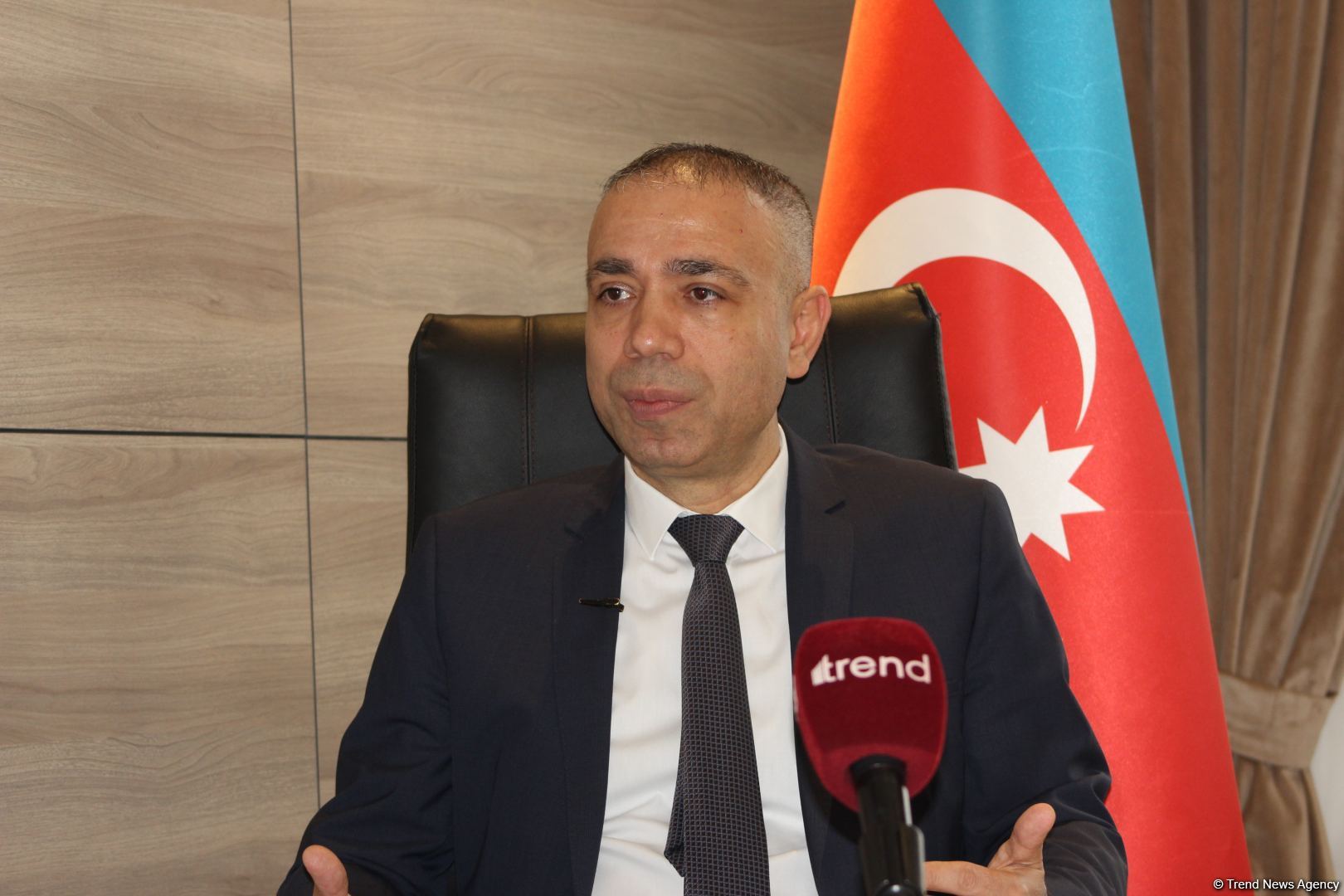

BAKU, Azerbaijan, February 24. The technical-economic feasibility study for the Central Asia-Azerbaijan Green Energy Corridor is expected to be completed by early 2027, with the Italian company CESI selected as the consulting firm to lead preliminary research over eleven months, Azerbaijan’s Deputy Minister of Energy, Elnur Soltanov, said in an exclusive interview with Trend.
Soltanov stated that the project aims to integrate the energy systems of Azerbaijan, Kazakhstan, and Uzbekistan and establish a “green energy” route to Europe.
"Selecting a consulting firm at this stage is crucial to ensure the project is completed on time and to a high standard, as advancing to the investment and construction phases is impossible without a feasibility study. This decision will have a direct impact on the project’s overall timeline," he stressed.
Elnur Soltanov highlighted that ongoing renewable energy projects enable the gradual achievement of strategic goals.
"In this context, the 230 MW Garadagh Solar Power Plant (SPP), built by the United Arab Emirates’ Masdar company and the largest in the Caspian region and the CIS, was commissioned in 2023.
Additionally, the 240 MW Khizi-Absheron Combined Energy Station (KES), constructed by Saudi Arabia’s ACWA Power, held its official opening on January 8, 2026. The successful completion of these projects marks a significant milestone in advancing the country’s renewable energy targets.
Within the “mega” project framework, Masdar is also developing the 445 MW Bilasuvar SPP, the 315 MW Neftchala SPP, and the 240 MW Absheron-Garadagh Combined Heat and Power Plant, with construction progressing steadily. The first solar panel at Bilasuvar GES was installed in October 2025, and construction of the station is ongoing," he added.
Soltanov highlighted that the implementation of other priority projects is also progressing.
"Work is underway on the 240 MW Shafag SPP in the liberated territories, the Shams and Ufug SPPs projects with capacities of 50 MW each, as well as two additional SPP projects totaling 50 MW in the Nakhchivan Autonomous Republic. Moreover, key cooperation agreements in renewable energy have been signed with companies from the People’s Republic of China, paving the way for several significant onshore and offshore projects," he said.
Regarding wind energy in the Caspian Sea, five potential zones have been identified, and work continues to designate these areas for renewable energy use. Soltanov noted that the Caspian wind projects are strategically important for strengthening energy security and advancing green energy targets, with technical potential estimated at 157 GW.
"Several agreements have already been signed to ensure this potential is effectively harnessed. Potential sites for wind projects were identified, reviewed by relevant state agencies, and formally agreed upon. Work is now underway to officially designate these areas as renewable energy zones," the official said.
He also discussed three main green energy corridors: Caspian-Black Sea-Europe, Azerbaijan-Türkiye-Europe, and Central Asia-Azerbaijan-Europe.
"The Caspian-Black Sea-Europe corridor has already established a joint venture involving operators from Azerbaijan, Georgia, Romania, and Hungary, with the feasibility study expected to conclude in the first quarter of the year. The first phase of the project is slated for completion in 2032, followed by the second phase in 2036, and the third in 2040. The project received a positive response when it was proposed for inclusion in the next Ten-Year Network Development Plan (TYNDP) of the European Network of Transmission System Operators for Electricity (ENTSO-E), and it was officially added to the TYNDP 2026 project portfolio on October 20, 2025. The next step will involve applying for PCI/PMI (Projects of Common Interest / Mutual Interest) status," he added.
Soltanov highlighted that the other two corridors, “Azerbaijan-Türkiye-Europe” and “Central Asia-Azerbaijan-Europe,” are also in the preliminary feasibility study and agreement phase.
“Projects continue to integrate the energy infrastructures of Azerbaijan and Türkiye and to enable electricity exports via Nakhchivan. As part of the project, the 'Jabrayil' substation, with a capacity of 330/110/10 kilovolts and 2x250 MVA, has been completed and is operational, establishing the 'Jabrayil' energy hub. Plans are underway to construct a 330 kV power transmission line linking the Jabrayil energy hub with Nakhchivan through the Zangezur corridor via Armenia and/or Iran, alongside a new 330 kV substation in Nakhchivan,” he explained.
In his statement, Deputy Minister elaborated on the transformative potential of the Trans-Caspian Energy Corridor agreement signed by Azerbaijan, Kazakhstan, and Uzbekistan within the region’s evolving energy architecture. He underscored that the “Agreement on Strategic Partnership in the Development and Transmission of Green Energy between the Governments of the Republic of Azerbaijan, the Republic of Kazakhstan, and the Republic of Uzbekistan” represents a pivotal step in deepening regional energy cooperation:
"This agreement establishes the framework for new 'green energy' corridors, enabling the transfer of substantial energy volumes from Central Asia to European markets. Enhanced integration of the energy systems of the three nations will bolster regional energy flows and stability while contributing to Europe’s energy diversification. Consequently, reliance on gas and other hydrocarbon sources will diminish, while the share of renewable energy will expand. Beyond energy supply, the agreement creates profound economic and geopolitical advantages, further consolidating regional energy security through intensified cooperation," he stated.
The Deputy Minister also highlighted the implications of the Protocol of the 6th meeting of the Azerbaijan-Italy Joint Intergovernmental Commission, signed earlier this year in Baku, for advancing bilateral green energy collaboration. He recalled that the Protocol endorsed the Cooperation Action Plan for 2026-2027 between the two countries, encompassing 73 areas of strategic engagement:
"This Action Plan provides for expanded collaboration across multiple sectors, with energy at its core. In the realm of green energy, it facilitates carbon reduction initiatives, promotes investment, and encourages the transfer of renewable energy technologies. The Caspian-Black Sea-Europe Green Energy Corridor, in particular, establishes a novel route for exporting renewable energy to Europe, enhancing Azerbaijan’s pivotal role in this dynamic. For Italy and other European nations, this corridor offers strategic advantages in energy diversification, export expansion, and the delivery of clean energy alternatives to traditional oil and gas supplies."
Looking ahead, Soltanov outlined Azerbaijan’s principal priorities and strategic direction for its green energy agenda in the near and medium term:
"Azerbaijan’s green energy policy, aligned with the nation’s long-term socio-economic development strategy, emphasizes the efficient utilization of energy in 2026, the expansion of renewable energy sources, implementation of large-scale wind and solar projects, phased decarbonization of the energy sector, enhancement of export potential, and the fortification of regional and international energy cooperation. By 2030, the plan anticipates the commissioning of six gigawatts (GW) of wind and solar capacity, expanding to eight GW by 2032. In Karabakh and East Zangezur, hydro, solar, and wind installations, including rooftop panels, are projected to generate 1.6 GW by 2030, culminating in a reduction exceeding two million tons of emissions," the official concluded.



