


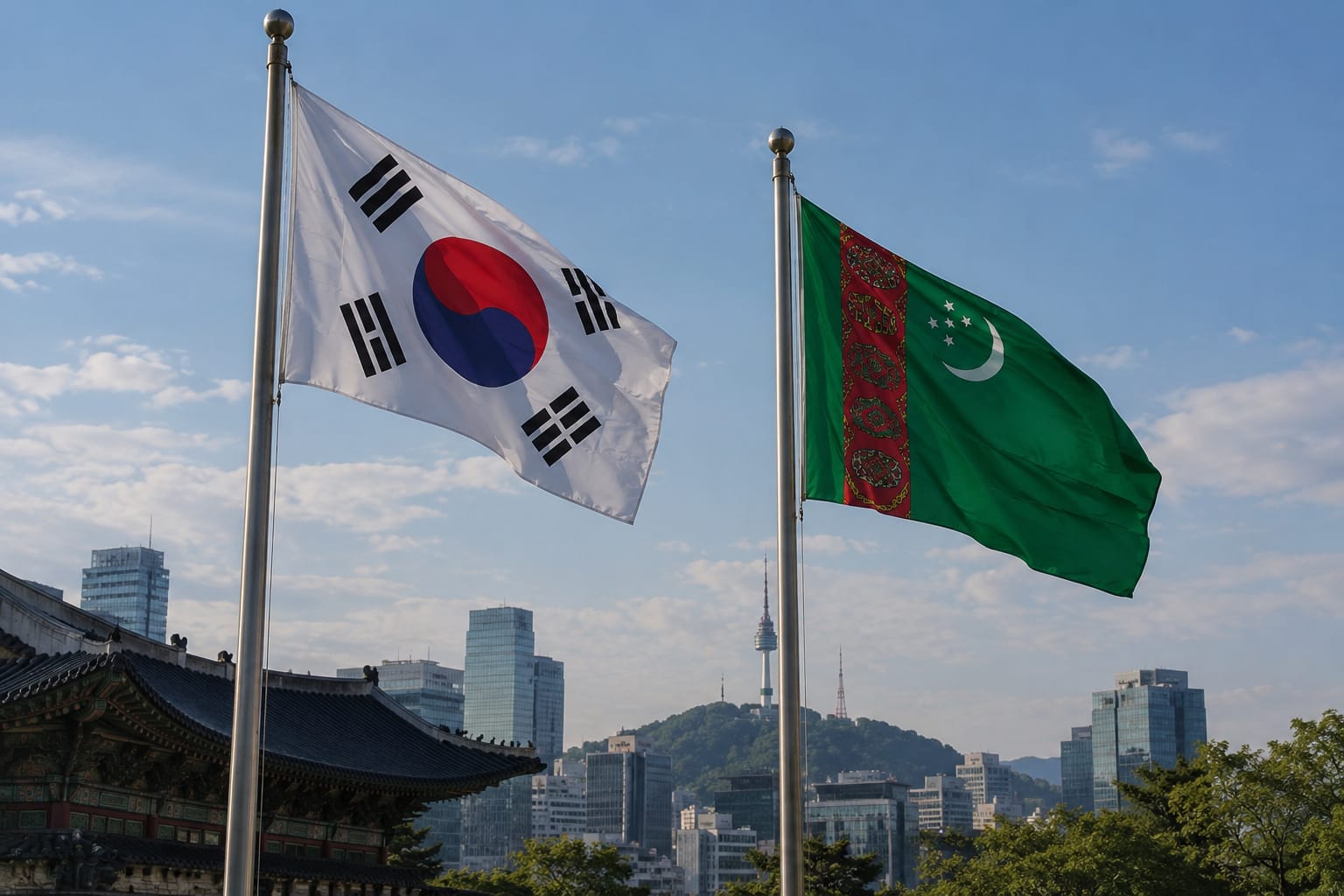

BAKU, Azerbaijan, September 18. The Central Asia–Republic of Korea Summit, which opened in Seoul on September 16, marked a new stage in economic cooperation between Turkmenistan and the Republic of Korea. During President Serdar Berdimuhamedov’s state visit, the two sides signed 13 bilateral agreements and memoranda, including an agreement on the mutual protection of investments, as well as arrangements covering rail transport, shipbuilding, the construction of new cities, water management, artificial intelligence, and science.
The economic dimension also constituted one of the central areas of discussion at the regional level. Following the meeting of the leaders of the five Central Asian states, President of the Republic of Korea Lee Jae Myung called for expanding cooperation beyond raw-material trade to encompass the entire value chain, from resource development and processing to the joint production of high-tech goods. Seoul likewise reaffirmed its intention to deepen cooperation with Central Asia in the fields of energy, infrastructure, technology, and supply chains.
For Turkmenistan, this agenda is particularly significant. The agreements reached correspond closely with the areas of transport, industry, technology, and investment that have assumed increasing importance in President Serdar Berdimuhamedov’s foreign economic policy in recent years. In this broader context, the summit may be viewed as another element of the country’s long-term strategy to strengthen its position as an energy, industrial, and transit hub of the region.
At the same time, the practical returns of such initiatives are becoming especially visible now. As Trend previously noted in its analytical piece "Inside Turkmenistan’s investment cycle: How Turkish contractors anchor a new phase of economic expansion," the country is entering a new investment cycle, triggered by the start of the fourth phase of development at the Galkynysh field - one of the world's largest gas deposits. In April 2026, Turkmengaz and CNPC signed an agreement to build new facilities that will allow processing of up to 10 billion cubic meters of additional gas per year. A project of this scale creates a multiplier effect across the economy: demand rises for construction work, industrial equipment, engineering solutions, transport infrastructure and logistics. Against this backdrop, international agreements take on added practical weight, giving foreign companies the chance to take part not only in individual contracts but in a much larger cycle of economic modernization.
Viewed against South Korea's existing footprint in Turkmenistan, many of the areas outlined in Seoul turn out to rest on solid practical ground. South Korean companies have been involved in the development of Turkmen industry for many years, chiefly in gas chemicals, infrastructure and machine building. One of the best-known examples remains the gas-chemical complex in Kiyanly, built by a consortium led by Hyundai Engineering with the participation of LG International (now LX International), which produces polyethylene and polypropylene.
This cooperation has not been limited to facilities already completed. In 2024, Hyundai Engineering signed new agreements with Turkmengaz on further development of the Galkynysh field and the rehabilitation of a polymer plant, with the value of potential orders estimated at roughly $6 billion. Korean companies are thus continuing to operate precisely in the segments that are gaining additional momentum under Turkmenistan's new investment cycle.
It is the transport dimension, however, that best illustrates the link between industrial cooperation and Turkmenistan's push to become a transit hub. In May 2026, Turkmenistan commissioned the Gadamly dry cargo ship, the first vessel of its kind to be fully built in the country. It was constructed at the Balkan Shipbuilding and Ship-Repair Plant together with South Korea's Koryo Shipbuilding Industry Technology Co., Ltd. Korean specialists took part in technology transfer and the training of local personnel. The vessel has a deadweight of 6,100 tons and can carry up to 240 twenty-ton containers.
In May, the Gadamly made its first voyage to Azerbaijan and now operates on a regular line between the ports of Turkmenbashi and Baku. In effect, Korean technology has been built directly into a working transport route linking Turkmenistan's Caspian coast with Azerbaijan's transport infrastructure. Turkmenistan also plans to commission a second dry cargo vessel, the Menzil, currently under construction with the involvement of the same Korean partners.
This is why it was significant that, ahead of the summit, South Korean President Lee Jae Myung specifically tied Turkmenistan's potential to its geographic position. He said the country's abundant resources could become the basis for high-value-added industries, while its location linking the Caspian Sea and Central Asia could turn it into a new hub for logistics and trade. During talks with President Serdar Berdimuhamedov, the two sides also agreed that the "Revival of the Great Silk Road" concept could serve as a new driver of growth connecting Central Asia with the Caspian Sea.
Seen in this light, the Gadamly route shows how a single industrial-technology project can become a building block of the Trans-Caspian transport system. Baku plays a pivotal role in this scheme for Turkmenistan: Azerbaijan is developing the port and rail infrastructure of Baku, along with other elements of the East-West corridor, which runs from Central Asia across the Caspian and through Azerbaijan onward to Georgia, Türkiye and Europe, thereby linking Asia with Europe. Azerbaijan has officially stated that developing this route creates opportunities for Turkmenistan and other Central Asian countries to reach European and global markets.
Korean involvement in Turkmen shipbuilding thus offers a fairly clear example of how industrial cooperation can evolve into transport infrastructure, which in turn feeds into international logistics. It is precisely this sequence that allows the current Korean-Turkmen dialogue to be viewed as part of building a route in which Turkmenistan serves as the Caspian link connecting Central Asia with Azerbaijan and, further on, with Europe.
Still, viewing what is happening in Seoul solely through the lens of bilateral relations between Turkmenistan and South Korea would be incomplete. For Ashgabat, the summit is another element of the C5+1 format, which gives the five Central Asian states a platform to discuss economic, technological and transport issues jointly with major outside partners. The most illustrative and comparable examples in terms of the issues covered have been the C5+1 summits and meetings held with the United States, Japan and now South Korea.
Over the recent period, this model has developed consistently along several tracks. At the first Central Asia-Japan summit in Tokyo in December 2025, a dedicated section was devoted to transport and digital connectivity. In the final declaration, the leaders stressed the need to expand Central Asia's access to international markets and backed the development of the Trans-Caspian International Transport Route as a tool for strengthening the region's connectivity and its access to global markets. The parties also agreed to develop cooperation in artificial intelligence and digital technologies. Trend examined Japan's strategy in Turkmenistan in more detail in its article "Serdar Berdimuhamedov's investment strategy: Role of Japanese business."
The American track has developed around a somewhat different set of interests. Within the C5+1 format, discussions in Ashgabat in early September 2026 focused on expanding cooperation between the five Central Asian countries and the United States in critical minerals, trade and transport, while a seminar held on September 15-16 was devoted to artificial intelligence, digitalization, cybersecurity, satellite communications and data centers. This shows that, even where specific priorities differ - from mineral supply chains to digital infrastructure - the central element of engagement remains connecting the region to international economic and technological chains.
The Korean summit looks like the next link in the same chain of events. Seoul is placing its emphasis on combining Central Asia's industrial potential with Korean technology, investment and manufacturing expertise. In the outcomes of the first summit, the parties agreed to develop joint value chains in critical minerals and energy, and to expand cooperation in industry, artificial intelligence, science and technology. Seoul has also established a separate mechanism for meetings between the industry ministers of Central Asian countries and Korea.
For Turkmenistan, the significance of this sequence lies in the fact that the country is acting simultaneously on several external fronts, drawing on different areas of expertise to serve its own development goals. At the same time, the C5+1 format gives each Central Asian country an additional platform to advance its interests as part of a region with a combined population of roughly 80 million people. This is not about creating a single market in an institutional sense, but about a regional platform that allows the shared infrastructural, resource, and economic potential of the five countries to be presented as an interconnected space.
This is precisely where the interests of Turkmenistan and its external partners converge. For the United States, Japan and South Korea, Central Asia is becoming a space where they can simultaneously work with resources, industry, technology and new transport routes. For Turkmenistan, these partnerships allow it to consistently attract the investment, technology and expertise needed to carry out President Serdar Berdimuhamedov's policy course as the country enters a new investment cycle. And the development of ties across the Caspian adds another important element to this system - a route for Central Asia, via Turkmenistan and Azerbaijan, to transport infrastructure leading further on to European markets.
In this sense, the Seoul summit can be viewed as a closing point in the current stage of Turkmenistan's efforts to build a new economic and transit configuration. The country has steadily attracted investment, technology and industrial expertise, while simultaneously developing its own production base and the infrastructure needed to access international transport routes. These strands are now beginning to converge into a single chain, in which industrial development generates cargo volumes, technology ensures their efficient movement, and the Caspian route together with the partnership with Azerbaijan opens the way to markets further to the west.
For Ashgabat, the next challenge is to make this accumulated potential function as a single system. New industrial projects need to generate sufficient cargo volumes, the development of ports and the fleet needs to ensure their movement across the Caspian, and international partnerships need to sustain a steady flow of investment and technology. If this chain is consistently put into practice, the current investment cycle could become the foundation for cementing Turkmenistan's role as a transit link between Central Asia, the Caspian, and the European direction.



