


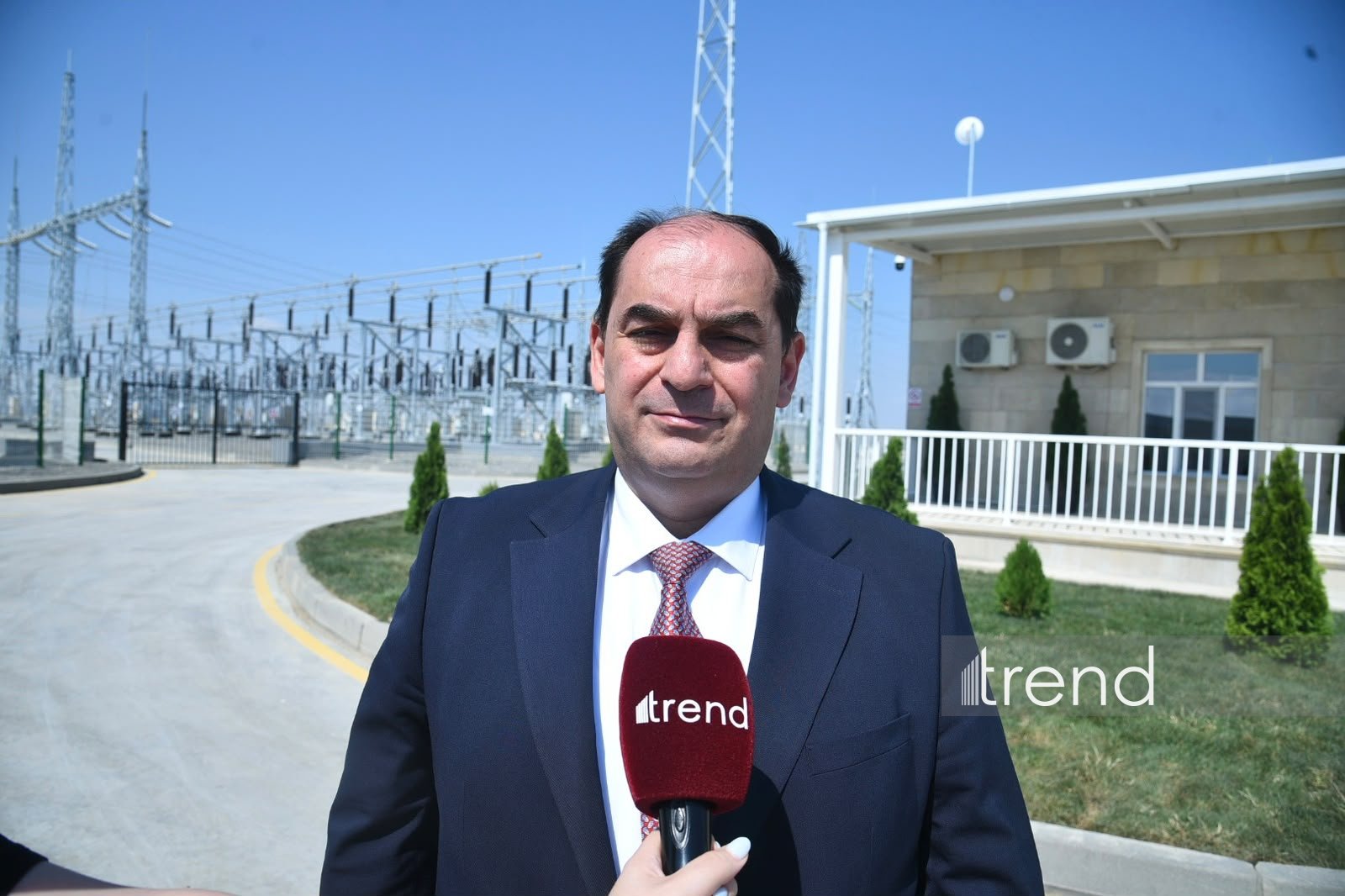

BAKU, Azerbaijan, September 17. Azerbaijan plans to commission up to 3 additional renewable energy plants by the end of the year, Director of the Azerbaijan Renewable Energy Agency under the Ministry of Energy, Javid Abdullayev, told Trend in an exclusive interview during a media tour of the Gobustan solar power plant.
"We envision the development of renewable energy sources in Azerbaijan proceeding in three stages. The first stage concludes at the end of 2027, and by its completion, we aim to have commissioned approximately two gigawatts of renewable energy capacity," he said.
According to him, all necessary work for the first stage has already been carried out, relevant contracts have been signed, and investors are conducting work at virtually all the sites.
"This facility is the third of the 11 plants we have commissioned. We expect to bring another 3 plants online by the end of the year," Abdullayev explained.
He added that the remaining plants are scheduled to be commissioned in subsequent years as preparations are finalized and the grid infrastructure is ready to connect them.
"Extensive studies regarding the grid are underway. Significant progress has been made here as well, and we plan to share the results of these studies soon—tentatively at the end of this month or the beginning of the next. These results will help determine what portion of the solar and wind facilities to be commissioned in the second stage will connect to Azerbaijan's power grid and what portion will be designated exclusively for export.
At the same time, we'll obtain comprehensive information on the grid reinforcement work required for connection, the geographical distribution of these loads, and the estimated investment needed for our power system, enabling us to make informed decisions based on this data," Abdullayev noted. He emphasized that, starting from the second stage, Azerbaijan must also begin developing capacity to export electricity via the relevant routes.
"Four interconnectors are currently on the agenda. A preliminary feasibility study has already been prepared and submitted for one of them: the Azerbaijan–Georgia–Black Sea–Romania–Hungary route. It is encouraging that the study demonstrated the route's attractiveness from both technical and economic perspectives.
Steps are currently being taken to launch the necessary financial mechanisms to enhance the project's appeal.
As part of these efforts, work is nearing completion on including this project in the ten-year development plan for the European energy system. Subsequently, work will proceed toward securing 'Project of Mutual Interest' or 'Project of Common Interest' status for the initiative," noted Abdullayev.
He reported that a joint venture involving the transmission system operators of the four respective countries has been established for this purpose.
"This entity coordinates all necessary activities on behalf of each country's grid operators. This will enable us to secure funding from specific financial institutions on concessional terms—or, in some instances, even in the form of grants—for such projects," the agency director said.
Speaking about the third stage, Abdullayev pointed out that it would require more innovative solutions.
"Azerbaijan is rich in oil, gas, and green energy. We have always ensured Europe's energy security. Now, we aim to continue this process through electricity and green energy as well. In the third stage, leveraging Azerbaijan's potential will foster hydrogen development, the utilization of other resources, and the implementation of new technologies.
Furthermore, given the global trend toward digitalization, facilities such as data centers require significant energy resources. Consequently, on the demand side, we can anticipate a substantial rise in the need for the capacity being developed," he concluded.



