


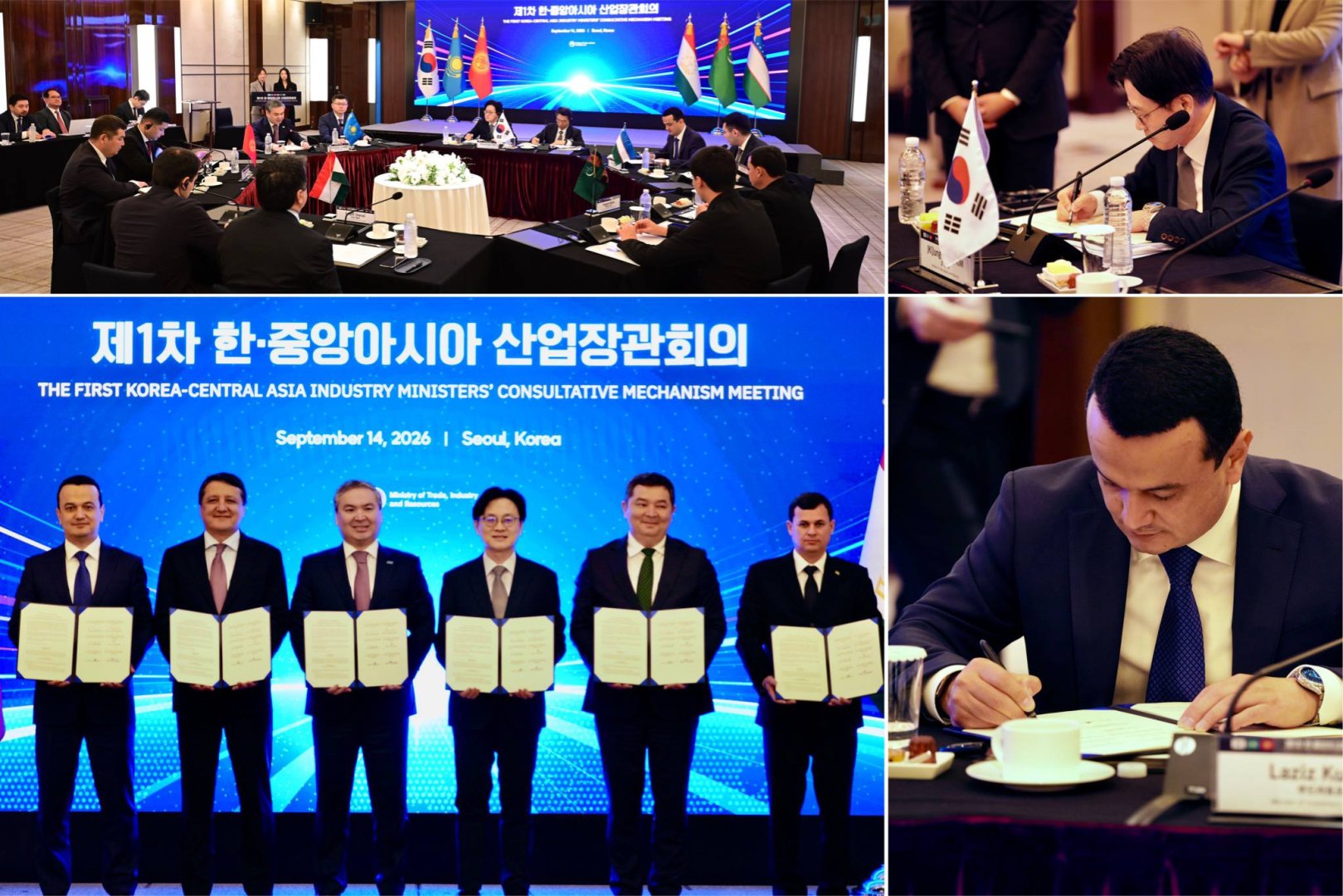

BAKU, Azerbaijan, September 14. South Korea and Central Asian countries have agreed to deepen industrial and supply-chain cooperation, signing a joint memorandum and adopting a joint statement at the first meeting of their industry ministers.
This was reflected in the statement by the Ministry of Investment, Industry and Trade of Uzbekistan, following the inaugural meeting of the Industry Ministers of Central Asian countries and South Korea, held in Seoul under the theme “Future Cooperation between Korea and Central Asia for Growth and Innovation.”
The meeting brought together Uzbekistan’s Investment, Industry and Trade Minister Laziz Kudratov, South Korean Minister of Trade, Industry and Energy Kim Jeong-gwan, and heads of relevant government agencies from Kazakhstan, Kyrgyzstan, Tajikistan and Turkmenistan.
The meeting concluded with the signing of a joint memorandum on cooperation in industry and supply chains and the adoption of a joint statement by the Consultative Mechanism of Industry Ministers of South Korea and Central Asia.
The new ministerial format is designed to complement political dialogue with a practical agenda focused on industry, trade and technology and to strengthen links between Central Asian companies and South Korean businesses.
“This new mechanism provides a practical platform for advancing industrial cooperation, strengthening supply chains and connecting the technological capabilities of South Korean companies with the industrial potential of Central Asia,” the Uzbek Ministry of Investment, Industry and Trade said.
The meeting was held ahead of the first Central Asia-South Korea summit.
Uzbekistan highlighted the growing scale of its economic ties with Central Asia and South Korea. In 2025, the country’s trade turnover with Central Asian states and South Korea exceeded $10 billion, increasing by nearly 10% year over year. From January through July 2026, the figure reached $6.5 billion, up 25%.
More than 3,000 enterprises with capital from South Korea and Central Asian countries currently operate in Uzbekistan.
Against this backdrop, Uzbekistan called for a shift from expanding trade toward joint production, localization and the development of regional value chains.
The Uzbek side proposed eliminating technical barriers, mutually recognizing certificates and test results, and developing an industrial cooperation program with specific high-tech projects. It also proposed creating a unified digital platform for industrial initiatives and a permanent expert group at the deputy-minister level. All of the initiatives received full support from the South Korean side.
The technology agenda covered critical minerals, industrial infrastructure, artificial intelligence in manufacturing and workforce development. The sides identified automated quality control, predictive maintenance, energy efficiency and industrial data analysis as potential areas for cooperation.
In a separate meeting, Kudratov and Kim signed agreements on creating an Uzbekistan-South Korea platform for the exploration and development of strategically important minerals, as well as expanding export potential and trade cooperation.



