


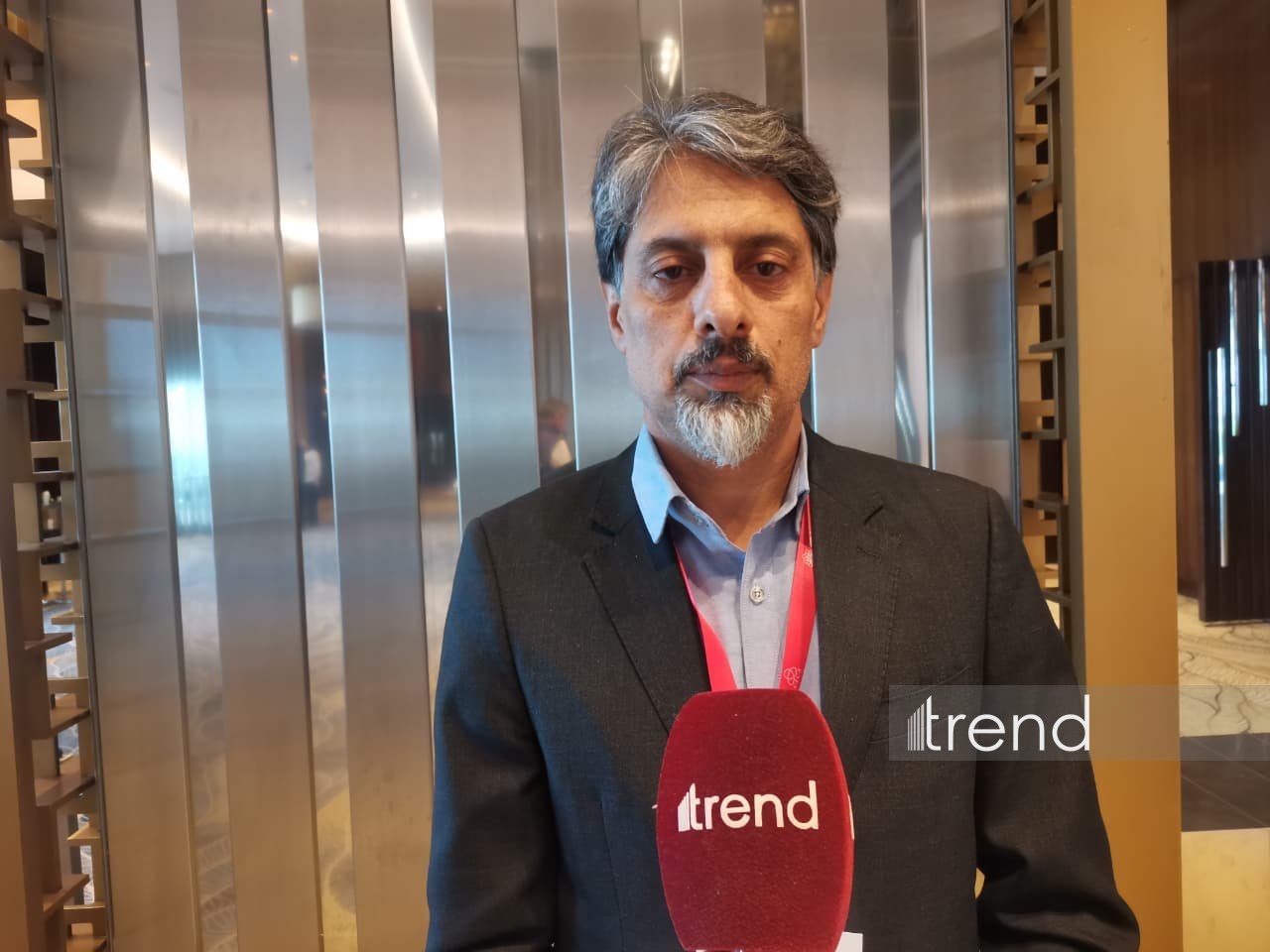
BAKU, Azerbaijan, June 25. Both Iran and Azerbaijan have very good experiences in the field of sustainable and green tourism, and both countries can share their great experiences with each other in developing green tourism strategies, Secretary of the National Ecotourism and Green Tourism Committee of the Ministry of Cultural Heritage, Handicrafts and Tourism of Iran, Mohammad Jahanshahi, told Trend in an exclusive interview.
He noted that they can help each other in the development of both rural tourism and local tourism, and in tourism infrastructures ranging from small residences to large hotels.
"First of all, the many commonalities between Iran and Azerbaijan, as well as their natural commonalities. In addition to nature, there are cultural, behavioral, and historical commonalities. Therefore, I do not feel any strangeness here. We feel the same kind of sincere behavior of Azerbaijani citizens in Iran every day. In this regard, citizens of both countries understand each other well," he said.
The ministry official added that when it comes to developing the tourism sector between the two countries, there is a need to implement strategic changes in this direction. The Caspian Sea as a valuable corridor, the Hyrcanian forests as a joint natural heritage, the use of the territories of the two countries for transporting various types of spices from Asia, especially India, and the existing caravanserai routes and corridors in Iran and Azerbaijan can be very effective if they are worked on.
"Strengthening railway connections between the two countries, increasing air travel, and naturally providing simplifications for tourists from the two countries can contribute to the development of tourism relations. Existing infrastructures can also create conditions for the development of ecotourism between the two countries," he noted.
Jahanshahi said that Azerbaijan has gained great experience and achievements in terms of green and sustainable tourism in recent years. The organization of COP-29 in Baku 2 years ago and the holding of WUF in Baku this year show that Azerbaijan has gained great experience in this field. It was along with COP-29 that the green tourism program was launched. This shows that Azerbaijan takes the green tourism sector seriously and attaches importance to it.
The ministry official noted that currently, green tourism is not a voluntary choice, but a necessary step that must be taken. Because climate change has negative effects on all countries of the world. If the tourism sector is not given serious attention and is not developed properly, it is one of the sectors that has a negative impact on the whole world. The tourism sector has an 8-10% role in the spread of greenhouse gases in the world. Greenhouse gases also have a 90% role in climate change. The development of green and sustainable tourism contributes to both the increase in tourists and the protection of nature.
"In my opinion, Azerbaijan is one of the main countries in the region that is making great efforts to develop green and sustainable tourism. I observe that there are hotels with green labels in Baku. This shows that hotels have the ability to optimize water and energy consumption and other opportunities. In the current situation, the listed indicators increase the quality of tourism.
The use of electric vehicles at the city level is one of the highlights in the development of green tourism. We clearly see the fundamental and principled implementation of these works in Azerbaijan. When we see the greenery and landscape of Baku, it is clear that great and serious work is being carried out. Currently, Baku is a training city in terms of urban management. It's known that Baku has great experience in urban management and tourism," he pointed out.
Jahanshahi added that considering Iran's experience in green and sustainable tourism, the two countries can share their experiences to achieve sustainable development in the tourism sector. This can benefit the tourism sector of the two countries both economically and in terms of values.
According to him, if we take literary figures as an example, geniuses such as Nizami Ganjavi, Khagani Shirvani, and Mohammad Hossein Shahriyar show that there is great potential between the two countries.
"Green tourism is being seriously monitored at the global level after 2023. In Iran, since then, the National Secretariat for Green Tourism has been operating in the Ministry of Cultural Heritage, Tourism and Handicrafts. This secretariat works together with the Environmental Protection Organization, the Natural Resources Organization, and the Geological Organization.
The secretariat is working on a number of projects in the field of sustainable tourism. The names of 5 Iranian villages have been listed in the list of the best rural tourism in the world. Various indicators must be at a very high level for the selection of tourist villages. Almost all of these indicators are within the framework of green tourism," he explained.
According to him, currently, work is being carried out within the framework of 3 projects for the development of green and sustainable tourism in Iran. These works include issuing green labels to hotels, equipping hotels with solar power plants, and applying energy consumption standards to hotels. Last year, 12 hotels in Iran were issued green labels. This year, it's also planned to issue green labels to other hotels.
Jahanshahi pointed out that initial steps have been taken in the direction of using solar power plants in the tourism sector in Iran. It's expected that solar power plants will be used to the maximum extent in the tourism sector in the next 4-5 years.
The ministry official noted that there are approximately 300 sunny days in Iran a year. The number of sunny days is the majority in the northern provinces of Iran, except Gilan and Mazandaran. Approximately 90% of Iran's tourism facilities are located in areas with many sunny days.
"Currently, standards are being developed in Iran regarding energy consumption in hotels. Work on 90% of these standards has been completed. Once these standards are fully implemented, hotels with low consumption will be able to receive more discounts accordingly. Hotels with high or medium consumption will also be informed to reduce their consumption.
Work has begun between the National Ecotourism and Green Tourism Committee and the Iranian Environmental Protection Organization within the framework of projects to develop national parks, forest parks with the Natural Resources Organization, and geotourism with the Geological Organization.
Currently, Iran's Ministry of Mineral Heritage, Tourism, and Handicrafts is taking the issue of green tourism seriously when issuing licenses to hotels. This is also in the interest of investors. When investors pay attention to priorities, their costs will be reduced by 30-40%. As a result, the process of returning investments to investors will also be accelerated, which will help both the environment and bring economic benefits,” he concluded.



