


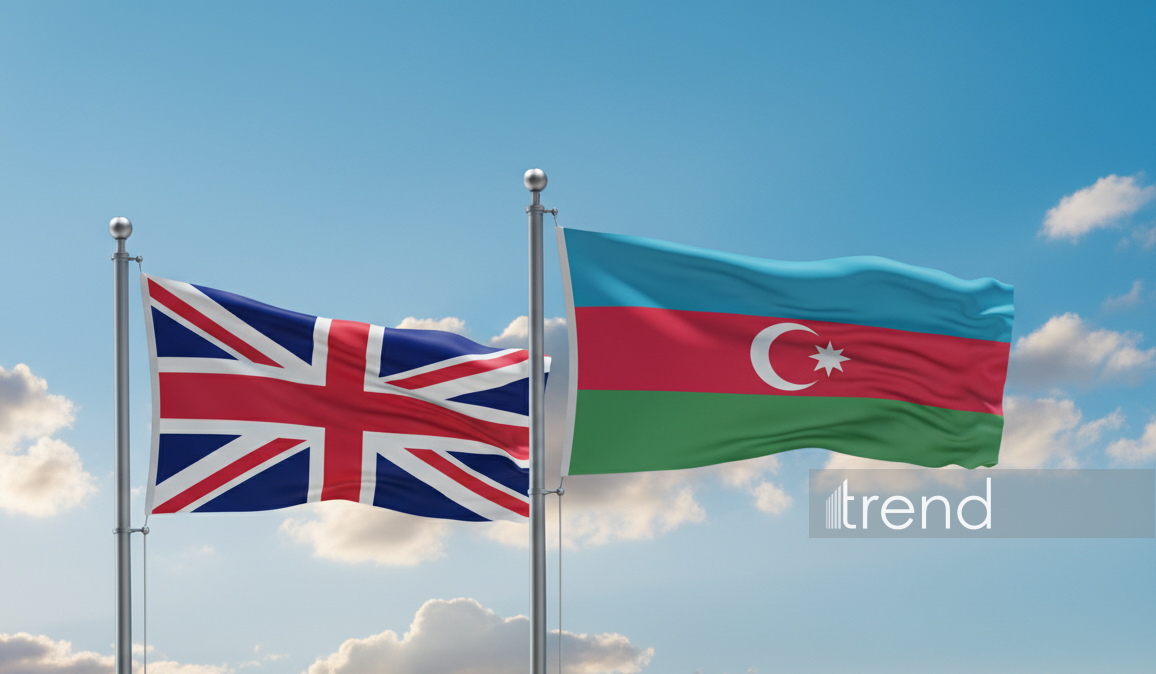

BAKU, Azerbaijan, January 7. Economic relations between Azerbaijan and the United Kingdom have in recent years moved beyond the framework of traditional cooperation, taking on a more systematic and strategic character. While for decades energy formed the backbone of bilateral dialogue, today the agenda has expanded significantly - from clean energy and transport to financial services, digital technologies, and sustainable infrastructure.
It is no coincidence that 2025 marked a turning point: in August, the United Kingdom and Azerbaijan announced the elevation of their relations to the level of a strategic partnership.
The energy sector continues to serve as the foundation of economic ties between the two countries. The United Kingdom is the largest source of foreign direct investment in Azerbaijan’s economy, having invested more than £37 billion, with a substantial share of these investments historically concentrated in the oil and gas sector.
However, the focus is gradually shifting today. In an exclusive interview with Trend, Lord John Alderdice, UK Trade Envoy to Azerbaijan and Central Asia, pointed out that there is particular interest in developing partnerships “in areas where British expertise aligns with Azerbaijan’s priorities.” At the center of this attention is clean energy, which, he emphasized, “aligns perfectly with the UK's new Industrial Strategy”.
This is not about declarations, but about concrete projects. More than 50 British companies are already operating in Azerbaijan in renewable energy, offshore wind, grid modernization, and hydrogen technologies. A flagship example is Xlinks, which signed a memorandum of understanding under the Green Energy Corridor initiative. The project aims to bring Caspian offshore wind energy to European markets through several countries and across the Black Sea.
"This illustrates how British companies are bringing expertise in interconnectors and grid modernisation to strengthen regional energy security and accelerate decarbonisation," he pointed out.
A key feature of this new phase of cooperation is moving beyond the hydrocarbon model. Examples include BP’s Shafag solar power plant, the electrification of the Sangachal terminal, and British companies’ involvement in modernizing distribution networks.
“Our cooperation goes beyond hydrocarbon resources,” emphasized the UK Trade Commissioner, noting that British companies are actively engaged in Azerbaijan’s plans to export clean energy.
One of the most promising areas of collaboration is transport and logistics, particularly in the context of developing the Middle Corridor. Azerbaijan plays a pivotal role in this route connecting Europe and Asia, and London sees it not only as a trade route but also as a component of energy and climate policy.
“The UK recognises the Corridor's strategic importance not just for regional trade, but for energy security and sustainable transport across a vast geography that matters enormously to global commerce,” Lord Alderdice stated.
British companies bring extensive experience in master planning for airports and ports, modernizing railways, and creating multimodal transport systems. Particular emphasis is placed on smart logistics solutions that speed up cargo movement and reduce bottlenecks at borders.
At the same time, the Trade Commissioner emphasized that the long-term success of the Middle Corridor must be based on low-carbon, sustainable transport. “As the world moves toward net zero, the Middle Corridor has an opportunity to position itself as a green trade route,” he said, adding that British expertise in sustainable infrastructure could help Azerbaijan lead this transition.
Despite the continued dominance of the energy sector, the structure of bilateral trade is gradually diversifying. The United Kingdom supplies Azerbaijan with equipment, technology, and engineering and consulting services, while Baku remains an important partner for energy exports.
The key trend, however, is a shift from simply increasing volumes to deepening cooperation in a meaningful and structural way. In this context, the UK is seen as a natural partner for Azerbaijan in diversifying its economy: British business expertise and London’s know-how closely align with Baku’s strategic priorities - from clean energy and high-tech manufacturing to digital solutions and financial services.
Financial cooperation deserves particular attention, with the UK’s export credit agency, UKEF, playing a significant role. According to the Trade Commissioner, Azerbaijan has access to a £5 billion credit line.
“This isn't just about financing - it's about derisking large-scale projects, making them attractive to contractors and investors, and accelerating the strategic investments that support Azerbaijan's economic diversification,” he emphasized. The first deal under UKEF support has already been implemented - the supply of a Boeing flight simulator to the National Aviation Academy - opening doors for deeper cooperation in aviation and aerospace.
UKEF sees especially promising opportunities in clean energy, transport infrastructure along the Middle Corridor, digital systems, water infrastructure, and sustainable construction - areas that require substantial investment and long-term financial certainty.
Economic relations between Azerbaijan and the UK are entering a phase of qualitative transformation. While maintaining a strong energy foundation, the two sides are increasingly developing cooperation in clean energy, transport, finance, digital technologies, and education.
The transition to a strategic partnership reflects a desire not merely to increase trade and investment volumes, but to build a sustainable, diversified economic model. In the medium term, the combination of the energy transition, the development of the Middle Corridor, and institutional investment support could become the key driver for deepening the Azerbaijan-UK economic dialogue.



