


BAKU, Azerbaijan, January 13. There is no force more awe-inspiring on Earth than the simple yet powerful element: Water.
Historically, grand vessels were crafted in myths and religious texts to shield humanity from the destructive power of water; today, however, we are compelled to construct vast reservoirs to conserve it.
Indeed, the alarming forecasts made by scientists decades ago have become a reality: water scarcity has emerged as the foremost challenge of the 21st century. Freshwater, once abundant, has now become a critical resource under threat, affecting not only major urban centers but also small rural communities.
At present, nearly every corner of the globe is grappling with the devastating consequences of drought and water shortages.
Water has now transcended the context of climate and ecological issues and has become a geopolitical challenge. Today, water, or more precisely, the lack of it, is a subject of interstate and intercontinental discussions. Regions with water resources have become as significant as lands once rich in gold or diamonds. This is because today, 2.2 billion people worldwide do not have access to safe drinking water. The most terrifying part is that more than half of the world's population, four billion people, experience severe water stress for at least one month each year. Population growth, climate change, and industrial development are already turning this prediction into a reality: by 2050, another one billion people will face extreme water scarcity.
Once a subject of films and something that seemed fantastical to many, water wars are now becoming a reality. Humanity is facing a terrible drama. Tensions between countries over water shortages are already visible. Last year, India's suspension of a water treaty with Pakistan led to the brink of war. The world is already experiencing water wars. If we also consider the tensions between the countries in the Nile basin, the scale of the problem signals a serious beginning.
Although Azerbaijan is located in one of the world’s most resource-rich regions, the Caucasus, it too is facing water scarcity problems. The country has the least amount of water resources in the South Caucasus. Azerbaijan's southern neighbor, Iran, has repeatedly raised alarms about water shortages. This indicates that the problem of water scarcity is pressing in the south.
When focusing on Azerbaijan's water scarcity issues, the first positive development is the government's early attention to this problem and the continuous strategic steps taken to prevent water shortages.
Looking back at President of Azerbaijan Ilham Aliyev's statements on the water problem from decades ago, it becomes clear that addressing water and irrigation issues, as well as ensuring a reliable supply of drinking water for the population, are among the government’s top priorities.
In September 2005, over 20 years ago, President Ilham Aliyev included water supply in the list of key problems requiring special attention in the coming years during a meeting at the Presidential Palace, where he discussed the work done in the field of water supply and irrigation and future projects.
Thanks to continuous state attention over the last 20 years, Azerbaijan has managed to erect a barrier against humanity's number one problem, water scarcity, with successful projects.
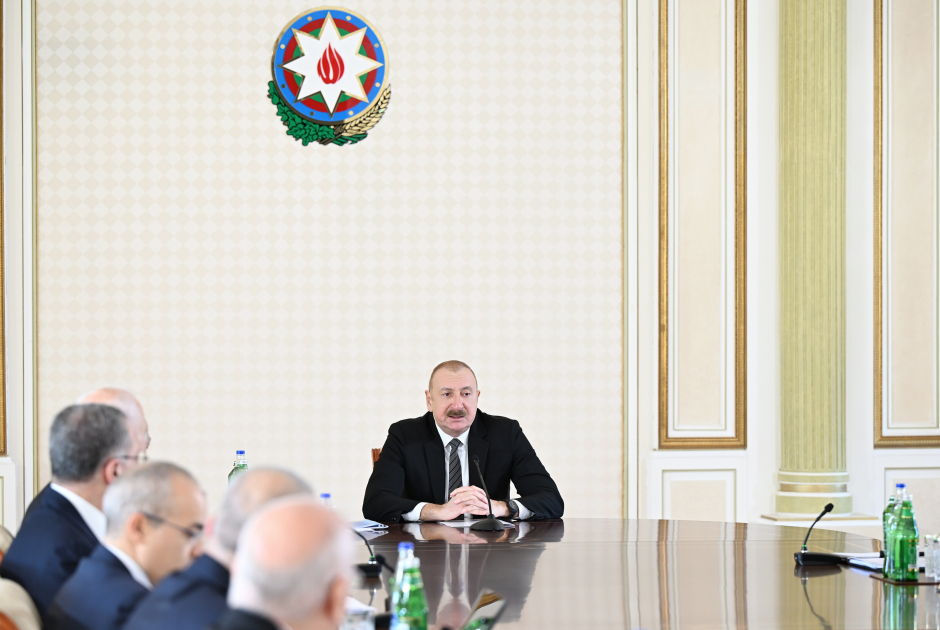
During a meeting dedicated to the state program for improving water supply, sewage, and rainwater systems in Baku and the Absheron peninsula, chaired by President Ilham Aliyev, a 20-year concept was discussed when talking about the projects aimed at solving the water problem.
Over the past 20 years, four large reservoirs with a capacity of over 500 million cubic meters have been built in the country. The Takhtakorpu and Shamkirchay reservoirs have played a decisive role in the water supply of Baku, the Absheron peninsula, and the western regions. The Samur-Absheron canal and the Oghuz-Gabala-Baku water pipeline have been reconstructed, becoming the main pillars of Baku’s sustainable water supply. The Jeyranbatan reservoir and water purification complex have been fully modernized.
Against the backdrop of global climate change, reduced rainfall, and increased demand for water, the risk of water scarcity has intensified. Approximately 75% of Azerbaijan’s surface water resources are formed outside the country, which makes the issue strategic and sensitive. For this reason, the systematic management of water resources, reducing losses, and strengthening digital control have been identified as the main goals.
In addition to being the country in the South Caucasus with the least natural freshwater resources, Azerbaijan has had nearly a quarter of its water sources under occupation for almost 30 years. During nearly a quarter-century of occupation, Azerbaijan not only lost 25% of its water resources but also became a victim of water terrorism by Armenia. Reservoirs were destroyed, natural water flows were dried up due to the uncontrolled exploitation of river waters, and the flora and fauna of the rivers were destroyed.
After the end of the occupation, active projects were implemented in the liberated territories not only to restore economic, social, and cultural infrastructure, but also natural resources.
After the control over water resources in the Karabakh and Eastern Zangezur regions was restored, reservoirs such as Sarsang, Sugovushan, Khachinchay, Kondalanchay, and Zabukhchay were rebuilt, and the construction of Hakarichay and Bargushadchay reservoirs is planned. The water resources formed in these areas play a significant role in the country's overall water security.
In Baku and the Absheron peninsula, the existing water and sewage infrastructure was mainly formed in the 1980s. As a result, problems have arisen regarding continuous water supply to the growing population and settlements, as well as sewage coverage and the management of rainwater. One of the key issues raised during the meeting on January 12, 2026, was the management of sewage and rainwater in Baku, which will be addressed in the comprehensive state program for 2026–2035.
The forecast that Baku will increase its continuous drinking water supply from 70% to 95% in the coming years signals that the state program discussed during the meeting has been developed based on solid foundations.
While many countries are already behind in addressing this major issue, Azerbaijan has always treated it as a top priority, and this is why the government is launching a comprehensive and well-planned program in response to the geopolitical challenge of water scarcity.
The state program, which aims to provide systematic solutions, envisions increasing the coverage of sewage services from the current 50% to 95%, reducing water losses in water management from 40-45% to about 20%, and constructing approximately 30 new water reservoirs across the country. In addition, new rainwater collectors will be built on 30 streets in Baku, minimizing the risk of flooding during intense rainfall and creating a technical water base.
Lastly, another important point: the once-paradoxical phrase "drinking seawater" is now becoming a reality as part of the state program. For the first time in the country’s history, a desalination plant will be built on the Absheron peninsula to desalinate seawater.
The Azerbaijani government is taking timely strategic steps against the problem of water scarcity, and citizens living in the world of 21st century should reconsider their approach to water usage and adopt a more sustainable attitude. We must not forget that today, the most valuable resource is not gold, platinum, or oil. The most valuable resource of the 21st century is water.
Sardar Amin
Head of the Azerbaijani-language news service at Trend News
Agency



