


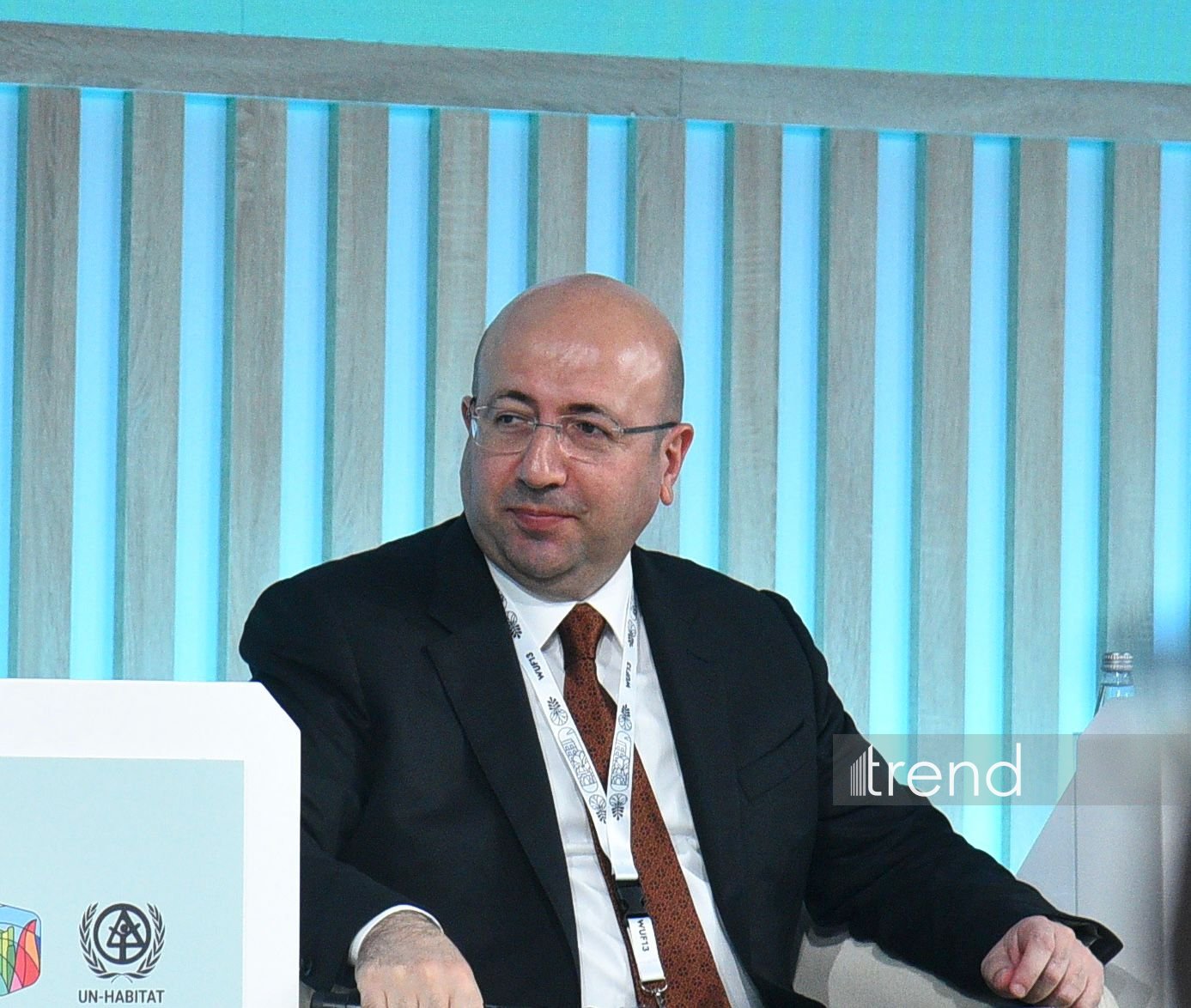

BAKU, Azerbaijan, May 18. Climate change adaptation and post-conflict recovery have become two of the most significant challenges facing modern urban planning, Anar Guliyev, Azerbaijan’s national coordinator for the World Urban Forum (WUF13), said Monday, Trend reports.
Speaking at the official opening press conference on the second day of WUF13 in Baku, Guliyev, who also chairs the State Committee for Urban Planning and Architecture, said discussions are underway with the United Nations Human Settlements Programme (UN-Habitat) on assessing implementation of the New Urban Agenda over the past decade and shaping a new urban climate agenda for the next 10 years.
Guliyev pointed to the heavy rainfall recorded during the first days of the forum as an example of the growing impact of climate change.
“This is a result of climate change. I have never seen so much precipitation in Baku in May. This is already a new reality,” he said.
He stressed the importance of strengthening cities’ ability to adapt to increasingly severe environmental challenges.
Guliyev also highlighted Azerbaijan’s post-conflict reconstruction and urban development efforts under the country’s “Great Return” program in the formerly occupied territories.
According to him, mine clearance operations, urban planning and large-scale restoration projects are being carried out simultaneously across the liberated territories, including in 12 cities and hundreds of villages.
He said the process involves not only rebuilding infrastructure, but also creating a new standard of living for returning residents.
Guliyev added that modern governance models and institutional reforms are being implemented in Karabakh and East Zangezur, where approximately 90,000 people currently live, work and study.
He noted that Azerbaijan’s reconstruction experience has attracted growing international interest, with discussions taking place with several countries on post-conflict urban recovery practices.
Concluding his remarks, Guliyev said the increasing number of conflict-affected regions worldwide makes effective reconstruction and the restoration of normal life especially important.



