



DUSHANBE, Tajikistan, January 5. In 2025, Tajikistan had an ambitious agenda to modernize its transport sector, focusing on infrastructure upgrades and stronger international connections. For a landlocked country facing difficulties in connectivity, transport development remains a priority—not only to ease domestic links, but also to expand transit and integrate into various logistics networks. Progress over the year was recorded across roads, railways, aviation, urban transport, logistics, and border infrastructure, which were supported by state funding and support from international partners.
1) Road transport:
Road transport continued to dominate Tajikistan’s transport system in 2025, supported by major public investments and large-scale construction works. Under the State Budget for 2025, nearly 3 billion somoni ($274.35 million) was allocated to the transport and communications sector, allowing reconstruction projects to move forward across the country.
In the Gorno-Badakhshan Autonomous Region, construction was completed on the Kalaikhumb–Vanj–Rushan road. Works in Barsem village included 4.5 kilometers of roadway, protection corridors, and two new bridges spanning the Shorf and Gund rivers. Meanwhile, in the Sughd region, more than 50 kilometers of national and international roads were restored.
One of the most recognized initiatives was the launch of the Dangara-Guliston Green Corridor. Covering 49 kilometers of a highway first built in the 1930s, the project will widen the road from 2 to 4 lanes and add bike lanes, sidewalks, lighting, crossings, and electric vehicle stations. Financing comes from a mixture of international sources, including a European Bank for Reconstruction and Development (EBRD) loan of up to €38 million and an Asian Development Bank (ADB) grant of up to $86.7 million. Preparatory work began in March 2025, with completion expected by 2030.
The construction of the Rogun reservoir affected the Obigarm-Nurobod section of the M41 highway, which was the focus of another important project. In June, the Asian Infrastructure Investment Bank approved a $2.04 million grant—its first under a Project-Specific Window—to support restoration of a 75-kilometer stretch.
In February, Tajikistan also signed an agreement with China’s Zhejiang Communications Construction Group to build Central Asia’s longest road bridge over the Surkhab River. The bridge will span 920 meters (1,500 meters including access roads) and is expected to be completed within four years at a cost of nearly $60 million.
Alongside physical infrastructure, digital reforms advanced as well. Under the World Bank’s CARs-4 program, a $1.1 million contract was signed to introduce a Road Asset Management System, aimed at improving planning and maintenance nationwide.
2) Railway transport:
Railway development in 2025 centered on electrification plans, feasibility studies, and regional integration. Tajik Railways began preliminary work on electrifying the 62-kilometer Vahdat–Pakhtaobod line, which links eastern Dushanbe with the Uzbek border. Authorities also explored electrification of the Kanibadam–Bekabad route.
Feasibility studies continued for a proposed 51-kilometer railway connecting Jaloliddini Balkhi with Nizhniy Pyandzh, discussed within cooperation frameworks involving South Korea. Tajikistan also examined possible participation in the China–Kyrgyzstan–Uzbekistan railway project, which is expected to span more than 530 kilometers and include 20 stations.
As part of its chairmanship of the CIS in 2025, Tajikistan launched work on a digitalization strategy for key intermodal transport corridors, with technical input from UN ESCAP experts.
3) Urban transport:
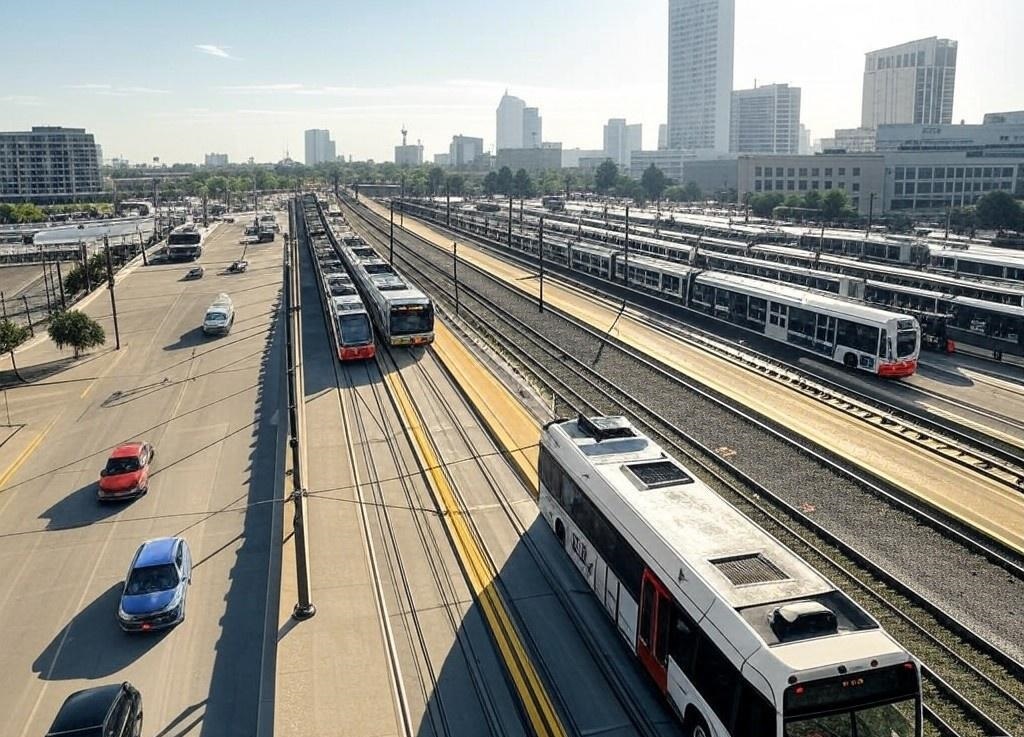
Urban transport modernization gained momentum, especially in the capital. Tajikistan announced plans to begin work on a light metro system in Dushanbe, with a feasibility study scheduled for completion by spring 2025. Design work is expected to follow later in the year. The first line, measuring 10.5 kilometers, will connect southern districts with the city center and the State Circus.
Electrification of public transport also moved forward. In August, Dushanbe authorities confirmed plans to purchase 30 electric buses, each capable of traveling up to 300 kilometers on a single charge and carrying up to 100 passengers.
The installation of 30 automated weight-and-dimension control stations strengthened road safety enforcement by monitoring heavy trucks at highway speeds. Tajikistan enforces a strict weight limit of 40 tons for heavy vehicles.
4) Aviation sector:
The aviation sector saw notable expansion through new routes and international agreements. New and resumed flights included Dushanbe–Krasnoyarsk, Dushanbe–Beijing, Kashgar–Khujand, and Xi’an–Dushanbe, improving links with Russia and China.
Visa-free air travel between Tajikistan and Iran came into effect on February 3, allowing citizens of both countries to stay for up to 30 days within a 90-day period. Tajikistan and China also continued efforts to convert the POMIR–AGVUT air corridor into a transit route, boosting Asia–Europe overflight capacity.
In July, Tajikistan and the United Arab Emirates signed an air transport cooperation agreement, creating a legal framework for regular and charter flights.
5) Logistics and transit:
International logistics integration accelerated during the year. Tajikistan reached agreements with Iran to use the Chabahar port for cargo transit and began planning a logistics center involving Tajik businesses. The port currently operates 10 berths and covers an area of 450 hectares.
Japan supported Tajikistan’s role in the Trans-Caspian International Transport Route with an $8.6 million grant to modernize freight-scanning equipment and build a crossover rail track at the Spitamen customs post. The project will be implemented over 36 months.
6) Border infrastructure:
Progress was also reflected in regional connectivity through new border agreements with Kyrgyzstan and Uzbekistan. Several checkpoints were reopened and upgraded, including the newly operational Bekabad Auto and Khavastabad crossings on the Tajik–Uzbek border. In total, 17 official checkpoints are now functioning between the two countries.



