


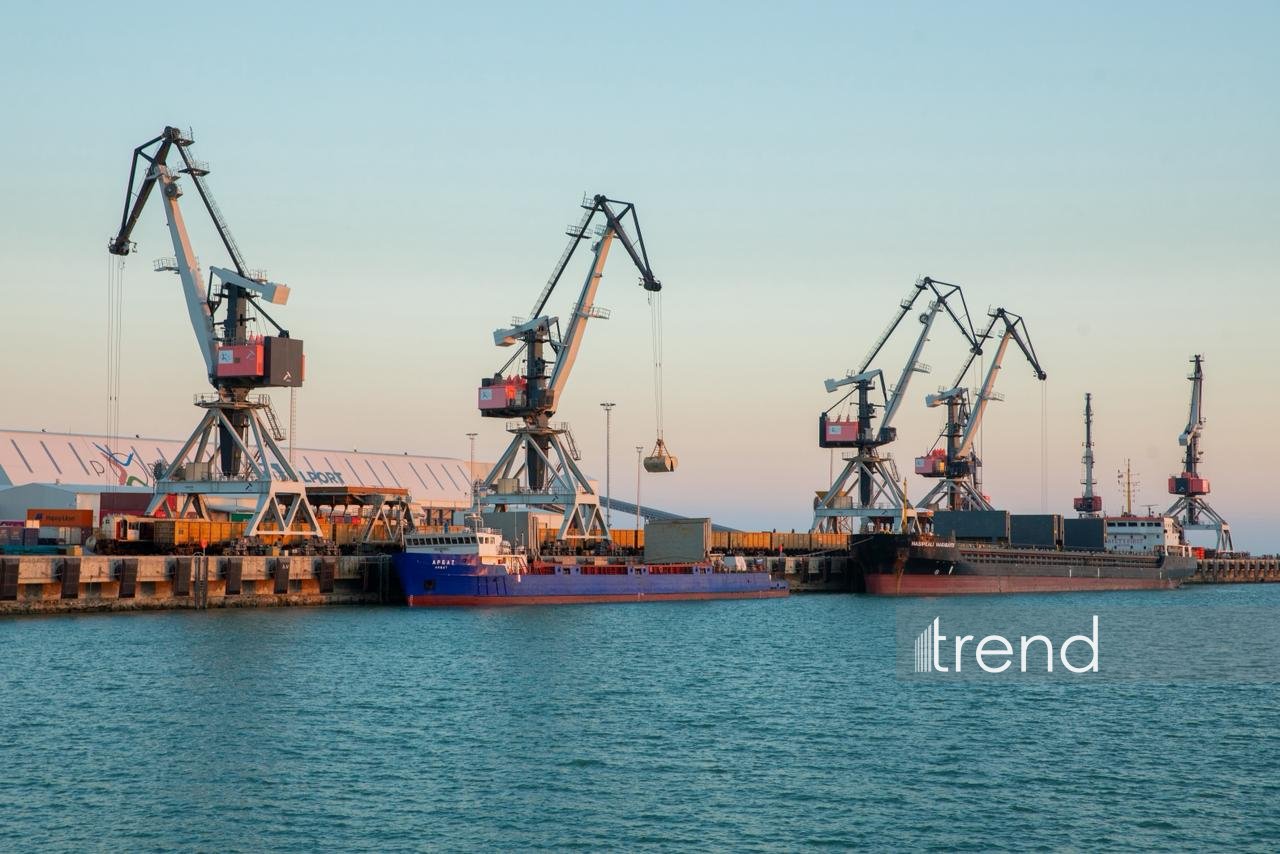

BAKU, Azerbaijan, January 26. The need for alternative, reliable, and sustainable logistics hubs in the Eurasian space is rapidly growing at a time when global supply chains are being reshaped, and traditional routes are facing geopolitical and economic risks. Namely, in this context, the Baku International Sea Trade Port (Baku Port) is becoming a point of strategic interest for dozens of countries, along with Azerbaijan, seeking to diversify cargo flows between Europe and Asia.
In recent years, the Trans-Caspian International Transport Route – more commonly known as the Middle Corridor – has entered a qualitatively new stage on the global trade agenda. This route, connecting China, Central Asia, the Caspian Basin, the South Caucasus, and Europe, has already begun to function as a major transit route for several cargoes. At the center of this route is the Port of Baku. Located at the intersection of the East-West and North-South corridors, the port plays the role of the main 'transit platform' of Eurasia, thanks to its multimodal capabilities - the integration of rail, road, and sea transport. Logically, container handling at the port has almost doubled in the last five years, and in 2025, the annual container turnover exceeded 100,000 TEU for the first time. Thus, from 2020 through 2025, the Baku International Sea Port of Azerbaijan Railways CJSC (ADY) handled more than 365,860 TEU containers. Last year alone, the port handled 107,540 TEU containers, marking a growth of almost 40% compared to 2024.
As of 2026, the port plans to handle more than 110,000 TEU of cargo. In general, the port aims to increase the annual cargo handling capacity to 260,000 TEU, which is quite different from the previous indicator. Currently, the annual cargo handling capacity of the port is 150,000 TEU. It would not be correct to explain this increase only with numbers. At the same time, we are talking about a combination of factors such as route safety, shortening delivery times, reducing risks, and optimizing costs. The World Bank's latest reports on Eurasian transport corridors also emphasize that the growth of transportation along the Middle Corridor is a real example of the adaptation of supply chains to geopolitical risks.
The completion of the first phase of the port's development in 2018 enabled the Port of Baku to achieve an annual handling capacity of 15 million tons of cargo and 100,000 TEU containers. However, the actual growth dynamics of cargo showed that this limit wasn't sufficient. That's why the planned expansion of the second phase - 25 million tons of cargo and 500,000 TEU containers per year - is considered a strategic necessity.
Director of the Baku International Sea Port, Eldar Salahov, told reporters during a media tour of the port late last year that the results of the design work on the second phase of the Port of Baku will be announced in the coming months. He recalled that work on the first phase of the Port of Baku had already been completed.
"The second phase of the Baku International Sea Trade Port will provide us with significantly increased capacity, including over 25 million tons of cargo and half a million TEU container equivalent. Design work is ongoing, and preliminary results are expected in the coming months," he said.
The remarkable point here is that Baku Port is not only increasing its capacity but also deepening its functionality. The fertilizer terminal, the planned wheat terminal, the TIR park, and the intermodal cargo terminal are transforming the port from a classic seaport into a complex logistics hub. Baku Port is becoming a critical transit gateway, especially in terms of access of fertilizers and agricultural products from Central Asian countries to European markets.
The merger of Baku Port into Azerbaijan Railways CJSC in February 2025 can be seen as a transition to a unified transport management model. This step will reduce transit time and lower logistics costs by strengthening coordination between sea and rail operations. The International Monetary Fund (IMF) also notes in its assessments of transport and trade flows that unified management models in multimodal transport significantly increase the competitive advantage of transit countries. In the case of the Port of Baku, this is already showing real results: the number of block trains is increasing, the waiting time for cargo is decreasing, and the quality of service is improving.
One of the most priority directions in the development strategy of the Port of Baku in recent years is digitalization. After the integration of the port into Azerbaijan Railways CJSC, this process has become more systematic and phased. The introduction of digital solutions not only increases operational transparency but also allows for the unification of information flows on a single platform and the formation of a customer-oriented service model.
The key steps in this direction include the development of a new generation solution for the Port Management Information System. Taking into account the technical limitations that emerged during the operation of the existing system from 2020 through 2023, work on a completely new concept has been started since 2025 and is currently in the active phase. The new system will integrate the port's ship, cargo, wagon, car, and warehouse operations into a single operational platform, allowing for real-time monitoring of cargo handling planning, queue management, bridge utilization, and resource allocation. As a result of integration with other information systems, customers will be able to obtain online information about the status of their cargo, stages of document execution, and operational processes, which will significantly improve the quality of service.
The second key component of the digitalization strategy is the automation of the port's internal business processes on a single platform. Within the framework of this phased project, the implementation of daily processes in procurement, finance, commercial, operational and control points is ensured in a digital environment. The integration established between the modules minimizes the re-entry of information, reduces risks arising from the human factor, and creates more complete reporting opportunities in real time. This approach, in addition to increasing flexibility in management, allows for more operational and justified decision-making.
The third important direction is the digitalization of security and surveillance infrastructure. At the initial stage of the project, modern surveillance and analytics equipment was installed in the port area, and the system was commissioned. Currently, work is underway to improve technical maintenance mechanisms and eliminate malfunctions detected in existing analytics systems. The next stage involves the creation of a centralized management zone that will ensure the management of all surveillance and security systems from a single center. This will create additional opportunities for the detection of operational risks at an earlier stage and the organization of cargo and transport traffic in the port area in a safer manner.
Overall, digitalization and the transition to unified management platforms at the Port of Baku significantly increase the speed of processes, while increasing the transparency and control capabilities of operations. Real-time data exchange, electronic documentation, and centralization of management functions reduce the port's operational burden, improve service quality, and turn the Port of Baku into a more flexible, predictable, and competitive logistics platform on the Middle Corridor.
The fact that the Port of Baku is the first port in the region to receive the EcoPorts certificate and the goal of net zero carbon emissions by 2035 further strengthen its international position. The Solar Panels and Battery Energy Storage System (BESS) project enhances the port's sustainability not only in terms of environmental sustainability but also in terms of energy security. For example, among the steps taken in this direction, we can mention the signing of a framework agreement on the installation of solar panels at the Baku Port within the framework of COP29. This agreement, signed with Tiza Green Energy, a subsidiary of Citaglobal, for the construction of a 5.4 MW solar photovoltaic (PV) plant, once again highlighted the role of the port in Azerbaijan's transition to clean energy.
Western think tanks emphasize in their latest reports that for European companies, the 'green' status of logistics hubs is no longer an additional advantage, but one of the main selection criteria. In this regard, the Port of Baku acts not only as a transit point for European investors but also as a platform for long-term partnerships.
The role of the Port of Baku has long gone beyond the borders of Azerbaijan. For Kazakhstan, Uzbekistan, Turkmenistan, China, Türkiye, and European countries, the port can be considered a critical link in the supply chain. The rapid increase in container traffic in China-Europe cargo flows, the opening of new block-train routes along the Middle Corridor, and the interest of international financial institutions in the project clearly demonstrate this.
The fact that representatives of the World Bank discussed the possibility of participating in the financing of the expansion of the Baku Port also confirms that the port is perceived not as a regional, but as a global logistics infrastructure.
Thus, the Baku Port is emerging as one of the main pillars of the new trade architecture against the backdrop of changing geopolitical and economic realities in Eurasia. Infrastructure expansion, 'green' transformation, and international partnerships are making the port increasingly visible on the global logistics map. In this sense, the development of the Baku Port can be seen as a strategic process that, along with Azerbaijan's transit ambitions, supports the formation of a more secure, sustainable, and predictable trade system between Europe and Asia.



