


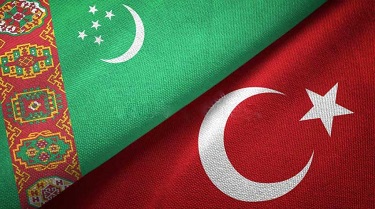

BAKU, Azerbaijan, February 6. In recent years, Turkmen-Turkish relations have been on the upswing, moving beyond the usual back-and-forth of bilateral ties. Since the establishment of diplomatic relations in 1992, the two sides have consistently developed interaction in trade, energy, construction, transport, and the humanitarian sphere, drawing on both shared cultural and historical roots and aligned strategic interests in Eurasia. Türkiye is among Turkmenistan’s key trade and economic partners, and the institutional framework for cooperation is reinforced through joint work within the Organization of Turkic States and its Economic Council, as well as multilateral platforms such as ECO and the UN.
The 12th Turkish Export Products Exhibition, scheduled to take place in Ashgabat from February 10 through 12, 2026, represents the next step in economic dialogue. The event is organized with the participation of the Turkmen Chamber of Commerce and Industry and the Ministry of Trade of Türkiye and is seen as a platform to expand direct contacts between business circles of the two countries. As of January 2026, around 100 Turkish companies had registered for the exhibition, significantly exceeding the participation of more than 70 companies at the 11th exhibition in 2024.
The exhibition casts a wide net across various sectors, including industrial equipment, construction materials, pharmaceuticals, textiles, food products, household appliances, and chemical products. All in all, this showcases Türkiye’s goal to not just boost exports but also to cement its foothold in crucial areas of Turkmenistan’s economy through enduring commercial and investment relationships.
The exhibition coincides with a visit by Türkiye’s Minister of Trade Omer Bolat, whose program includes participation in the official opening and meetings with the leadership of the Turkmen Chamber of Commerce and Industry and relevant economic agencies.
At the end of January 2026, Türkiye’s Ambassador to Turkmenistan, Ahmet Demirok, announced his country’s intention to simplify customs and logistics procedures trilaterally with Azerbaijan and Turkmenistan. During the minister’s visit, practical mechanisms for implementing this initiative are expected to be discussed, along with measures to increase bilateral trade turnover.
The minister’s visit is just another cog in the wheel of ongoing intergovernmental connections, the most significant of which was President Recep Tayyip Erdoğan’s visit to Ashgabat in December 2025 to participate in the International Forum on the 30th anniversary of Turkmenistan’s permanent neutrality. Following that visit, President Erdoğan announced Türkiye’s plans to raise bilateral trade turnover from the current $2 billion to $5 billion.
Since Turkmenistan’s independence, Turkish companies have implemented more than 1,000 projects in the country with a total value exceeding $54 billion. Currently, 19 projects worth around $10 billion are ongoing. Türkiye’s main investment areas remain construction, energy, textiles, and infrastructure. According to the Eurasian Development Bank, Turkmenistan holds the largest share of Türkiye’s total investments in Central Asia. Among two major projects alone, Ankara invested $1.1 billion, including the construction of the Turkmenistan-Afghanistan-Pakistan (TAP) power transmission line.
A key practical dimension of Turkmen-Turkish economic cooperation is logistics, in which Azerbaijan plays a central role. The Turkmenistan-Azerbaijan-Türkiye trilateral link forms one of the main routes of the Trans-Caspian International Transport Corridor, also known as the Middle Corridor.
Within this framework, Turkmenistan provides access to the Caspian Sea via the Turkmenbashi port, from where cargo flows proceed to the port of Baku and then by rail along the Baku-Tbilisi-Kars line to Türkiye and further to European markets. This route allows diversification of transport chains and reduces dependence on alternative directions, enhancing trade resilience amid regional and global risks.
Logistics development is complemented by institutional mechanisms within the Organization of Turkic States, of which Turkmenistan has been a full member since 2022. Member countries promote initiatives to simplify trade procedures, digitize transit, and create unified logistics solutions, including the e-Permit electronic system and coordination of transport operators. Additional legal support is provided by bilateral agreements between Türkiye and Turkmenistan in economic cooperation, as well as memorandums on the development of the Middle Corridor signed between 2022 and 2025.
In the broader regional context, Turkmen-Turkish cooperation aligns with Ankara’s strategy to expand its economic presence in Central Asia. In recent years, key tools for strengthening Türkiye’s presence have included investment projects, participation of Turkish companies in infrastructure construction, and development of transport corridors connecting Central Asia to European markets. In this scenario, Turkmenistan stands out as the vital connection in regional logistics and serves as one of the biggest playgrounds for Turkish business in the area.
The geopolitical aspect of this dynamic relates to Türkiye’s efforts to diversify transport options and reduce the risk of bottlenecks along the Middle Corridor. Expanding access to Central Asian infrastructure, including Turkmenistan, allows Ankara to flexibly manage trade and transit routes.
In this context, at the end of January 2026, a delegation from the Turkmenbashi International Sea Port held talks with Azerbaijani counterparts on cooperation in developing the Caspian-Black Sea transport corridor, with the ports of Baku and Turkmenbashi serving as key nodes in this logistics chain.
For Turkmenistan, deepening cooperation with Türkiye opens additional opportunities to diversify foreign economic ties and enhance strategic autonomy by balancing foreign policy and economic vectors.
Thus, the upcoming Turkish Export Products Exhibition in Ashgabat and the visit of the Minister of Trade are not isolated events but part of a broader and consistent effort to deepen Turkmen-Turkish engagement. Against the backdrop of stable trade performance, a significant investment portfolio, and active regional transport initiatives, these steps reflect the parties’ desire to translate political signals and institutional agreements into practical economic cooperation.



