


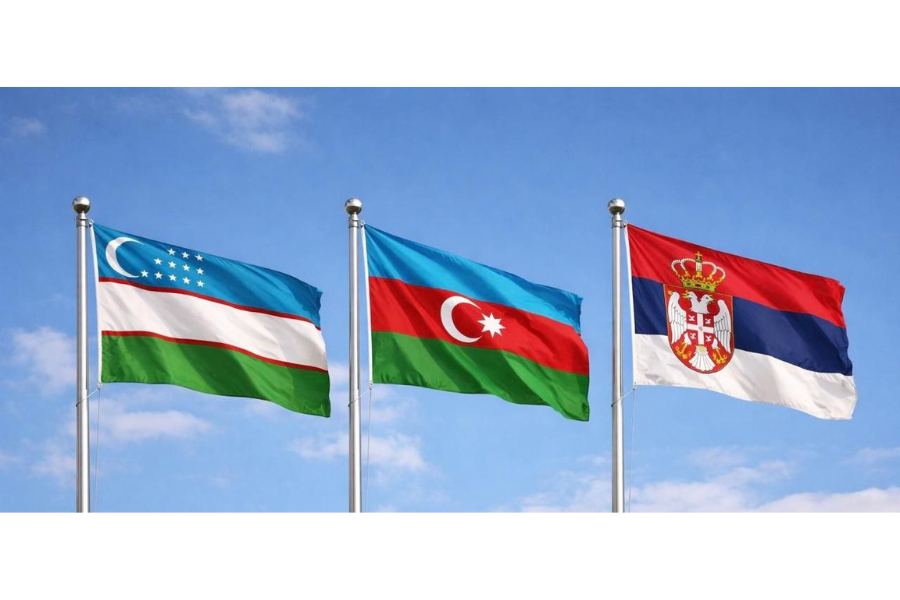

BAKU, Azerbaijan, February 17. In recent months, the relationship between Uzbekistan and Serbia has gained significant momentum. The forthcoming business forum, scheduled for February 20, 2026, in Tashkent, underscores the mutual intent to shift bilateral cooperation toward a more practical and results-oriented framework. For Uzbekistan, this reflects a broader strategic effort to fortify ties with European nations and diversify foreign trade partnerships.
A defining moment that injected new energy into bilateral relations was the official visit of Serbian President Aleksandar Vučić to Uzbekistan from October 28-31, 2025. This historic visit marked the first by a Serbian head of state and signalled both sides’ commitment to transitioning from political dialogue to tangible economic engagement. The business forum held during this visit laid the groundwork for the establishment of regular business exchanges between the two countries.
In January 2026, the two nations held another business event, and the upcoming February forum will represent the third such meeting within a relatively short time frame. This growing frequency of engagements highlights a deepening interest from both governments and the private sector in expanding and solidifying their economic collaboration.
During Vučić’s visit, several agreements were signed in the presence of the two leaders, focusing on the promotion and protection of investments, the development of economic partnership, and cooperation in engineering, advanced technologies, and artificial intelligence. In addition, a cooperation program between the foreign ministries for 2026–2027 was approved, and partnership ties were established between Tashkent and Belgrade. These arrangements created clearer conditions for business and laid the groundwork for joint projects.
Special attention in the Uzbek-Serbian dialogue has also been devoted to transport connectivity. Uzbekistan and Serbia emphasized the importance of developing new routes that could link Central Asia and the Balkans, including within the framework of the Trans-Caspian Corridor. For landlocked Uzbekistan, expanding alternative logistics directions is becoming one of the key tools for diversifying foreign trade and reducing reliance on traditional transit routes.
In this emerging transport architecture, Azerbaijan plays an important role as a crucial link in the Middle Corridor. Through Azerbaijan’s infrastructure, its Caspian Sea ports, railway routes, and transit hubs, Central Asian countries gain access to European markets via the South Caucasus and Türkiye.
Against this backdrop, the intensification of Azerbaijani-Serbian relations stands out as particularly significant. On February 15-16, Serbian President Aleksandar Vučić hosted Azerbaijani President Ilham Aliyev in Belgrade, further reinforcing the ties between the two nations. The discussions between Baku and Belgrade highlighted Serbia's growing interest in fostering cooperation with the Caspian region, while also creating a conducive environment for Uzbekistan, which is likewise strengthening its connections with the Balkans.
“Partnership between Azerbaijan and Serbia, particularly within the Middle Corridor, demonstrates one of the fastest rates of development globally. Our economic cooperation, which follows strong political relations, is becoming increasingly diversified, facilitated by a shared transport route,” remarked Serbian Minister of Domestic and Foreign Trade Jagoda Lazarević during the First Azerbaijan International Investment Forum in Baku.
This development reflects a broader regional trend: Balkan countries are progressively turning to the Trans-Caspian route as a viable alternative to traditional trade corridors, with Azerbaijan positioning itself as a critical transit hub bridging Central Asia and Europe. For Uzbekistan, this evolving configuration presents new opportunities to access emerging markets and further solidify its economic connections with Southeast Europe.
Amid growing interest in new logistics routes and expanding economic connections between Central Asia and the Balkans, the upcoming Uzbekistan–Serbia Business Forum in Tashkent will serve as another platform for discussing concrete joint projects.
The event is expected to help companies from both countries establish direct contacts and identify practical areas of cooperation. Key sectors in focus include mechanical engineering, agriculture and agro-processing, pharmaceuticals, the chemical industry, construction materials, textiles, and information technologies. Uzbekistan aims to present opportunities for production localization and joint ventures, while Serbia views Uzbekistan as a promising market with rising domestic demand.
Economic cooperation between the two countries remains limited in scale but has shown positive dynamics. In 2022, bilateral trade turnover grew by 134%, followed by a further 63% increase in 2024. In January–September 2025, trade continued to expand by 2.5%.
Currently, nine enterprises with Serbian capital are registered in Uzbekistan, including four joint ventures and five fully foreign-owned companies. These firms operate mainly in construction materials, trade, services, mechanical engineering, as well as furniture and household goods production.
Serbia exports construction and finishing materials, furniture, chemical products, marble, and agricultural goods to Uzbekistan. Uzbekistan, in turn, supplies cotton yarn, textiles, and legumes to Serbia. Despite still modest trade volumes, both sides acknowledge significant untapped potential.
“We see great opportunities to expand our partnership in the economic sphere and are ready to give it a practical character,” Uzbekistan’s Foreign Minister Bakhtiyor Saidov noted during a phone conversation with Serbia’s First Deputy Prime Minister and Foreign Minister.
In addition to economic matters, the two nations are exploring the expansion of humanitarian cooperation, which includes academic exchanges, cultural programs, and the potential establishment of direct air links between Tashkent and Belgrade. Labor migration also remains a significant focus, as the number of Uzbek nationals receiving work visas for Serbia has risen markedly in recent years.
The Uzbekistan-Serbia partnership is gradually transitioning into a more tangible phase, with emphasis on concrete projects, investments, and the development of new trade and logistics routes. For Tashkent, this marks another pivotal step in deepening ties with Europe, while for Belgrade, it presents a valuable opportunity to broaden its footprint in Central Asia.



