


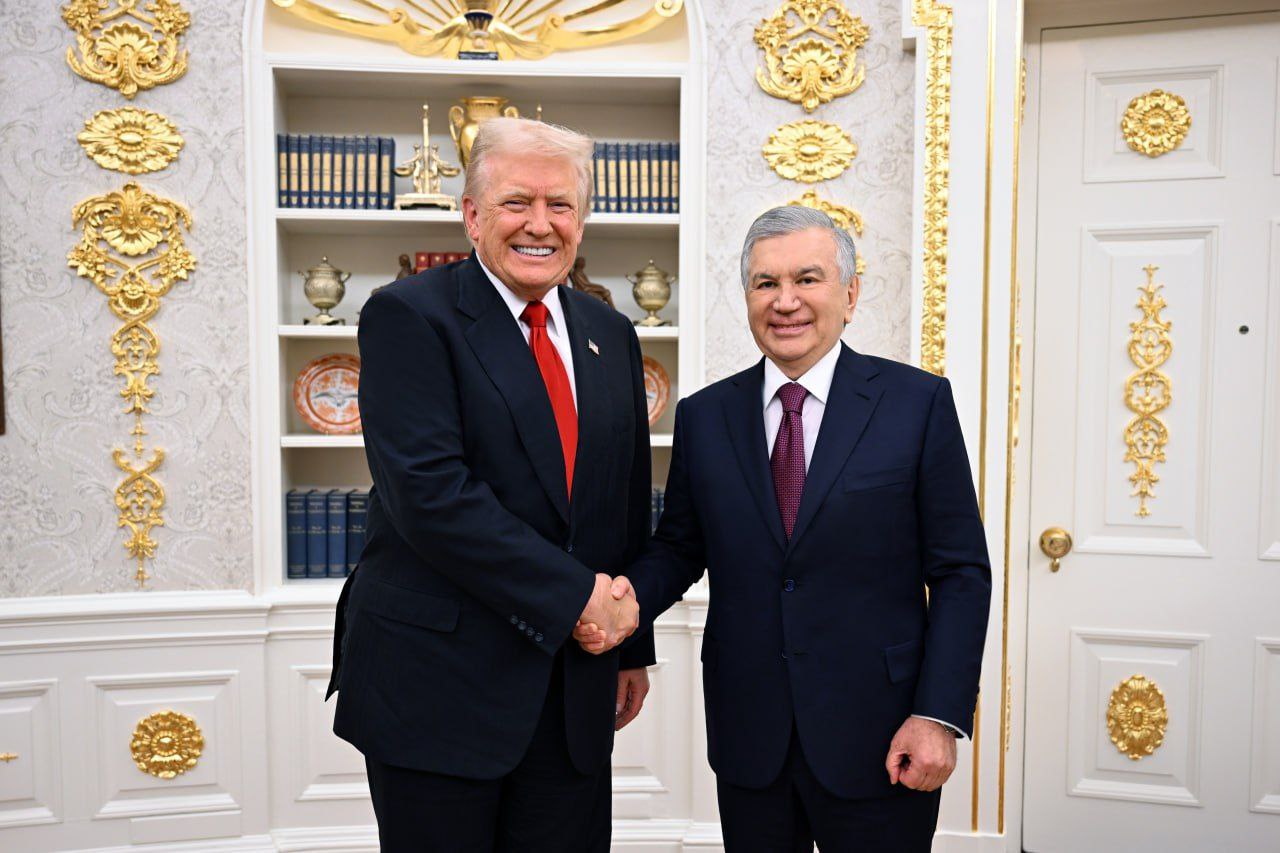

BAKU, Azerbaijan, February 24. In recent years, the United States' engagement with Central Asia has evolved into a more systematic and strategic approach. Washington is strengthening its political dialogue, expanding its economic footprint, and working to solidify its position in a region that has increasingly emerged as a pivotal nexus between East and West.
In this setup, Uzbekistan holds a pivotal position. This nation stands out as one of the foremost beneficiaries of U.S. aid in the region, thanks to its strategic position at the center of Central Asia and its closeness to the tumultuous landscape of Afghanistan. Washington views Tashkent as a key partner, extending beyond security to encompass infrastructure development, energy initiatives, and trade routes. In the face of increasing competition for influence, the United States sees its engagement with Uzbekistan as a crucial, long-term component of its regional strategy.
Against this backdrop, Uzbek President Shavkat Mirziyoyev’s visit to the United States on February 17-19 became a logical continuation of the course toward deepening cooperation.
The political dimension of the trip was reflected in Mirziyoyev’s participation in the inaugural meeting of the Peace Council, established at the initiative of U.S. President Donald Trump. The Council is dedicated to the reconstruction and humanitarian assistance efforts in the Gaza Strip. In January of this year, Uzbekistan proudly became a founding state during the event in Davos. This move broadens the scope of dialogue between Tashkent and Washington, extending beyond regional concerns and highlighting Uzbekistan's commitment to participating in wider international initiatives.
The economic aspect of the visit was the heart of the matter. The trip unfolded under the shadow of a previously unveiled three-year Economic Cooperation Program valued at $35 billion.
“I am thrilled to announce an incredible trade and economic deal between the United States and Uzbekistan. Over the next three years, Uzbekistan will be purchasing and investing almost $35 billion and, in the next 10 years, over $100 billion in key American sectors, including critical minerals, aviation, automotive parts, infrastructure, Agriculture, energy & chemicals, information technology, and others,” Donald Trump wrote on Truth Social following his meeting with Central Asian leaders in Washington in November 2025.
When compared with the current level of bilateral trade, which exceeds $1 billion, these figures point to a qualitatively new scale of interaction. In effect, the discussion is shifting from gradual trade growth to the formation of a deeper investment architecture.
The February negotiations demonstrated both sides’ intention to give practical substance to these agreements. One of the key outcomes was an agreement to launch a new bilateral investment platform designed to structure large-scale projects and ensure long-term financing.
In addition, during the visit, the U.S. Export-Import Bank announced its intention to expand support for industrial and infrastructure projects in Uzbekistan. The U.S. International Development Finance Corporation (DFC) confirmed its readiness to invest in major national and regional initiatives, with particular attention to energy and financial market development.
In Mirziyoyev’s presence, a flurry of bilateral documents was signed, paving the way for a network of gas stations, the rollout of sprinkler irrigation technologies, initiatives for extracting and supplying critical minerals, the establishment of a poultry cluster, the enhancement of the agro-industrial complex, the financial market, and the fine-tuning of the investment climate. Notably, cooperation spans a wide range of areas - from raw materials and infrastructure to agriculture and the financial system. Such a diversified approach reduces dependence on a single sector and forms a more sustainable, long-term model of engagement.
Simultaneously, the trend of institutional convergence persists. Uzbekistan is modernizing its financial sector and capital market with the backing of American experts while also enhancing investment protection mechanisms.
“Over the past years, Uzbekistan has taken significant steps in transitioning from a centralized economy to a market economy. Laws have been adopted to protect investments, including guarantees for foreign investors. The 2017 Strategy, ‘New Uzbekistan’ 2022, and ‘Uzbekistan-2030’ are clear examples of this,” said Carolyn Lamm, Chairperson of the American-Uzbekistan Chamber of Commerce (AUCC), during the Uzbek-American Business Forum in Tashkent.
The United States is lending a hand to Uzbekistan as it navigates the waters of joining the World Trade Organization, a move that Tashkent sees as a key step to solidify its standing in global markets and boost the appeal of its economy for investors.
At the same time, the deepening of collaboration is unfolding amidst a tangled web of regional dynamics. China keeps its fingers in many pies in Central Asia, while Russia continues to be a key player in the economic game, and the European Union is stepping up to the plate with its own transport plans. The situation in Afghanistan continues to be a wild card in the mix.
In this context, the bolstering of ties with the United States can be viewed as part of diversification strategy. Tashkent sees this as a chance to broaden its investment and technology avenues, enhance its bargaining power, and speed up internal reforms. For Washington, it offers a chance to consolidate its economic and political presence in a key country of the region.
The February visit demonstrated that Uzbek-U.S. relations are moving to a more structured level. The key question now is the implementation of the declared agreements and the ability of both sides to translate large-scale figures into concrete projects. Even partial implementation of the program could significantly transform the scale of bilateral ties and reinforce Uzbekistan’s position as one of the United States’ central partners in Central Asia.



