



BAKU, Azerbaijan, December 26. The Southern Gas Corridor (SGC) started transportation of Azerbaijani gas to Europe on December 31, 2020. It transports gas from the Caspian Sea region to European countries through Georgia and Türkiye.
This large-scale project is aimed at diversifying energy supply routes and sources, thereby contributing to strengthening Europe’s energy security. The project’s cost totaled $33 billion, as compared to the forecast of $45 billion. Capital expenditures on the SGC project are expected to be fully reimbursed within 8-10 years.
The data obtained from the State Customs Committee of Azerbaijan shows that the total export of natural gas from the country amounted to 22.8 billion cubic meters in the first 11 months of 2025, which is almost 3% less compared to the same period in 2024.
Back on July 18, 2022, a "Memorandum of Understanding on Strategic Partnership in the field of energy between the European Union, represented by the European Commission, and the Republic of Azerbaijan" was signed between Azerbaijan and the European Union, when the sides agreed to support bilateral trade of natural gas, including exports to the European Union, via the Southern Gas Corridor, of at least 20 billion cubic meters of gas annually by 2027, in accordance with commercial viability and market demand.
In July 2025, Moody's upgraded the Southern Gas Corridor CJSC's long-term foreign currency rating from Ba1 to Baa3, assigning the company an investment grade rating. The positive outlook on the rating was maintained.
This decision was made against the backdrop of strengthening the institutional capacity of the Azerbaijani government and maintaining macroeconomic stability. The country's increasing fiscal resilience, reduced dependence on oil revenues, and steps toward economic diversification also positively impact the sustainability of the Southern Gas Corridor project.
In November 2025, XRG, ADNOC's international energy investment arm, signed a non-binding Term Sheet with the Ministry of Economy of the Republic of Azerbaijan for the acquisition of a stake in the Southern Gas Corridor Closed Joint-Stock Company (CJSC).
The document was signed in accordance with the Memorandum of Understanding on Investments in the Southern Gas Corridor between the Ministry of Economy of Azerbaijan and XRG ASC, which was agreed upon during a meeting between President of the Republic of Azerbaijan Ilham Aliyev and President of the UAE Sheikh Mohammed bin Zayed Al Nahyan in September 2025.
In December 2025, the international rating agency Fitch Ratings assigned Southern Gas Corridor Closed Joint-Stock Company a long-term issuer default rating of 'BBB-' with a stable outlook.
Fitch Ratings forecasts that Southern Gas Corridor Closed Joint-Stock Company (CJSC) capital expenditures will average $0.2 billion per year from 2025 through 2028.
The rating agency expects the company to generate stable gas transportation revenues of approximately $1.5 billion per year during this period.
"As of August 31, 2025, Southern Gas Corridor CJSC had $2.3 billion in cash and deposits and $1.5 billion in funds under a treasury agreement with SOCAR Capital. The $2 billion Eurobond matures in March 2026, and we expect CJSC to repay it from its existing funds. Repayments in 2025–2028 include only modest annual amortization payments on bank loans of approximately $0.12 billion. We expect CJSC to generate positive free cash flow before dividend payments in 2025–2028," Fitch noted in its report.
The agency also emphasized that Southern Gas Corridor's debt includes a $2 billion Eurobond and $1.5 billion in loans from international financial institutions maturing from 2032 through 2046, including the European Bank for Reconstruction and Development, the Asian Infrastructure Investment Bank, the International Bank for Reconstruction and Development, and the Asian Development Bank.
Fitch forecasts that gas transportation EBITDA (Earnings Before Interest, Taxes, Depreciation, and Amortization,) will remain stable in absolute terms, and its share of total EBITDA will gradually increase to around 80% in 2027, compared to approximately 60% in 2024.
However, Southern Gas Corridor's upstream segment is under pressure due to a gradual decline in production amid the natural depletion of the Shah Deniz field. Furthermore, it's dependent on gas and oil prices, as a significant portion of contracted gas volumes is linked to commodity market prices.
According to Fitch, upstream EBITDA will gradually decline between 2025 and 2028, and its share of total EBITDA will decrease from approximately 40% in 2024. This is due to the expected decline in production and Fitch's projected decline in Brent and TTF prices.
The rating agency predicts that, from 2026, Southern Gas Corridor CJSC will direct the majority of its annual generated funds to SOCAR and the state as dividends.
Trans-Anatolian Natural Gas Pipeline (TANAP)
TANAP transports gas from Stage 2 of Azerbaijan’s Shah Deniz field from the Georgian-Turkish border to Türkiye’s western border. The total cost of TANAP turned out to be lower than $7 billion.
The initial capacity of TANAP is 16 billion cubic meters of gas per year, with the possibility of expanding to 31 billion cubic meters per year in the future. Around six billion cubic meters of gas are delivered to Türkiye, while the rest of the volume is supplied to Europe.
TANAP shareholders are as follows: Southern Gas Corridor CJSC – 51 %, SOCAR Türkiye Enerji—seven %, BOTAS – 30 %, and bp – 12 %.
The filling of the TANAP pipeline across Türkiye began in late January 2018.
A ceremony to launch Phase 0 of TANAP took place on June 12, 2018, in the Turkish city of Eskisehir. First commercial gas deliveries to Türkiye commenced on June 30, 2018. The opening ceremony of TANAP’s connecting with Europe took place on Nov. 30, 2019, in Ipsala town (Edirne province, Türkiye).
For expansion, it is necessary to add several additional compressor stations in order to achieve a throughput of 24 billion cubic meters per year. To achieve a capacity of 31 billion cubic meters, a total of seven compressor stations will be required.
Project status
In March 2025, bp and Apollo announced they had reached agreements for Apollo to acquire a 25% non-controlling stake in BP Pipelines (TANAP) Ltd. – bp TANAP, a subsidiary of bp, which holds a 12% stake in TANAP.
Under the agreement, Apollo acquired a non-controlling stake in bp TANAP for approximately $1 billion. Proceeds from this transaction will contribute to bp's $20 billion asset divestment and other cash acquisition program.
While the transaction allows bp to monetize its stake in TANAP, the company remains the controlling shareholder of bp TANAP and retains long-term commercial and strategic interests, including management rights, in the pipeline.
In September, medium- and long-term environmental, social, and governance (ESG) objectives for TANAP were announced.
By 2030, TANAP plans to:
- implement renewable energy projects at its facilities;
- implement international ESG standards in its reporting practices;
- expand climate resilience initiatives in local communities;
- modernize infrastructure to reduce emissions;
- increase the level of digitalization and efficiency in sustainability management.
By 2035, the company's long-term ESG goals include:
- implement hydrogen and synthetic methane blending technologies in the system;
- strengthen emissions monitoring and management;
- review and update the overall sustainability strategy in line with global energy transition goals.
From January through September 2025, TANAP exported 4.3 billion cubic meters of gas to Türkiye, up from 4.2 billion cubic meters in the same period in 2024.
The estimated useful life of the TANAP system is expected to last until 2062.
Trans Adriatic Pipeline (TAP)
TAP transports natural gas from the Shah Deniz field to Europe.
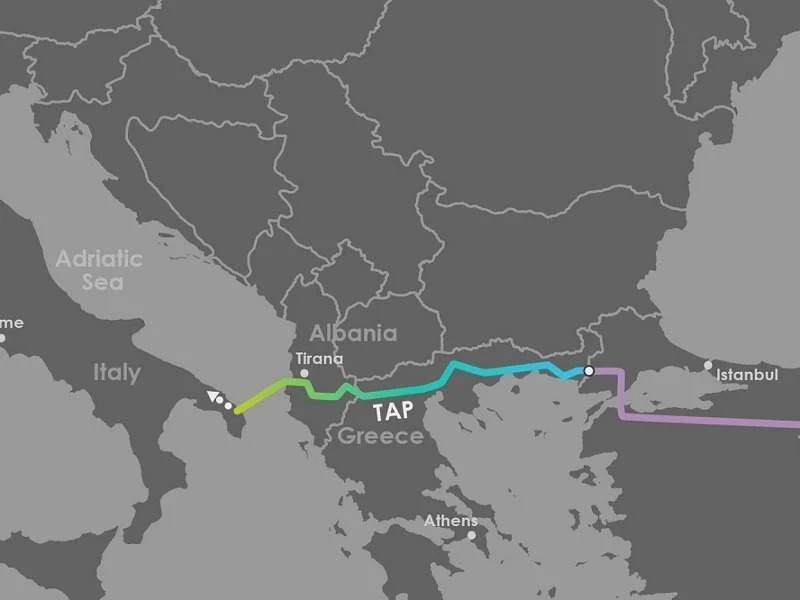
The length of the gas pipeline is 877 kilometers. It connects with the Trans-Anatolian Pipeline at the Turkish-Greek border at Kipoi, passes through Greece and Albania, crosses the Adriatic Sea, and makes landfall in Southern Italy.
The pipeline ensures gas supply to countries in South-East Europe through existing and prospective interconnectors. The pipeline is connected to the Greece-Bulgaria Interconnector (IGB), which began commercial operation in October 2022, supplying Caspian gas to Bulgaria, thus enhancing the energy security of another European country. The exit points of the Trans-Adriatic Pipeline (TAP) in Greece and Albania, as well as the land point in Italy, create numerous opportunities for further transportation of Azerbaijani gas to broader European markets.
As a key part of the Southern Gas Corridor, the TAP is of strategic and economic importance for Europe, providing reliable access to a new source of natural gas. TAP plays an important role in strengthening Europe's energy security, diversifying supplies, and achieving its decarbonization goals.
The TAP shareholders are bp (20 %), SOCAR (20 %), Snam (20 %), and Enagas (20 %).
Project status
This January, the TAP AG consortium signed a contract with Penspen to provide services for analyzing gaps in infrastructure to assess the readiness of the pipeline for hydrogen integration.
Penspen’s engineering team from the UK will conduct a thorough analysis of data and a field assessment of TAP’s ground installations (AGI), line valves (BV), and compressor stations (CS). This study will evaluate the feasibility of introducing hydrogen blends into the existing gas infrastructure, supporting TAP’s strategy to expand capacity for new volumes of hydrogen and other renewable gases, thus promoting long-term sustainability and decarbonization in the region.
Penspen will assist TAP in ensuring the safe and sustainable blending of hydrogen while maintaining the safety and reliability of TAP’s existing gas transportation infrastructure in Europe.
In January, the consortium announced that a roadmap had been defined for the preparation of medium- and long-term transportation of natural gas and hydrogen blends, as well as renewable gases. A preliminary study conducted in 2021 confirmed TAP’s potential for transporting hydrogen blends in the future. Pipeline material testing is currently underway in an international laboratory, with the first test results expected in the fourth quarter of 2024 and currently under evaluation.
The necessary modifications can only be determined after a complete analysis of the suitability of the existing pipeline and other equipment.
After the material tests are completed, they will undergo thorough evaluation. Additionally, the suitability of other equipment required for hydrogen transportation will need to be assessed, and these results should be taken into account. Only after all checks are carried out will TAP’s readiness for hydrogen transportation be more accurately determined.
This February, TAP Italia received the EMAS certificate (Environmental Management and Audit Scheme)—a voluntary environmental protection tool created by the European Union for monitoring and controlling the environmental impact of organizational activities and publishing information in the form of environmental statements.
In October, TAP AG launched a new online registration portal, simplifying and speeding up the process for stakeholders wishing to become TAP shippers.
The interface serves as a centralized nexus for the submission
of requisite forms and documentation. The newly implemented
framework supersedes the antiquated email-centric methodology,
delivering enhanced visibility and operational efficacy.
The newly implemented framework facilitates TAP in sustaining a
contemporary and dependable document repository, thereby augmenting
the precision and operational efficacy of quotidian processes.
In October, TAP confirmed its commitment to the Gold Standard Pathway under the Oil & Gas Methane Partnership 2.0 (OGMP 2.0) initiative, the UN Environment Programme’s leading initiative for methane emissions accounting and reduction.
This important recognition reflects TAP’s dedication to more accurately understanding, quantifying, and reducing methane emissions at all stages of its operations. The certification confirms that TAP has developed a detailed roadmap for measuring and accounting for methane emissions in accordance with the stringent OGMP 2.0 standards, which serve as a global benchmark for transparency and effectiveness in the oil and gas sector.
The Gold Standard Pathway is a key step toward obtaining the Gold Standard Reporting certificate, which TAP plans to receive in 2026 after fully implementing all measurement-based emissions accounting requirements.
In November, TAP Italia successfully renewed its European environmental certification, confirming compliance with the strict EU environmental management standards.
The certificate renewal followed the submission of TAP Italia’s updated Environmental Declaration Report for 2025–2027 to the ISPRA (Istituto Superiore per la Protezione e la Ricerca Ambientale) Eco-Audit and Eco-Labeling Committee. The new document includes updated key environmental performance indicators, reflects improvements achieved at TAP’s facilities in Italy, and sets goals for the upcoming three-year period.
On November 15, five years passed since the commercial operation of TAP began. During this time, approximately 52.7 billion cubic meters of natural gas have been transported through TAP.
TAP successfully completed work on the Kipoi compressor station in Greece as part of the first phase of capacity expansion, which will allow an additional 1.2 billion cubic meters of gas per year to be supplied to Europe on a long-term basis starting from January 1, 2026. The expansion project, which began in January 2024, was completed ahead of schedule, within budget, safely, and without interrupting current gas deliveries. Of this volume, 1.04 billion cubic meters per year are reserved for delivery to Italy, and 0.16 billion cubic meters per year are reserved for Albania.
The conversion of the ACS02 measurement station in Bilisht, Albania, into a compressor station is a potential project that could be implemented only if the results of the market test justify the new phase of expansion, including the doubling of TAP’s capacity.
TAP’s long-term capacity, currently around 10 billion cubic meters per year, could be gradually increased to approximately 20 billion cubic meters per year based on the results of a market test—an regulated procedure conducted every two years to assess market demand for expanding the pipeline’s long-term capacity. If the need for a new expansion phase, up to doubling TAP’s capacity, is confirmed by the market test, additional compression capacity will be required in Albania. In this context, the ACS02 facility in Bilisht, which currently serves as a measurement station, will need to be upgraded to a compressor station.
Currently, two market tests are underway: the binding phase of the 2023 market test and the non-binding phase of the 2025 market test.
Any additional expansion will only be necessary if the market demonstrates sufficient long-term demand for capacity through these processes. The total applications for binding capacity potentially received during the market test will need to undergo an Economic Viability Test (EVT) before an investment decision is made. If the implementation of a new expansion phase, up to doubling TAP’s capacity, is confirmed by the market test, the Environmental and Social Impact Assessment (ESIA) for TAP will need to be amended. As part of the amendment process, local residents and stakeholders are invited to participate in public hearings, which will be held on December 5 in the Devoli Municipality (Albania). During the hearings, information about the potential project will be provided, and there will be an opportunity to ask questions and leave comments. The public hearings are organized jointly with the Devoli Municipality in accordance with Albanian law and TAP’s commitment to transparent stakeholder engagement.
The conversion of the ACS02 measurement station in Bilisht, Albania, into a compressor station is a potential project that can only be realized if the results of the market test—a regulated procedure conducted every two years to assess long-term demand for pipeline capacity expansion—justify a new expansion phase, including the doubling of TAP’s capacity. The consortium has begun conducting the environmental assessment for the project.
Upon execution of this initiative, the current ACS02 measurement station will undergo a transformation into a compressor station, thereby augmenting gas pressure within the pre-existing pipeline infrastructure. This enhancement will facilitate a substantial escalation in the annual throughput capacity for natural gas transportation, elevating it from the present 10 billion cubic meters to an impressive 20 billion cubic meters annually.
The existing measurement station will be converted from its current configuration into a compressor station by installing up to four electric-drive compressors, each with a capacity of 35 MW, along with corresponding air coolers, providing a total installed capacity of up to 140 MW.
Existing environmental permits in Albania already anticipated the transformation of ACS02 into a compressor station with gas turbine compressors. The updated proposal for increased capacity now suggests replacing the gas turbines with fully electrified systems. This change will require the installation of a high-voltage substation and connection to the relevant national electricity grid in Albania. The electrified station will avoid CO2 emissions compared to the original project and will ensure alignment with energy transition and climate goals.
Over the past five years, the number of companies registered to transport gas through the Trans Adriatic Pipeline has grown from three to forty-six. These companies represent a diverse range of major European and regional energy players, trading houses, and utilities. Many of the new participants are actively operating in Greece and Bulgaria—markets that TAP has helped interconnect—further supporting new gas flows from Italy and Western Europe to Southeastern Europe.
Additionally, in December, it was announced that gas from TAP may also be supplied to Ukraine.
National energy regulators in Greece, Bulgaria, Romania, Moldova, and Ukraine have officially approved new transportation capacities—Route 2 and Route 3, which is an important step toward strengthening regional gas connectivity and supply security for Ukraine.
The decisions made ensure the possibility of supplying natural gas to Ukraine from two diversified sources:
- liquefied natural gas (LNG) from the Alexandroupolis FSRU floating terminal via the IGB pipeline;
- Caspian pipeline gas via the Trans Adriatic Pipeline (TAP) through the IGB pipeline.
Baku-Tbilisi-Erzurum (South Caucasus Pipeline - SCP)
The SCP has been operational since late 2006, transporting Shah Deniz gas to Azerbaijan, Georgia, and Türkiye. The expanded section of the pipeline commenced commercial deliveries to Türkiye in June 2018 and to Europe in December 2020.
The SCP Co. shareholders are: bp (29.99%), SGC (21.02%), LUKOIL (19.99%), TPAO (19 %), and NICO (10%).
Project status
The latest data obtained from bp shows that average daily export volumes via the South Caucasus Pipeline increased from 61.7 million cubic meters of gas per day in the first nine months of 2024 to 63.1 million cubic meters in the same period of 2025, representing a 2.3 % year-on-year increase.
In the first three quarters of 2025, SCPC (the pipeline operator) spent approximately $52 million on operating expenses and $21 million on capital expenditures. This compares to $60 million and approximately $13 million, respectively, in the same period last year. Therefore, operating expenses decreased by 13.3%, while capital expenditures increased by 61.5% year-on-year.
Interconnector Greece-Bulgaria (IGB)
IGB is a gas pipeline that allows Bulgaria to receive Azerbaijani gas, in particular, the gas produced from Azerbaijan's Shah Deniz 2 gas and condensate field. IGB is connected to TAP via which gas from the Shah Deniz field is delivered to the European markets.
The pipeline’s length is 182 kilometers.
In the first stage, the pipeline capacity stands at 3 billion cubic meters of gas, of which 2.7 billion cubic meters is offered for the long-term market, and the remaining share of 0.3 billion cubic meters is for the short-term market.
In a second phase, depending on the evolution of the market, the capacity of the pipeline can be increased to 5.3 billion cubic meters of gas thanks to the addition of a compression station: 4.5 billion cubic meters of gas will be offered for the long-term market, and 0.5 billion cubic meters will be offered for the short-term market.
Bulgarian Energy Holding EAD (BEH EAD) holds 50% of this project, while the remaining 50 % is owned by Greek DEPA and Italian Edison.
In January 2014, the Trans Adriatic Pipeline AG (TAP) and Interconnector Greece-Bulgaria (ICGB) signed a Memorandum of Understanding and Cooperation (MOUC) aimed at establishing the technical cooperation in order to further develop strategic infrastructure in the region.
The total investment cost of the project is estimated at around 240 million euro (excluding VAT), of which 220 million euro account for capital expenditures.
The IGB is designed to operate for 50 years.
Project status
In March, ICGB announced that it continues to view the expansion project as a strategic long-term task and is actively working on finding a sustainable financial model to support it.
The company believes that the expansion of IGB is a key element of the Vertical Gas Corridor, contributing to the strengthening of overall security and diversification of the European gas transportation network. To ensure the competitiveness of the project without imposing financial burdens on network users, funding through grants will be crucial.
In July, ICGB successfully implemented the Damas MMS:G commercial dispatching system as part of its digital transformation strategy. The deployment of the new platform was a significant step toward automating all the company’s commercial and operational processes, enhancing its capabilities for efficient, reliable, and transparent management of cross-border gas flows.
The Damas MMS:G system has become the digital core of ICGB's commercial operations, providing comprehensive management of gas transportation services, including:
- offering transportation capacities at interconnection points through auction platforms PRISMA and RBP
- managing capacity bookings and customer allocation
- full administration of nomination processes and coordination with operators of adjacent transport systems
- daily balancing, imbalance calculations, and preparation of regulatory and market reports
- issuing monthly invoices to customers via a specialized module
Additionally, the platform is fully integrated with the Balkan Gas Hub, enabling easy gas trading for market participants.
On July 8, ICGB launched the non-binding phase of the market interest assessment process for the expansion of the gas pipeline's capacity.
The assessment was aimed at determining the feasibility of increasing IGB’s technical capacity from three to five billion cubic meters per year.
In August, ICGB received permission for the construction of the first section (Lot 1) of the project to increase the capacity of the interconnector from three to five billion cubic meters of gas per year. The permit, issued by the Bulgarian Ministry of Regional Development and Public Works, covers the modernization of the gas metering station located near the Bulgarian city of Stara Zagora.
This key step allows ICGB to begin the procedure for selecting a contractor for design, supply, and construction (EPC). After the tender is completed, the contractor will install additional equipment for gas filtration and preheating, as well as build pressure reduction and gas measurement lines at the gas metering station near Stara Zagora. The modernization of Lot 1 will enable the station to handle increased throughput—up to five billion cubic meters of gas per year—while fully complying with safety and operational standards.
In addition, the company launched a new two-year cycle of the market interest assessment procedure for increasing capacity (incremental capacity process). Binding agreements are expected to be signed by the summer of 2026.
After approval of a sustainable financial plan and final investment decision by ICGB's shareholders, construction work on Lot 1 can begin. At the same time, documentation for the second section (gas metering station in the Greek city of Komotini) is being prepared to ensure the synchronized progress of both project components in line with the overall contracting strategy.
Although the expansion project is under review by the company’s shareholders, ICGB has already made significant progress: the procurement strategy has been approved, and the project for the first gas metering station is ready. The operator has completed the necessary preparatory work and continues to actively engage with international partners, including U.S. institutions, whose financial support could accelerate the final investment decision.
In November, ICGB joined regional partners in signing an agreement to launch two new route products aimed at supporting Ukraine.
The initiative also represents an important step in the development of the Vertical Gas Corridor. Gas Transmission System Operators (TSOs) agreed to create Routes 2 and 3, designed to strengthen energy security, regional connectivity, and market integration in Southeast and Eastern Europe.
Route 2 and Route 3 are intended for transporting natural gas from the LNG terminal in Alexandroupolis and the Trans Adriatic Pipeline (TAP) through the Greece–Bulgaria interconnector, further via the Trans-Balkan Gas Pipeline, through Romania and Moldova to Ukraine.
The creation of Routes 2 and 3 complements the successful launch of Route 1.
In a joint letter to regulators, the operators proposed to make Routes 2 and 3 available from December 2025 to April 2026, synchronizing their timelines with the operation of Route 1.
In December, the National Energy Regulators of Greece, Bulgaria, Romania, Moldova, and Ukraine officially approved the new transportation capacities—Routes 2 and 3, marking an important step in strengthening regional gas connectivity and supply security for Ukraine, as reported by ICGB, the operator of the Greece-Bulgaria interconnector (IGB).
The decisions made provide the possibility of supplying natural gas to Ukraine from two diversified sources:
- liquefied natural gas (LNG) from the Alexandroupolis FSRU floating terminal through the IGB pipeline
- Caspian pipeline gas via the Trans Adriatic Pipeline (TAP) through the IGB pipeline
ICGB has been a key driver in developing and coordinating Routes 2 and 3, working closely with partner TSOs and national regulators from all the countries along the route to design, approve, and undergo the full regulatory approval process for these products.
Since the start of commercial deliveries on October 1, 2022, and until the end of October 2025, the total volume of gas transported via the Greece-Bulgaria interconnector exceeded 39.85 million MWh from Greece to Bulgaria, and 1.9 million MWh in the virtual reverse direction to Greece. Just from January through October 2025, volumes reached 8.48 million MWh from Greece to Bulgaria, and 153,062 MWh in the reverse direction.
Ionian Adriatic Pipeline (IAP)
The Ionian Adriatic Pipeline can be connected to the Trans Adriatic Pipeline (TAP) to transport gas to many countries in Southeast Europe.
The total length of the pipeline is approximately 511 kilometers, of which 96 kilometers pass through Montenegro, and 37 kilometers will be laid on the seabed. The total capacity of the pipeline is five billion cubic meters per year. Albania and Bosnia and Herzegovina will receive one billion cubic meters each; Montenegro will receive 0.5 billion cubic meters, and Croatia and Central Europe will be connected to the pipeline with 2.5 billion cubic meters.
TAP has already signed memorandums of understanding and cooperation with the developers of this project, in particular with companies of Plinacro (Croatia), BH-Gas (Bosnia and Herzegovina), and Geoplin Plinovodi (Slovenia), as well as with the governments of Montenegro and Albania.
A TAP-IAP joint working group has been established that gathers regularly to synchronize the timing of both pipeline projects and coordinate the technical issues of interconnection.
Project status
SOCAR states that the Ionian-Adriatic Pipeline project has likely been removed from the regional energy agenda.
"We have been actively collaborating on the project with interested countries—Albania, Montenegro, Croatia, and Bosnia and Herzegovina—since 2014. SOCAR served as a technical consultant on the project. We worked extensively with these countries through the so-called Steering Committee, providing them with technical assistance, and these countries are grateful for our practical support. However, for various reasons—most likely, the lack of a fully justified demand for this project from regional companies—it has effectively been removed from the regional energy agenda," said Murad Heydarov, head of SOCAR's regional office in the Balkans.
Furthermore, as the head of SOCAR Balkan noted, this project was not included in the list of priority projects of the European Union and the Energy Community.
"Yes, some work was carried out, a feasibility study was completed. The necessary engineering studies were conducted in Croatia, but nothing further was done. We sense a certain skepticism from regional countries. Moreover, Croatia is actively pursuing alternative gas transportation projects with neighboring countries. We never planned to be investors in this project, limiting ourselves to providing technical and advisory support. We also envisioned supplying our gas to the Balkans via connecting this infrastructure to the Southern Gas Corridor system. Currently, the Steering Committee's activities have been suspended, and no negotiations on the project are underway," he noted.
Ighdir-Nakhchivan gas pipeline
Azerbaijan and Türkiye signed a memorandum of understanding on the Ighdir-Nakhchivan gas pipeline on December 15, 2020. The project envisaged cooperation between Azerbaijan’s state oil company SOCAR and Türkiye’s BOTAS.
The Igdir-Nakhchivan pipeline will not only allow for the diversification of Nakhchivan's gas supply but also eliminate its dependence on a single source. The project is among the priority initiatives outlined in the "State Program for the Socio-Economic Development of the Nakhchivan Autonomous Republic for 2023-2027," adopted on June 5 of this year.
The pipeline stretches 97.5 kilometers from Igdir to the Sadarak district, including a 17.5-kilometer Azerbaijani section and an 80-kilometer Turkish section. The pipeline is capable of transporting 2 million cubic meters of gas per day and 730 million cubic meters annually. This will fully meet Nakhchivan's gas needs.
Furthermore, the pipeline's capacity can be more than doubled in the future.
Project status
On March 5, 2025, the opening ceremony of the Iğdır-Nakhchivan gas pipeline took place in Ankara via video link.
Trans-Caspian Gas Pipeline
Turkmenistan is studying the possibility of delivering its energy resources to the European market. To this end, it promotes the project for construction of the Trans-Caspian Gas Pipeline to the coast of Azerbaijan, from where the Turkmen gas can be delivered to Türkiye and further to Europe.
The Trans-Caspian Gas Pipeline project may be implemented as part of the Southern Gas Corridor.
Project status
Currently, there are no direct agreements on the implementation of the Trans-Caspian Gas Pipeline project.
Turkmenistan has expressed readiness to supply 40 billion cubic meters annually to Europe, 10 billion cubic meters of which can be provided by the Petronas company, which operates in the Turkmen sector of the Caspian Sea. The remaining volume can be provided by the 800-km East-West pipeline, which originates from the Galkynysh field and finishes off the coast of the Caspian Sea.
In April 2015, a declaration on the development of energy cooperation was signed in Ashgabat following the multilateral talks on the Trans-Caspian Gas Pipeline project between Turkmenistan, Azerbaijan, Türkiye, and the EU.
Moreover, in order to consider the complex of organizational, legal, commercial, technical, and other issues related to gas supply from Turkmenistan to Europe, the parties agreed to create a working group at the level of deputy ministers in charge of energy issues of Turkmenistan, Azerbaijan, Türkiye, and the EU.
The European Commission proposed that Turkmenistan develop a feasibility study for Turkmen gas supplies. The EU companies need the necessary guarantees from Turkmenistan for serious participation in this project.
Solidarity Ring (STRING)
On April 25, 2023, a memorandum of understanding was signed in Sofia to promote cooperation between the "Bulgargaz" (Bulgaria), Transgaz (Romania), FGSZ (Hungary), EURSTREAM (Slovakia), and SOCAR (Azerbaijan) companies.
Additional gas supplies will be transported through the upgraded gas transmission systems of Bulgaria, Romania, Hungary, and Slovakia—referred to as the Solidarity Ring.
The total estimated investment cost of the Solidarity Ring initiative is around 730 million euro.
The initiative could be implemented by the end of 2026 with the necessary financial support from the EU. The Solidarity Ring (STRING) can transport between five and 9.5 billion cubic meters of gas per year.
Azerbaijan plans to send an additional 5 billion cubic meters of gas to the Balkan countries through the Solidarity Ring.
Azerbaijan-Georgia-Romania Interconnector (AGRI)
The AGRI project envisages the transportation of Azerbaijani gas to the Black Sea coast of Georgia via gas pipelines. Azerbaijani gas delivered to Georgia's Black Sea coast will be liquefied at a special terminal, and following this, it will be delivered in tankers to a terminal at the Romanian port of Constanta. Further, it will be brought to the gaseous state and sent via Romanian gas infrastructure for meeting the demands of Romania and other European countries.
The project’s cost is estimated at 1.2-4.5 billion euro depending on the terminals’ capacity, which can vary between two and eight billion cubic meters of gas per year.
The participants of the AGRI project are SOCAR, Georgia's Oil and Gas Corporation, as well as MVM (Hungary) and Romgaz (Romania). The parties established the SC AGRI LNG Project Company SRL with the purpose of developing the Feasibility Study.
Project status
Azerbaijan, Georgia, and Romania signed on June 24, 2015, a joint declaration on supporting the development of the Azerbaijan-Georgia-Romania Interconnector project.
UK Penspen engineering company presented to shareholders of AGRI the final version of the feasibility study (FS) of the project in late 2015.
Turkmenistan is highly interested in the Azerbaijan-Georgia-Romania Interconnector project. To supply this project with Turkmen gas, it is necessary to build a separate gas pipeline along the Caspian seabed to the coast of Azerbaijan or to deliver liquefied gas through the sea via tankers.
It is expected that the AGRI gas pipeline system project (Azerbaijan-Georgia-Romania Interconnector), which provides for the transportation of Azerbaijani gas to Europe, will be implemented after 2024-2026.
Presently, the shareholders of the AGRI LNG project company are discussing issues related to the further development and implementation of the AGRI project, presumably after 2024-2026, when the second stage of development of Azerbaijan’s Shah Deniz field and other fields will be completed.
The Azerbaijan-Georgia-Romania interconnector project is currently frozen.



