




BAKU, Azerbaijan, December 30. Azerbaijan ranks highest in the capability pillar, and second behind China in the technology pillar in the CAREC Country Rankings for Capital Market and Fintech Development, said the Asian Development Bank (ADB), Trend reports.
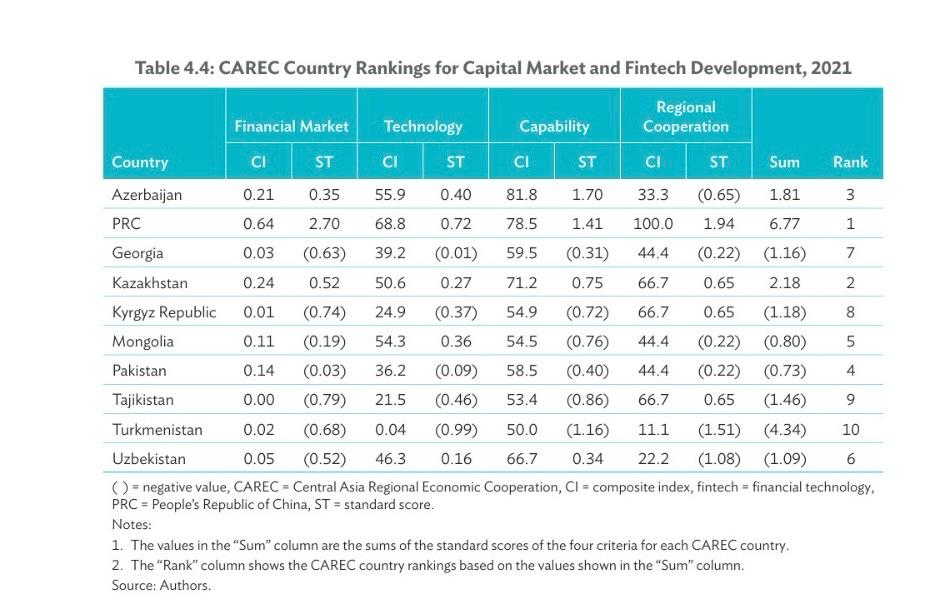
"These facts imply that Azerbaijan could rapidly boost capital market development using its potential in fintech technology and its regulatory and business capabilities. Fintech could be leveraged to improve traditional capital markets and introduce alternative financing platforms," reads the latest report released by the Bank.
The ADB analysts believe that Azerbaijan is expected to show leadership by making full use of its potential, as shown in the technology and capability pillars, for capital market development.
"Areas of leadership could include the regional fintech passport, regional regulatory sandbox and collaborative regional fintech community, regional harmonization of digital ID regulations, and cross-border payments using distributed ledger technology (DLT) and similar systems," the report reads.
ADB notes that regional cooperation is needed to accelerate capital market development in the CAREC region.
"It is an optimal strategy for speeding up regional financial integration, as it would create wide and deep capital markets in which firms could choose the most efficient sources of funding and investors could simultaneously choose the most productive investment opportunities. Regional cooperation is also needed to cope with the potential risks of financial globalization and regional financial integration. Regarding regional fintech-cooperation strategies, this chapter has focused on regional cooperation for payments and remittances, capital market integration, and cross-border fintech regulation and supervision.
It should be recognized that capital market development is a difficult goal that can only be achieved through continuous policy efforts across various areas. Although the goal can indeed be better approached through fintech and regional cooperation, changes are likely to occur more slowly than would be ideal, due to structural and immutable constraints. Therefore, policy authorities need to take a step-by-step and strategic approach guided by a comprehensive, well-structured plan that may take a decade to complete for some countries and as much as 2 decades for others," the report reads.



