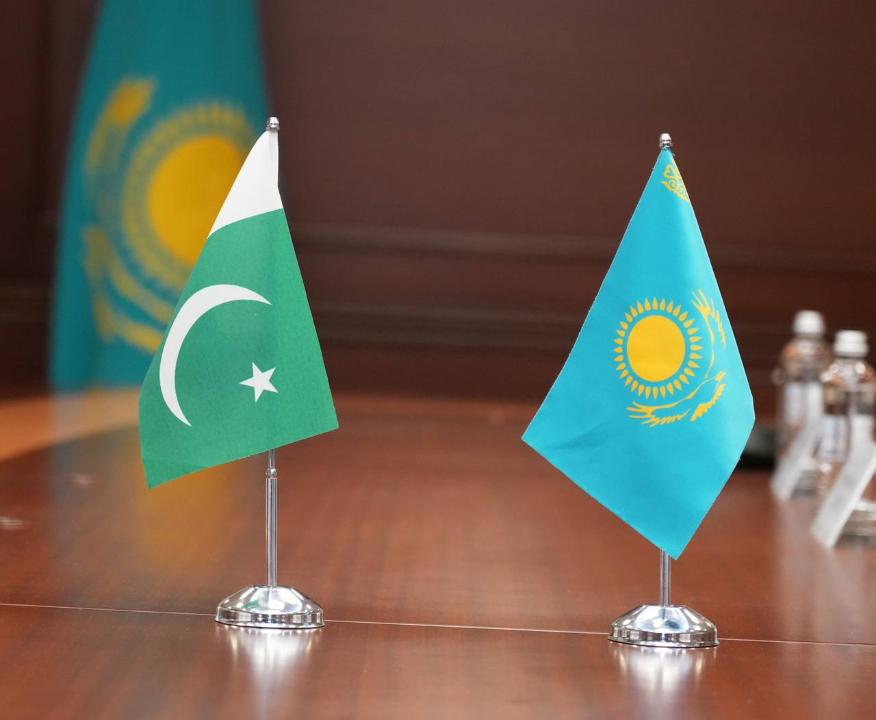
Kazakhstan, despite its strategic location, lacks direct access
to the world’s oceans, which constrains its ability to diversify
foreign trade and heightens its reliance on traditional transit
routes. As Kazakhstan's international stature and economic
influence continue to rise, the need to establish alternative
connections to global maritime routes has become a key priority
within the country's transport and foreign economic policies.
In this regard, the prospect of accessing Pakistan’s seaports is
gaining increasing importance. Astana and Islamabad are actively
engaged in discussions aimed at enabling Kazakhstani cargo to reach
the ports of Karachi, Qasim, and Gwadar. These ports are viewed not
only as crucial logistical solutions for Kazakhstan but also as
potential transit hubs for the broader Central Asia region,
providing vital access to markets in the Persian Gulf, Africa, and
Southeast Asia.
On May 7, 2025, at a business forum in Karachi, Kazakhstan and
Pakistan signed a transit trade agreement, opening the country’s
access to the ports of Karachi and Gwadar. The Ministry of Trade
and Integration of Kazakhstan emphasized that "this document lays
the foundation for the development of new transport and logistics
routes and further strengthening economic ties between the two
countries."
At the same time, with the involvement of Astana and Islamabad,
other large-scale infrastructure projects are being discussed.
Kazakhstan, Turkmenistan, and Afghanistan are in consultations
regarding the construction of a new railway line from Turgundi -
Herat - Kandahar - Spin Boldak, which will run from the western
border of Turkmenistan through Afghanistan to Pakistan and then
toward India. The project plans to create facilities for the
transshipment of grain, containers, and other goods. It is expected
that the launch of this route will give an additional boost to the
growth of cargo turnover, including through the Turgundi hub.
Afghanistan, for its part, has expressed its readiness to ensure
the transit of goods from Kazakhstan and Turkmenistan to
Pakistan.
The economic rapprochement between the two countries is also
reflected in the growth of bilateral trade. According to
Kazakhstan’s National Bureau of Statistics, in January-November
2025, the trade turnover between Kazakhstan and Pakistan amounted
to $101.3 million, more than twice the figure for the same period
the previous year ($48.6 million). Moreover, the parties aim to
increase mutual trade volume to $1 billion annually and expand the
range of supplies to 40 product categories.
Achieving these targets would be difficult to envision without
substantial advancements in transport infrastructure and the
establishment of new, sustainable trade routes. The development of
the southern corridor offers Kazakhstan a unique opportunity to
significantly broaden the scope of its export markets. Currently,
the majority of cargo flows are directed toward the north and west.
The introduction of the Pakistani route provides a means to reduce
logistics costs for transporting grain and other goods from
Kazakhstan’s southern regions, streamlining the process and
enhancing economic efficiency.
Looking to the future, integration with Pakistani ports holds
the potential to transform Pakistan’s coastline into Kazakhstan’s
strategic gateway to global maritime trade routes. This shift does
not diminish the importance of existing routes; rather, it serves
to reduce dependence on them, bolstering the resilience of
Kazakhstan's foreign trade. Furthermore, it allows the country to
develop a more adaptable and diversified logistics network,
enhancing its long-term competitiveness on the global stage.