


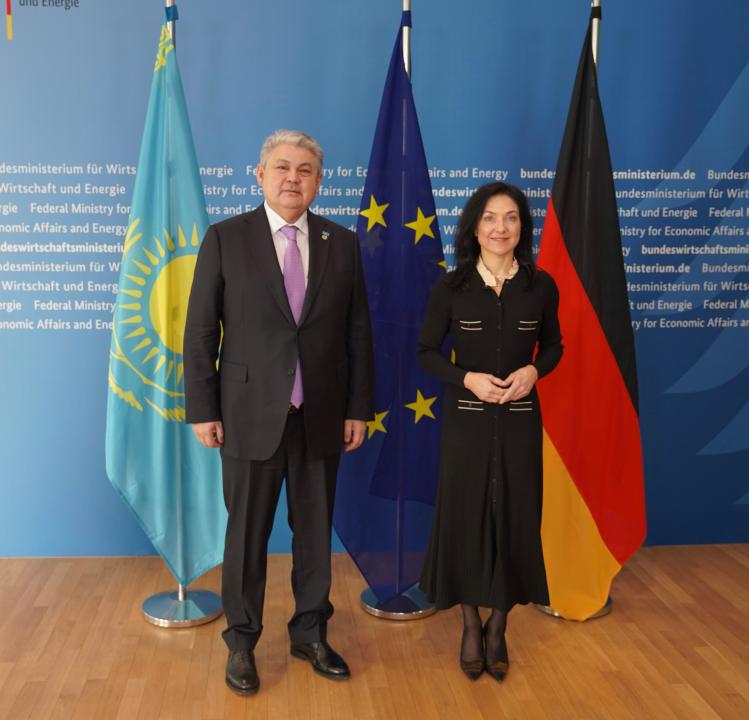

ASTANA, Kazakhstan, February 12. Kazakhstan's Minister of Foreign Affairs, Yermek Kosherbayev, and Germany's Federal Minister for Economic Affairs and Energy, Katherina Reiche, engaged in discussions regarding the potential for cooperation in the production and export of green hydrogen from Kazakhstan to Germany, as well as other European Union countries, Trend reports.
Meanwhile, the talks took place during Kosherbayev’s official visit to Germany.
The parties reviewed the current state and prospects of Kazakh-German cooperation, focusing on industrial and technological partnership, energy, logistics, digitalization, and agriculture.
“Kazakhstan attaches exceptional importance to developing cooperation with Germany and considers it a key strategic partner within the EU. We are ready to actively expand economic cooperation both bilaterally and within the EU–Central Asia regional formats, aiming to translate agreed initiatives into concrete projects and tangible results,” Kosherbayev said.
According to him, Kazakhstan has achieved significant socio-economic progress and, based on the International Monetary Fund (IMF) data, entered the top 50 global economies with a GDP of $300 billion, or approximately $15,000 per capita. He also noted that Kazakhstan ranks among the top five countries in terms of average real GDP growth, which stood at 3.6 percent between 2000 and 2025.
Reiche, in turn, described Kazakhstan as a reliable partner for Germany in Central Asia and expressed readiness to further deepen economic and energy cooperation based on sustainability and innovation.
Special attention was paid to energy cooperation, including supplies of Kazakh oil to the refinery in Schwedt. The ministers also discussed joint projects in mechanical engineering, the chemical industry, and the mining and metallurgical sector, as well as the transfer of German technologies and best practices.
The sides reaffirmed the importance of developing logistics corridors, including the Trans-Caspian International Transport Route, and expressed readiness to cooperate in digitalizing transport and industrial processes.
Following the meeting, the parties confirmed their commitment to strengthening the strategic partnership and agreed to continue substantive dialogue on joint initiatives.
During the visit, the minister also met with representatives of several major German companies and business associations, including Deutsche Bahn, Noble Elements, Lanxess, Rhenus Group, and DIHK (German Chamber of Industry and Commerce).



